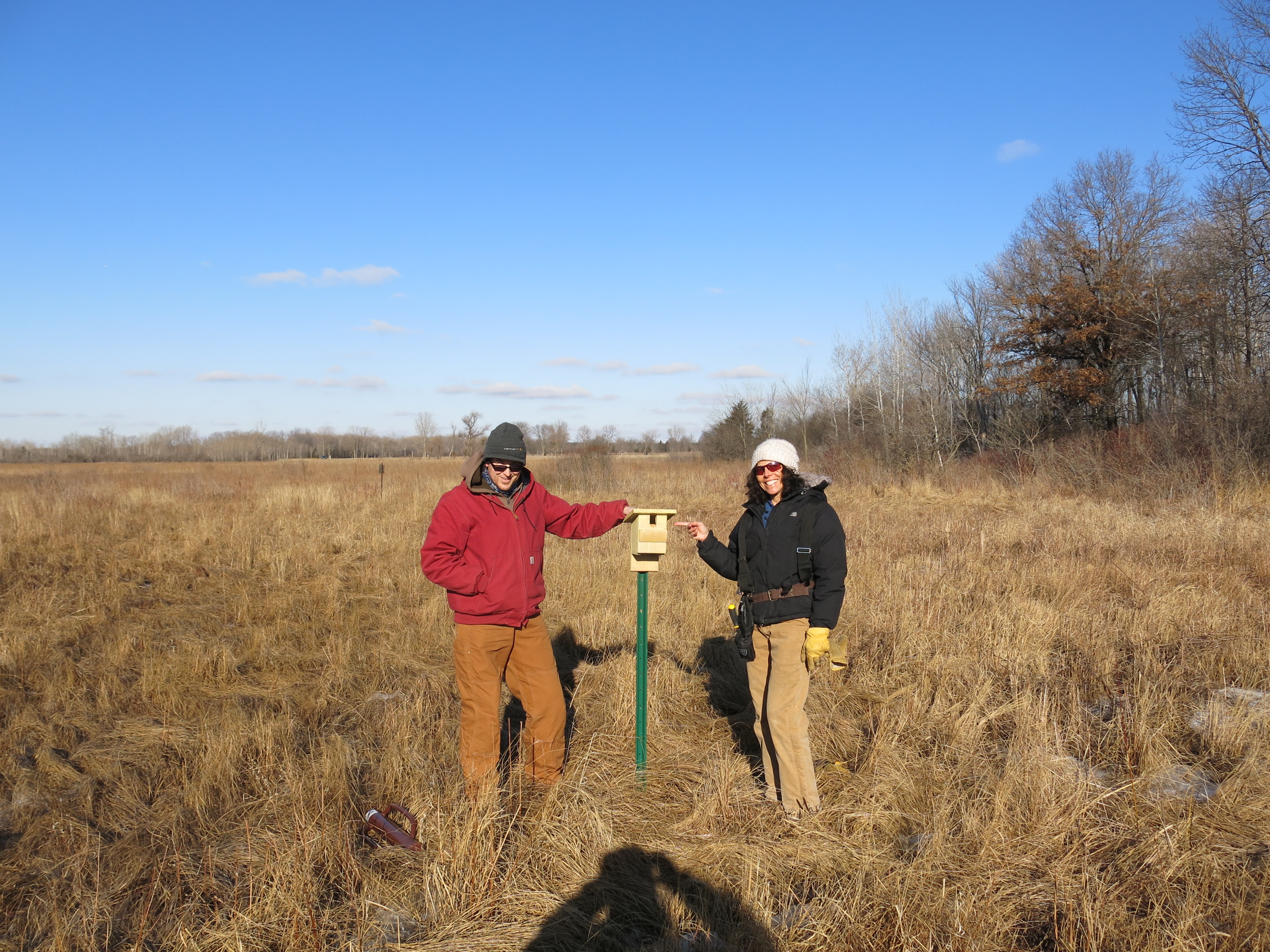
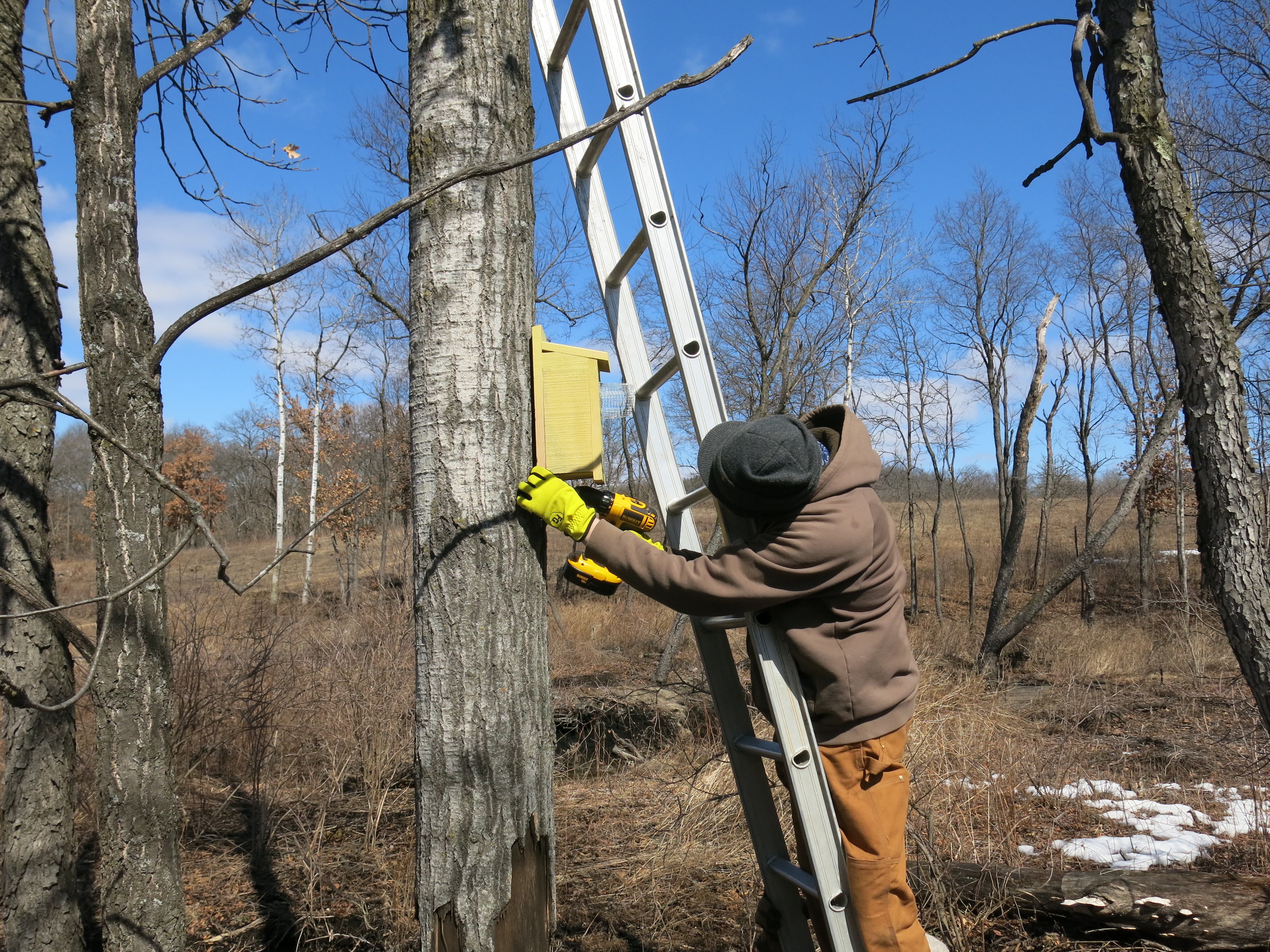
Thanks to Ben Johnson there has been a bird-housing boom at the Scuppernong Springs. On March 13, Ben put up 26 woodland bird houses and this past Sunday, Pati, Mark Miner and I helped him put up 4 more woodland bird houses and 20 bluebird houses. He made all of the houses with scrap wood salvaged from work. Ben captured the GPS locations of all the houses and he is planning to convert the data to GIS so he can accurately display the locations on maps of the Scuppernong Springs Nature Preserve. By the way, check out the new topo maps of The Springs. We hope to overlay the trail map from the brochure over one of the topo maps. That would be cool.
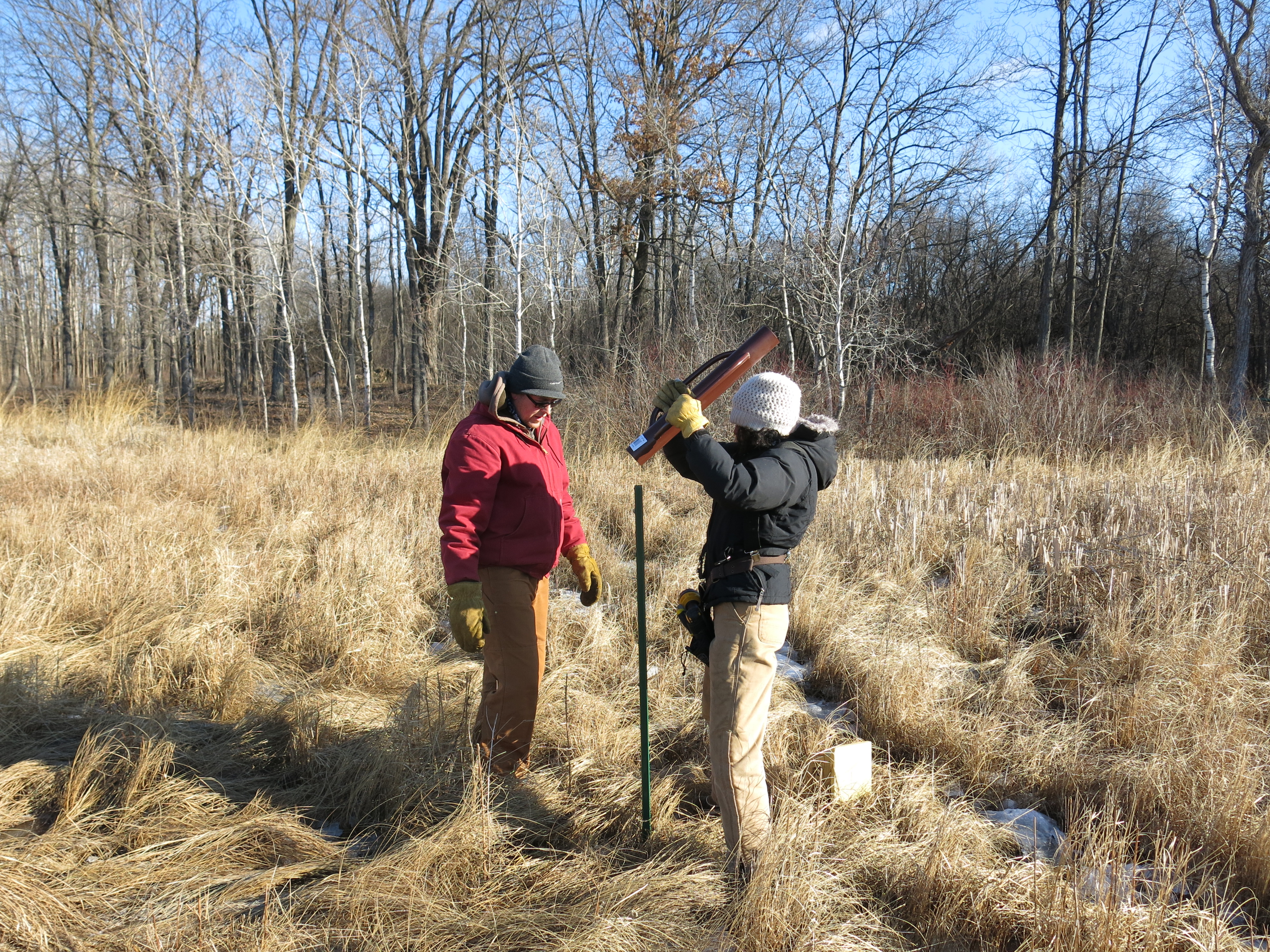
Sunday morning was cold, but that was a good thing because we were able to walk over ice to get to some of the bluebird house sites. Ben and Pati putting up the first house near signpost #1.
A new house erected between the gaging station and marl pit bridges.
Ben mounts a woodland birdhouse near the Indian Spring.
Mark Miner was interested in monitoring bluebirds and heard about our efforts at The Springs at a DNR volunteer information meeting. We are very happy to have Mark join us, and he provided invaluable assistance yesterday as I continued burning brush piles in the Buckthorn Alley.
The morning started off cold — what’s new — but I warmed up fast.
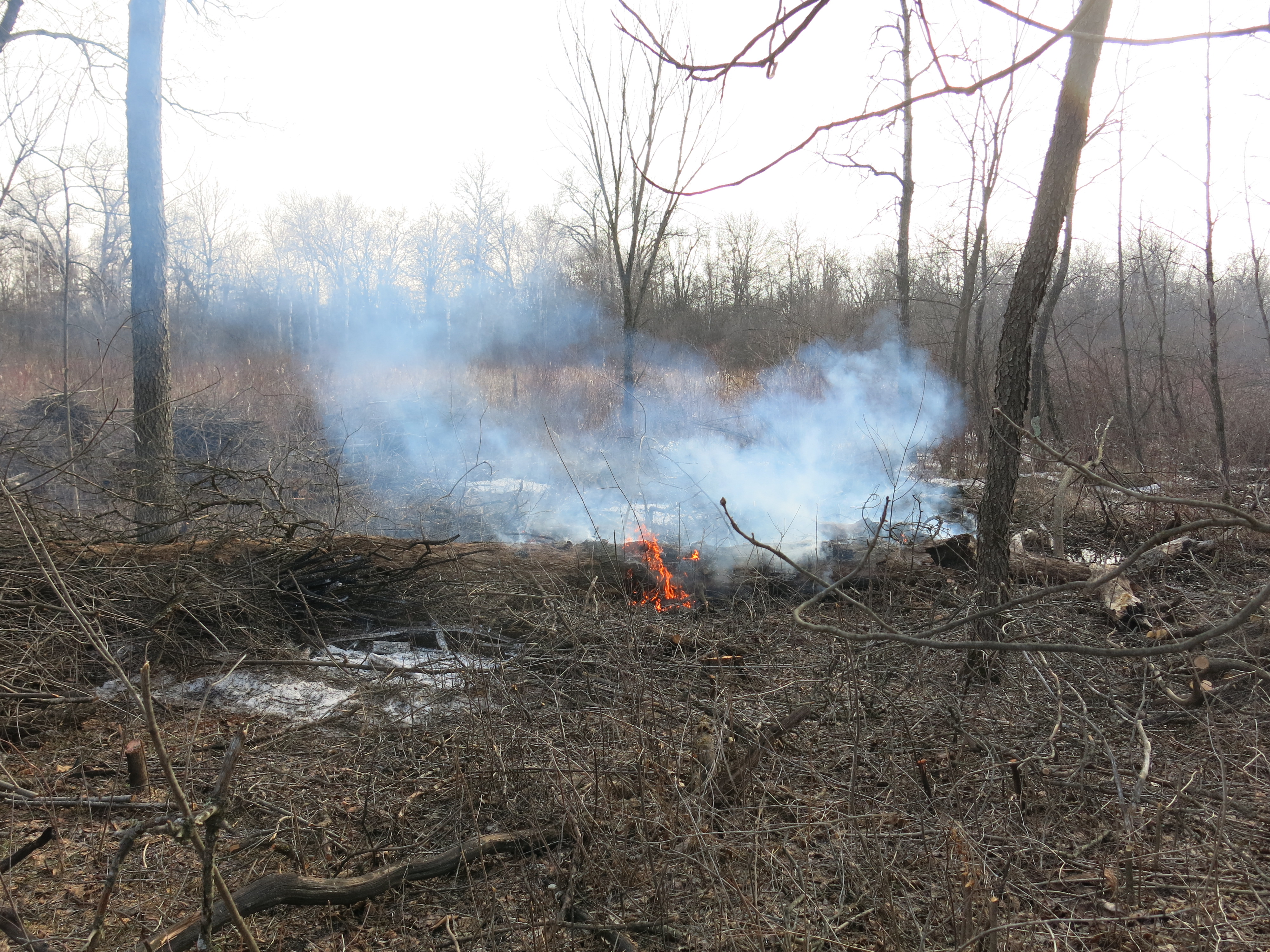
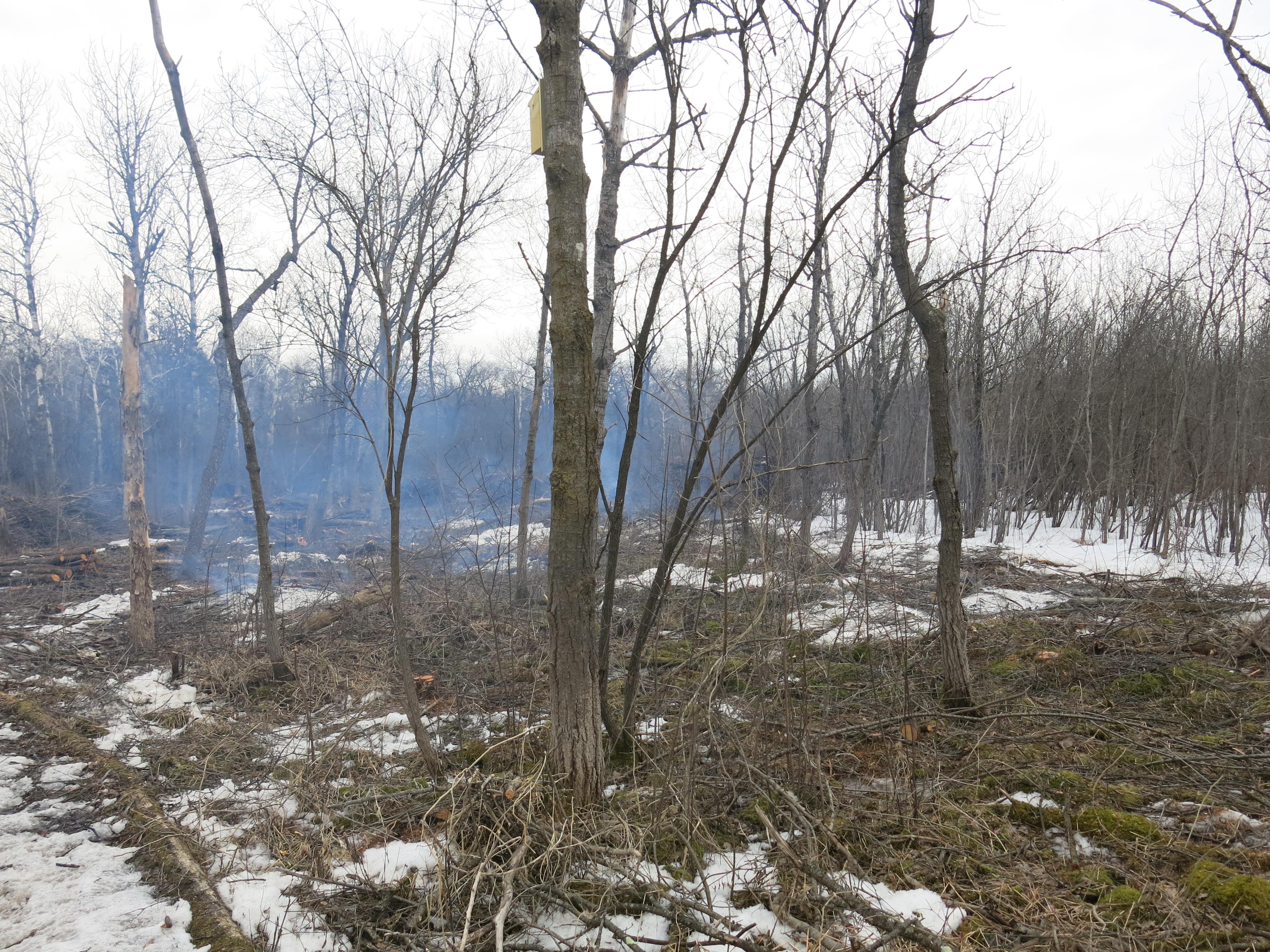
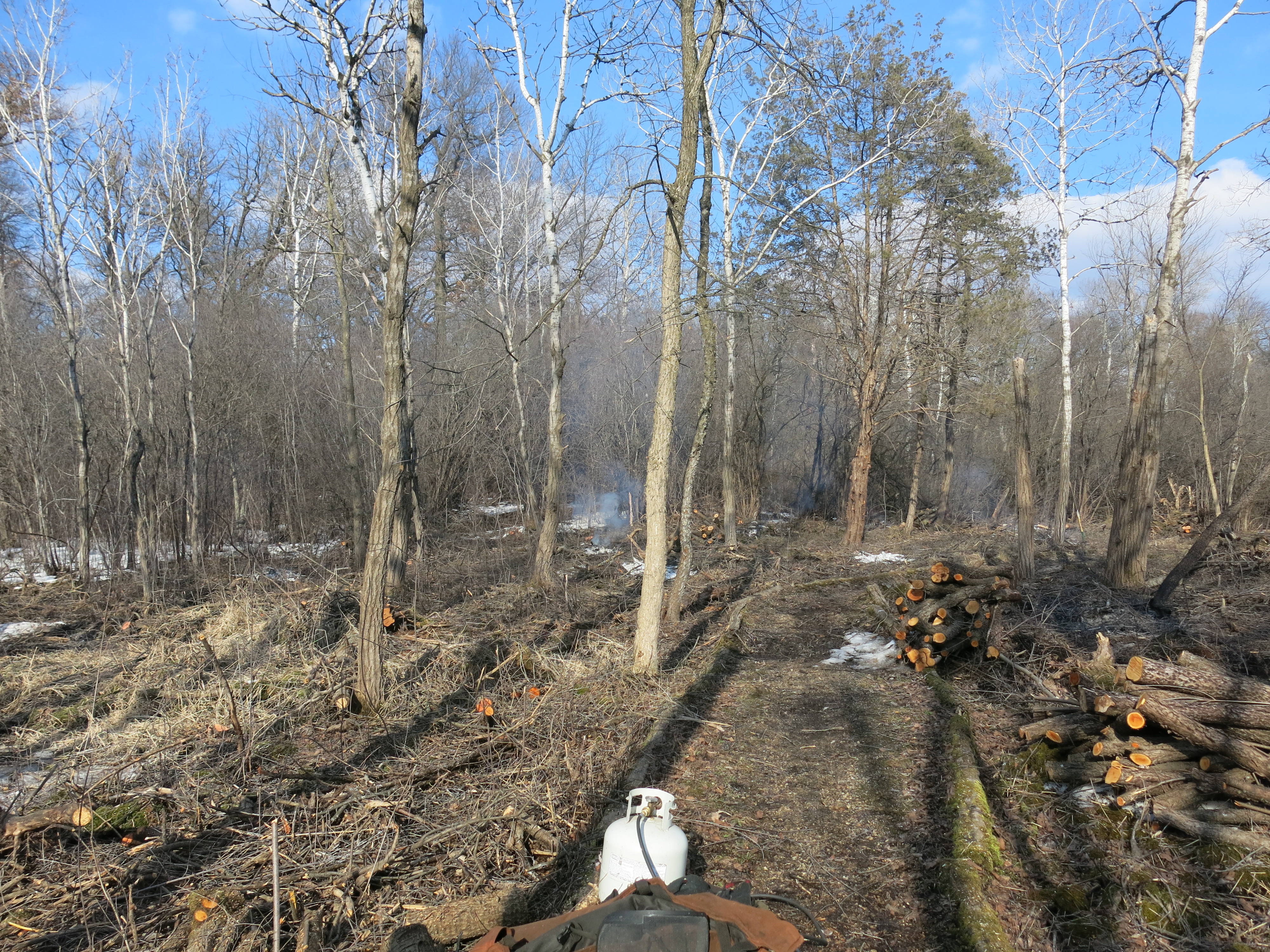
The wind blustered occasionally and was steady enough all day to make it relatively easy to start fires. I was able to light piles all the way around the corner.
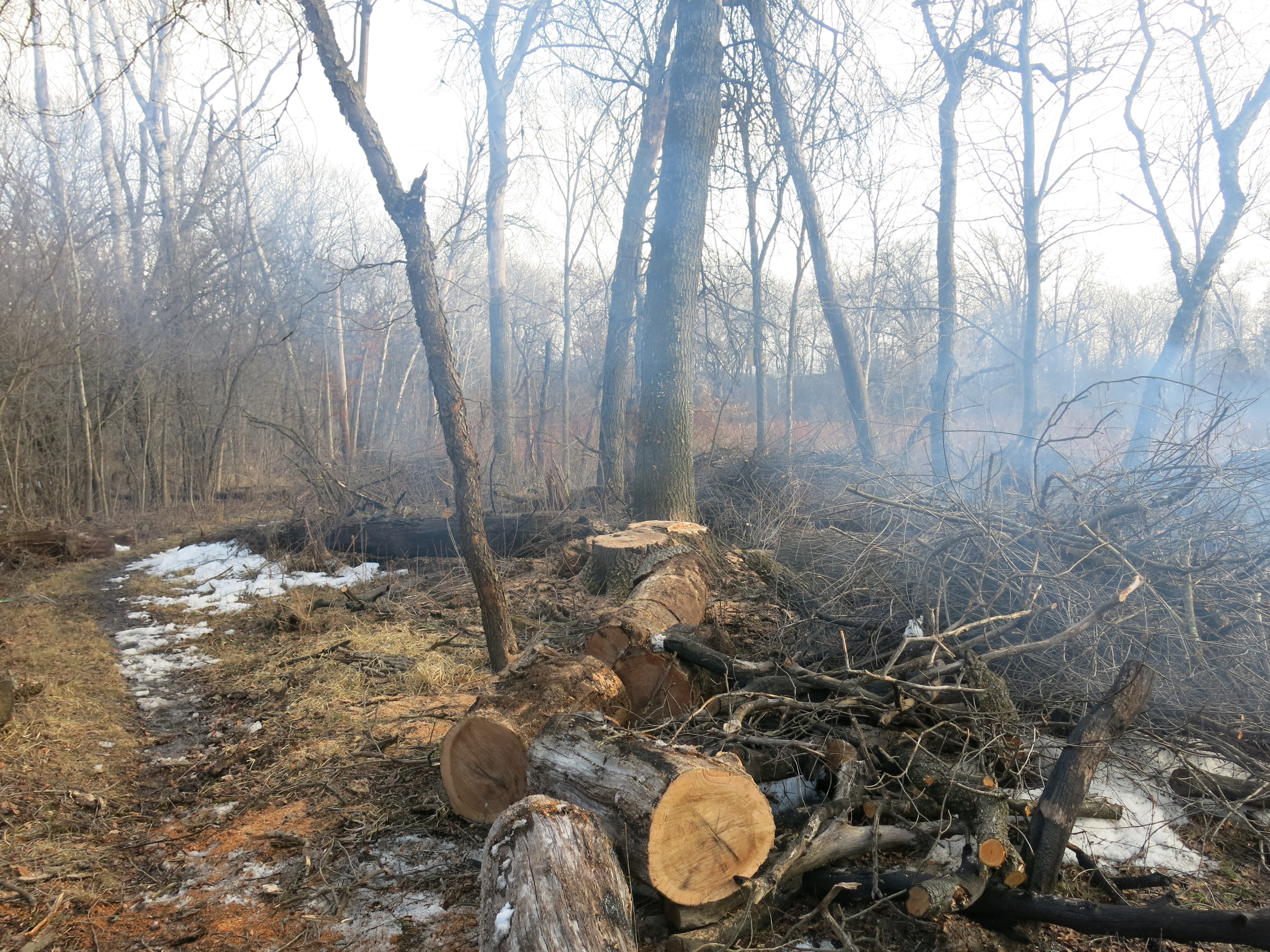
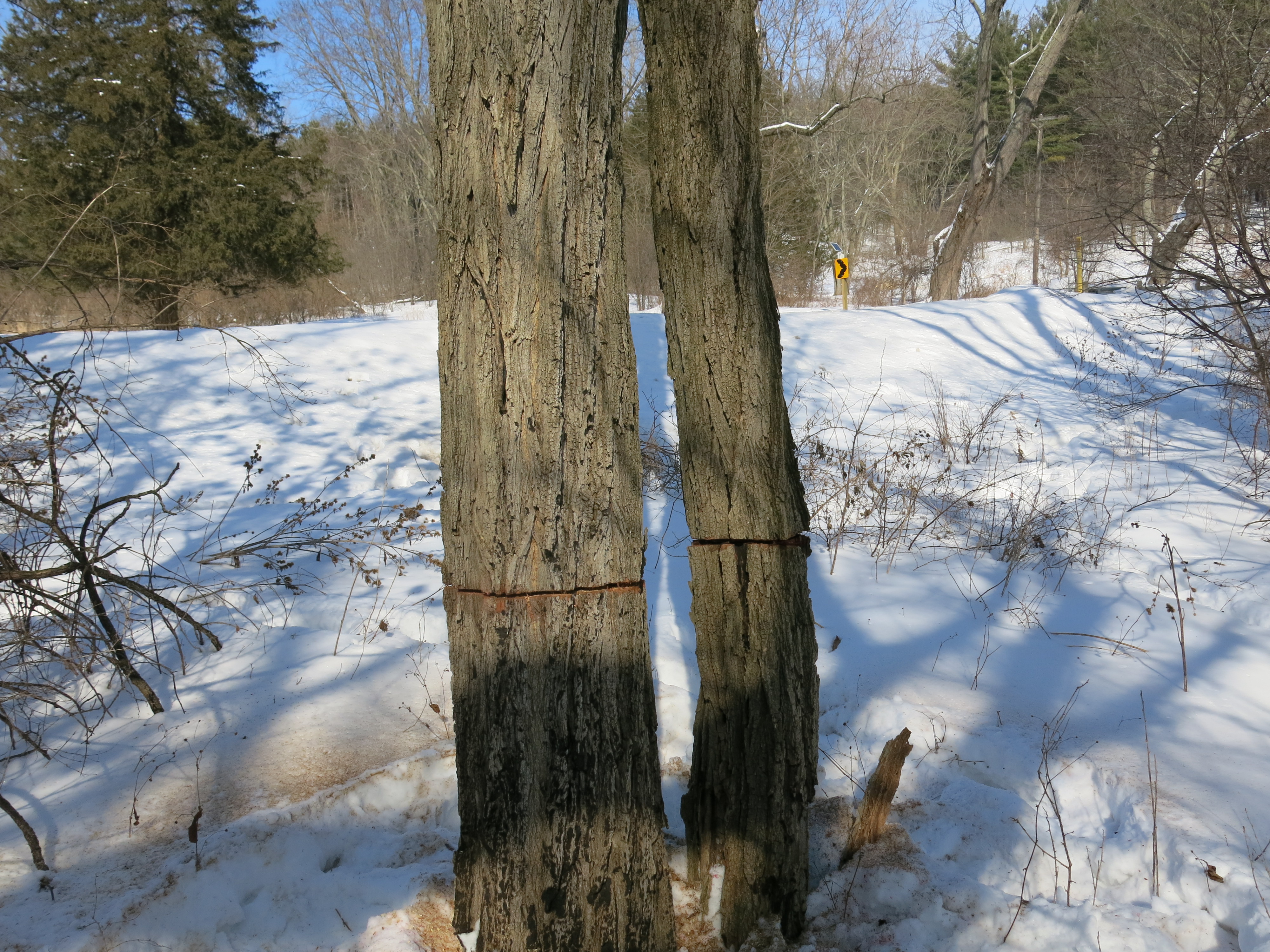
Two huge, dead, black oaks caught fire and Mark and I agreed; they had to come down.
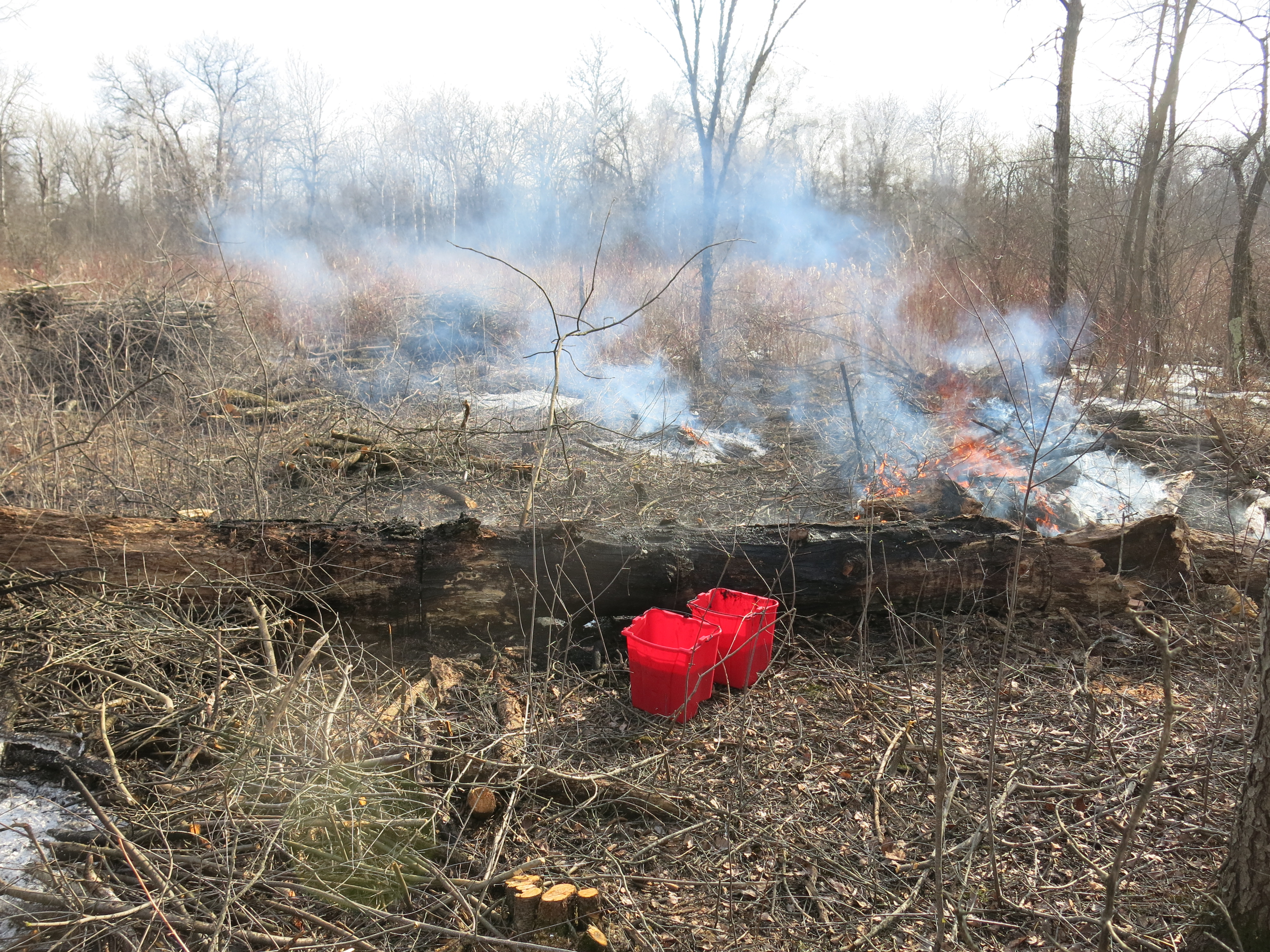
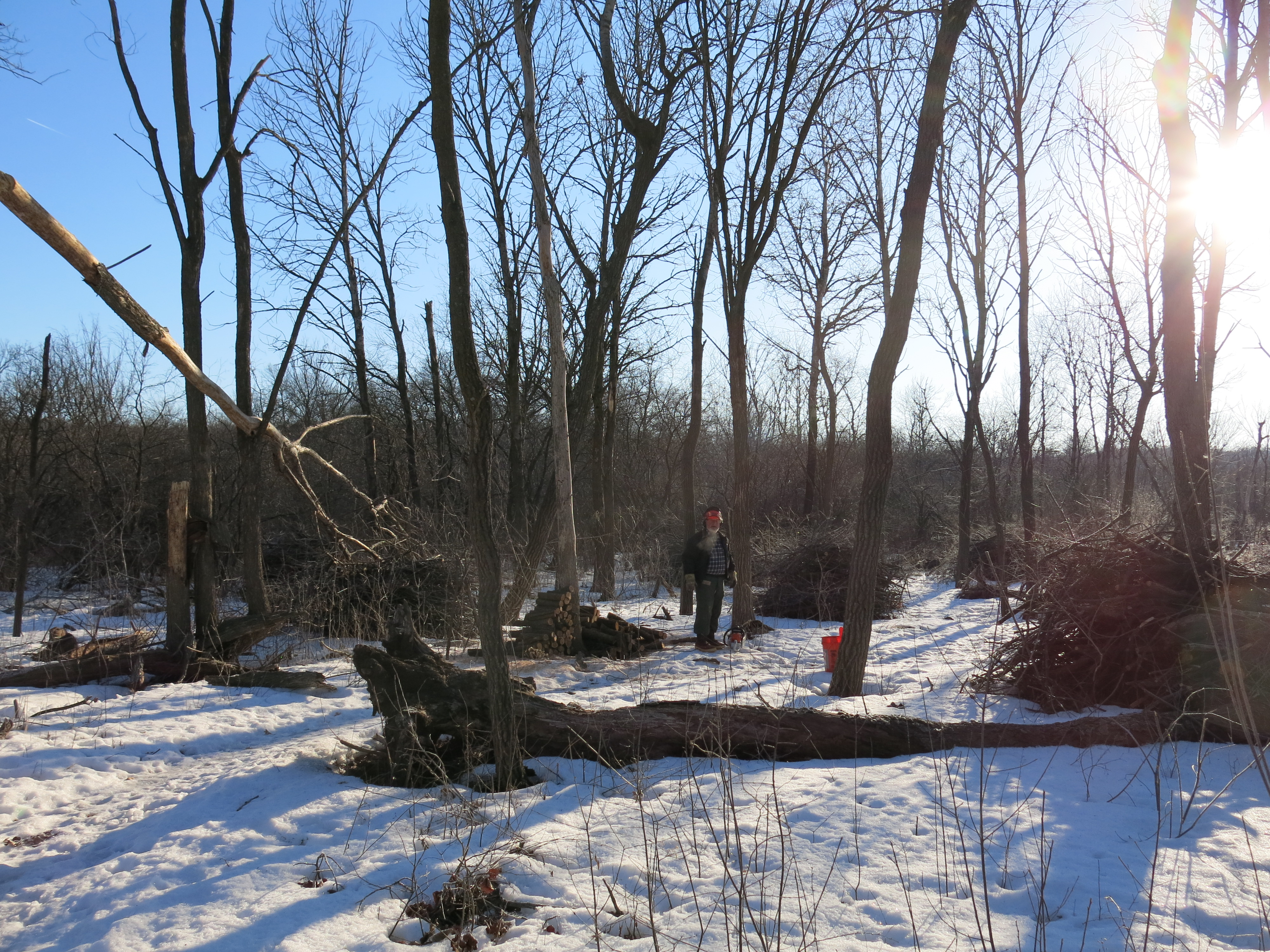
Mark worked with the Forestry Service for 8 years and he is very experienced! He fetched the red buckets shown above that enabled us to put the fires out that were raging in the fallen black oak. Thanks Mark!
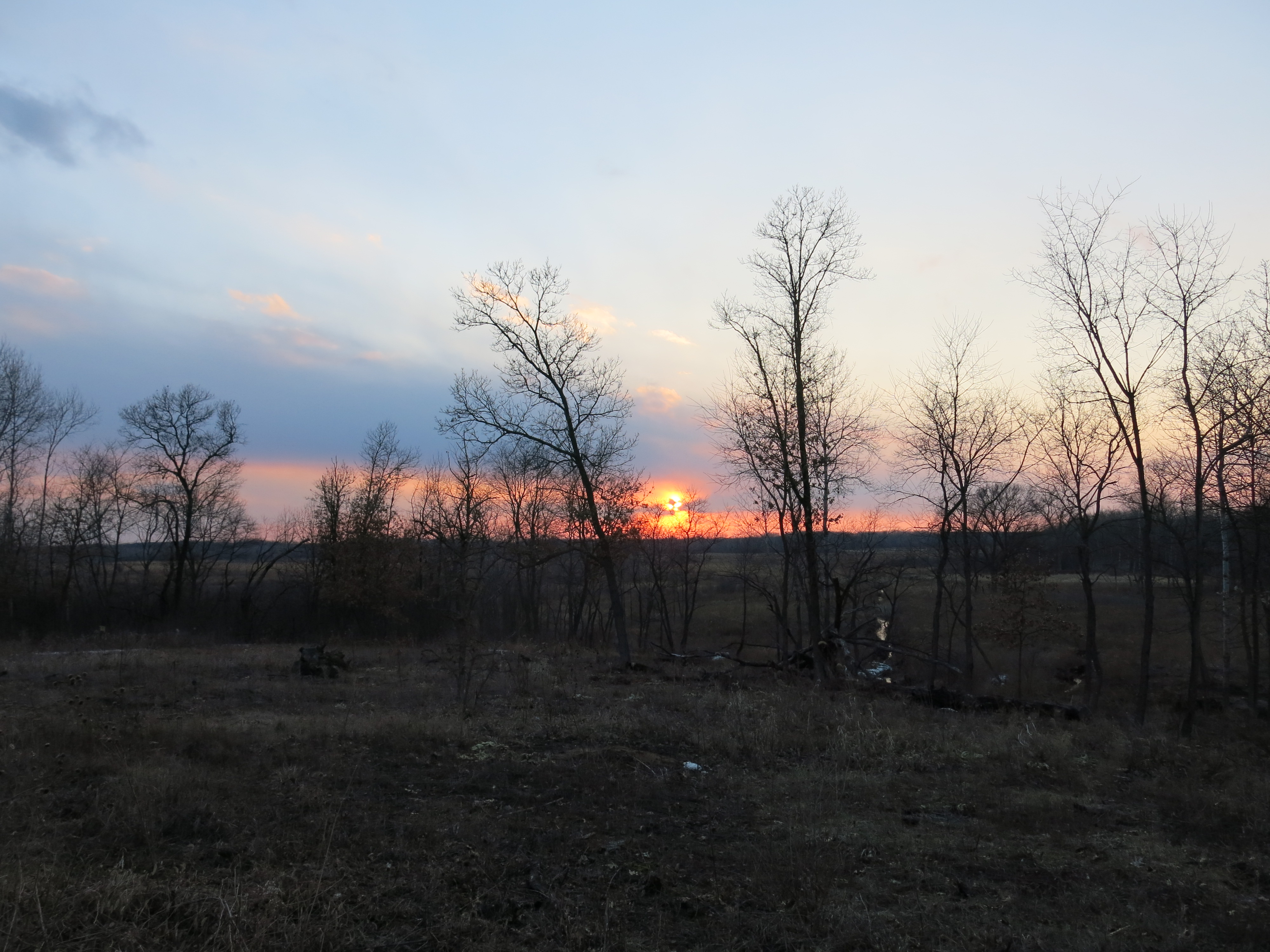
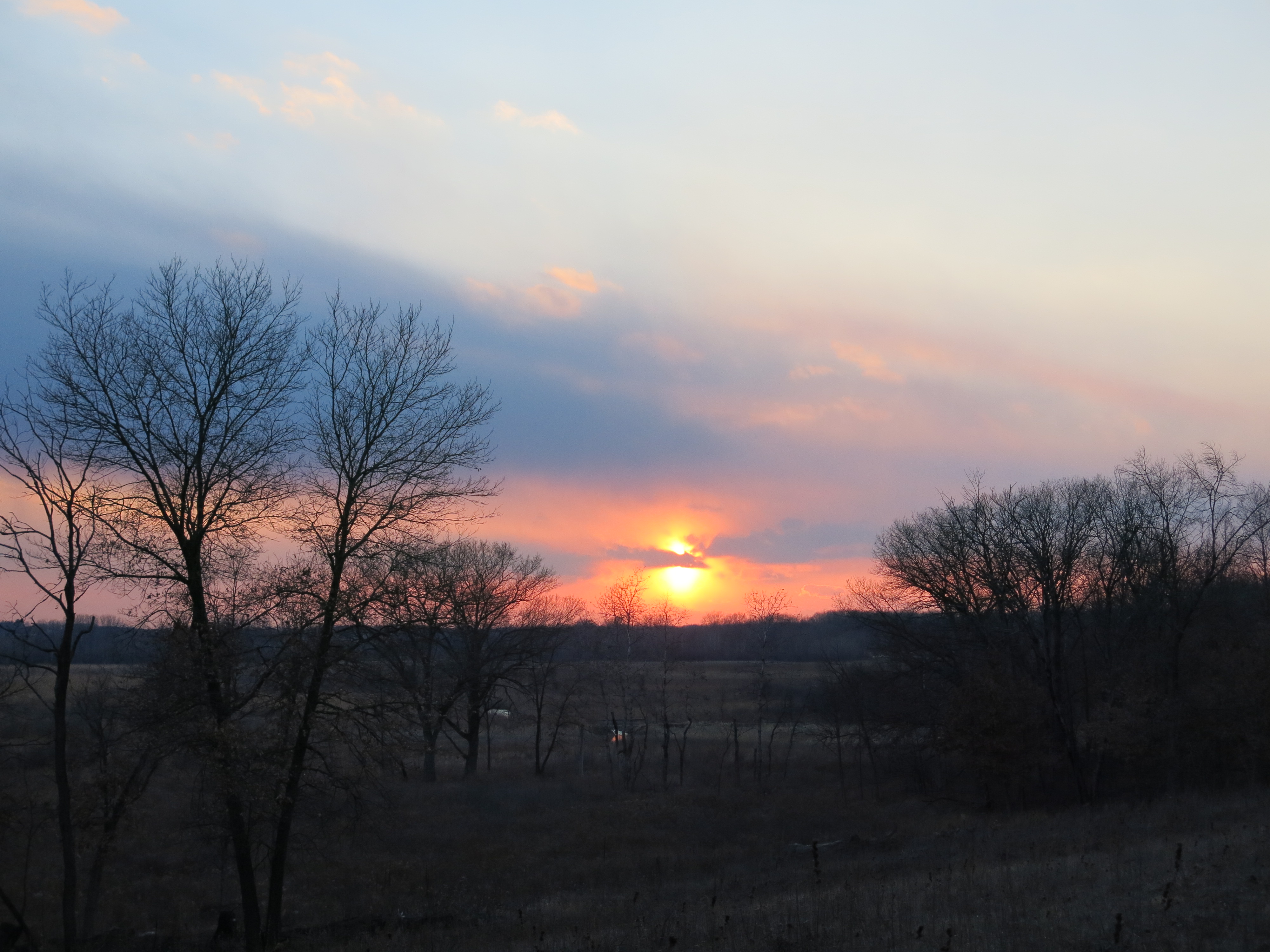
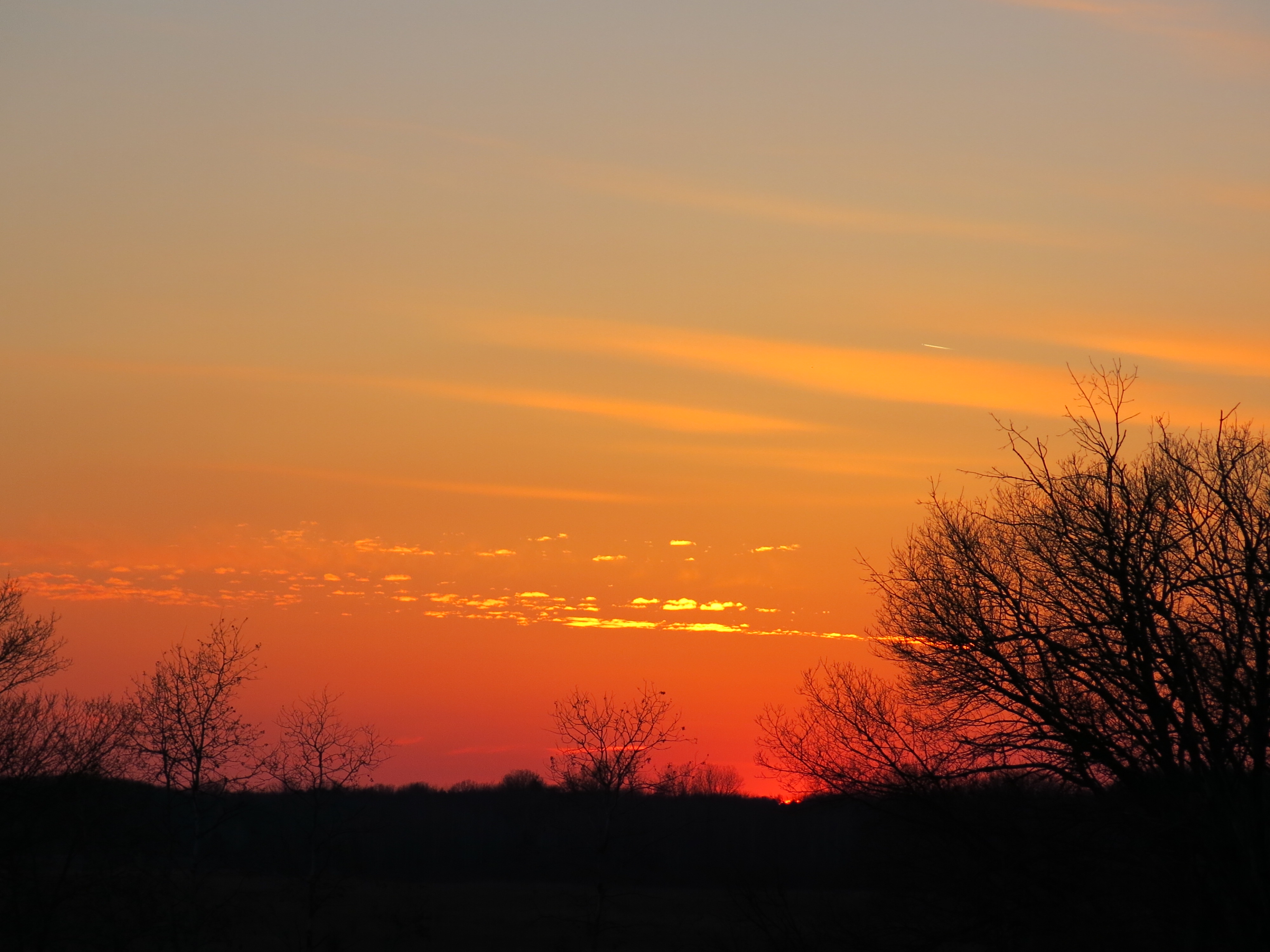
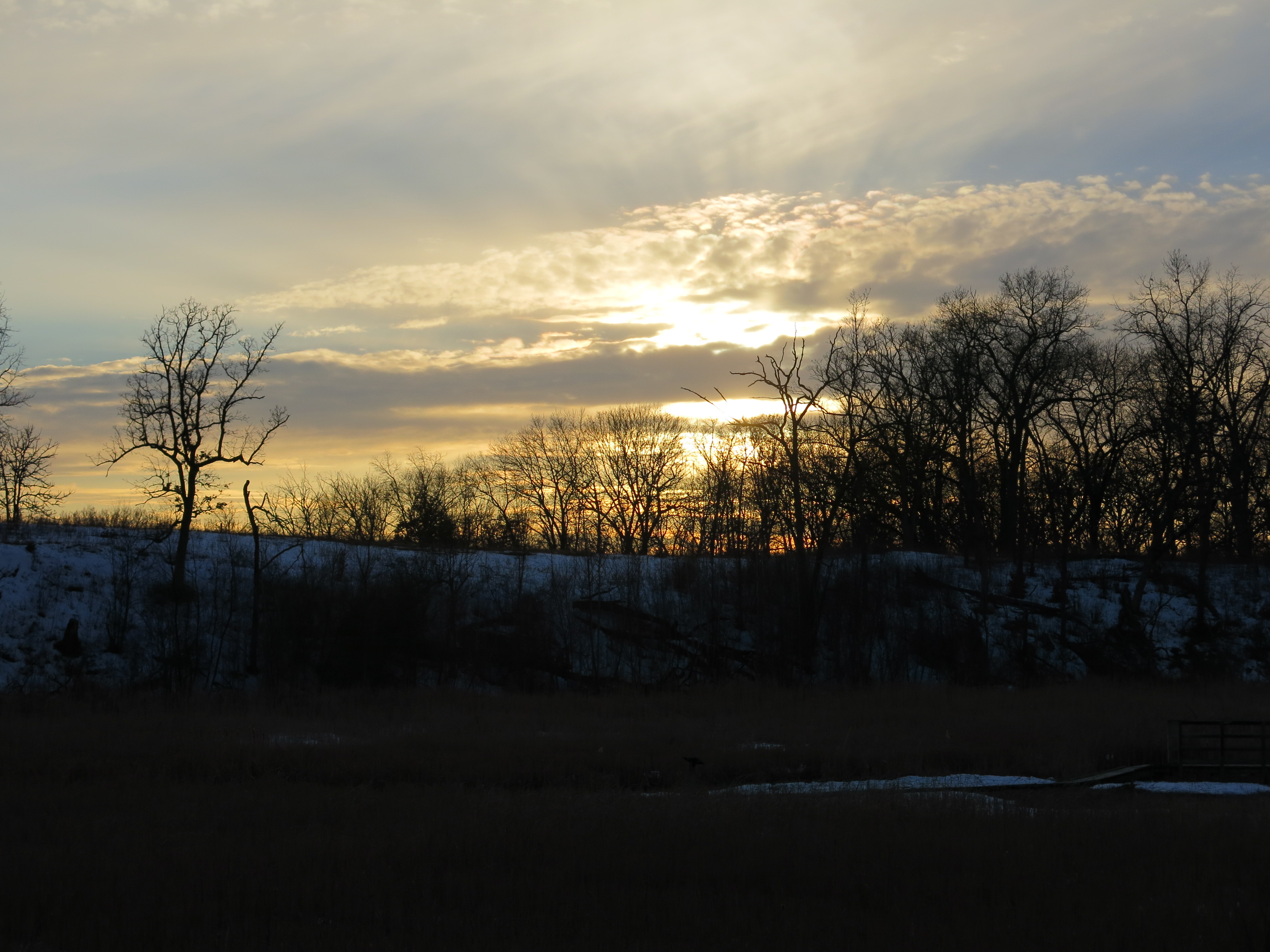
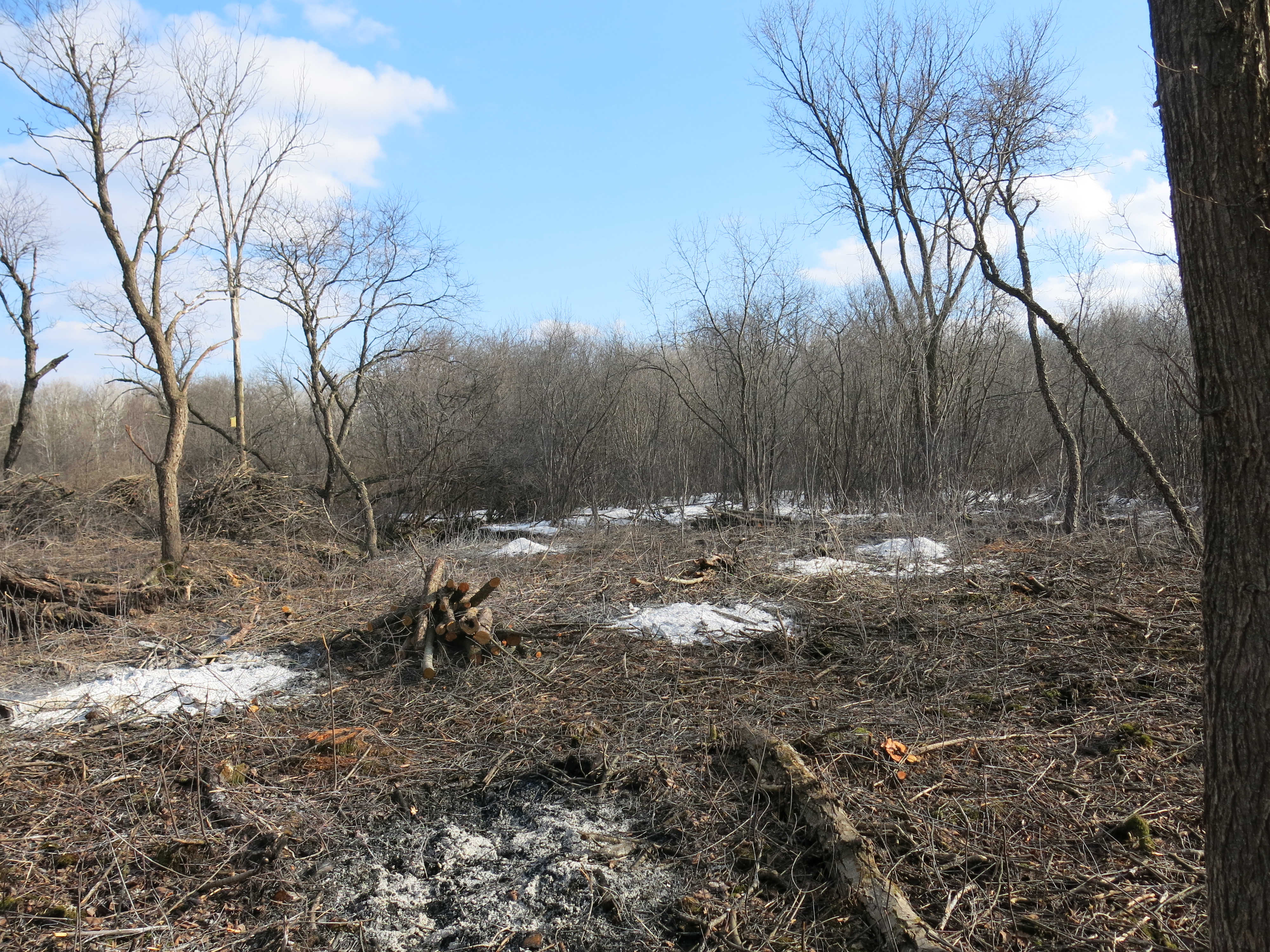
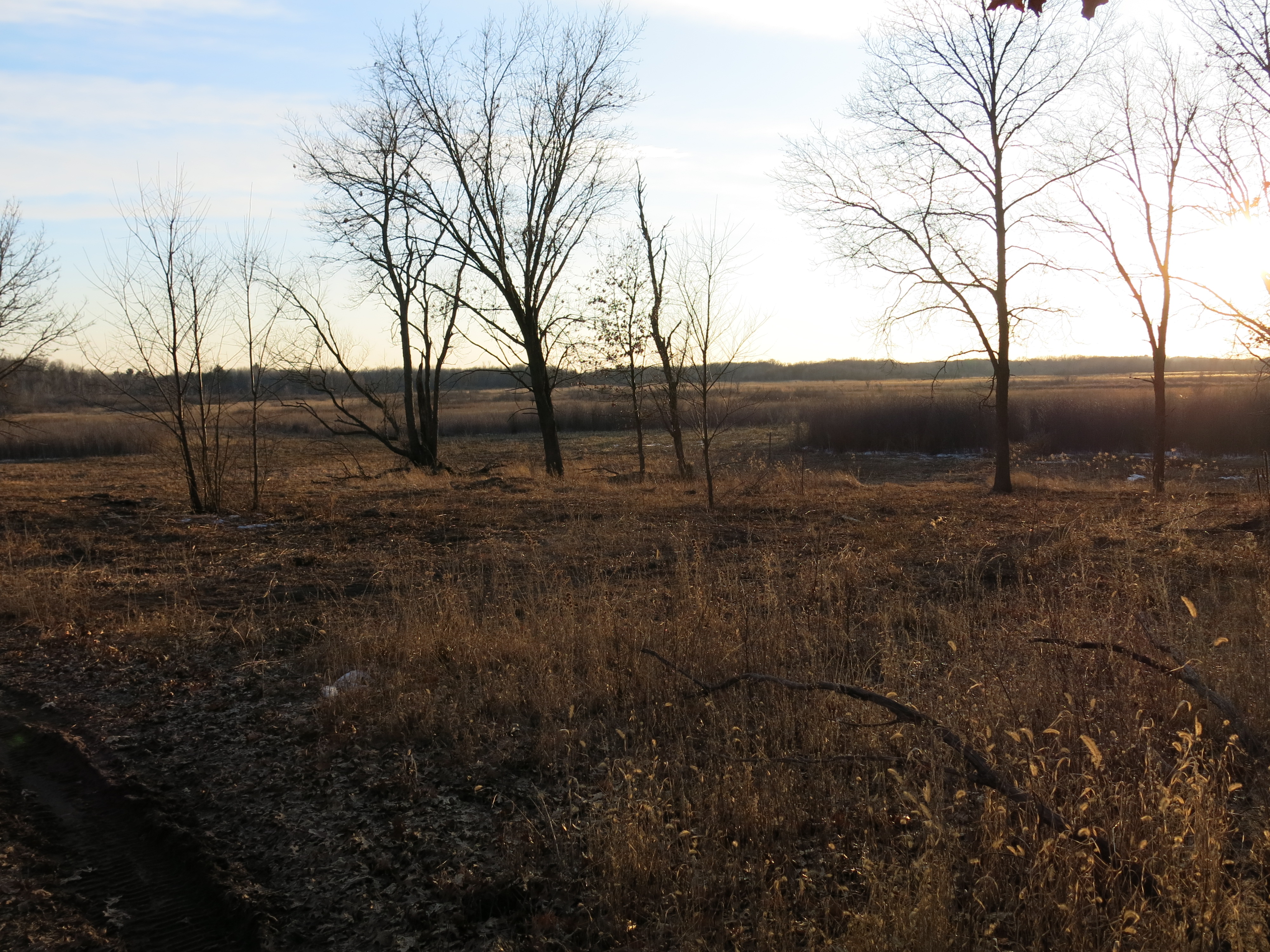
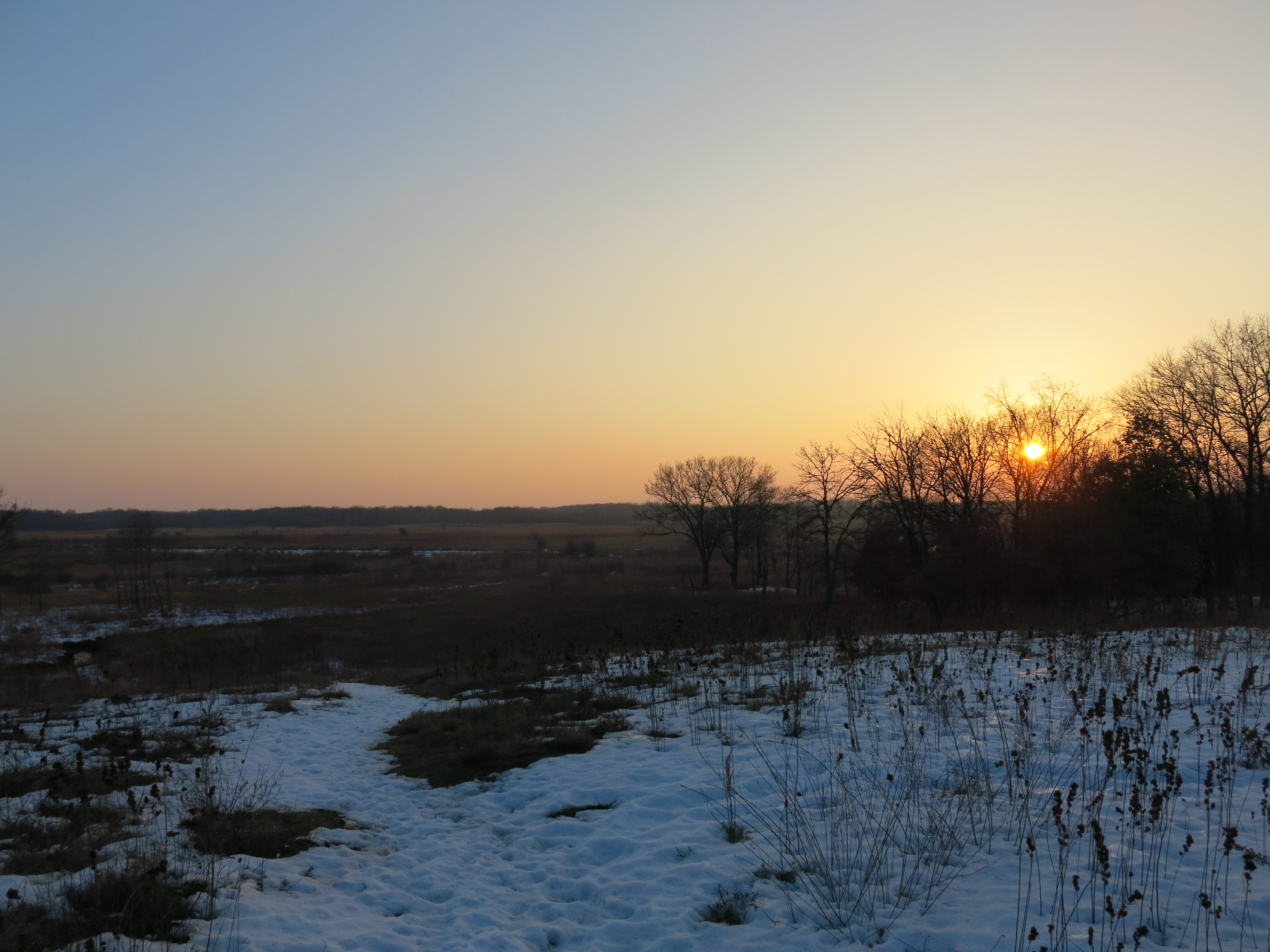
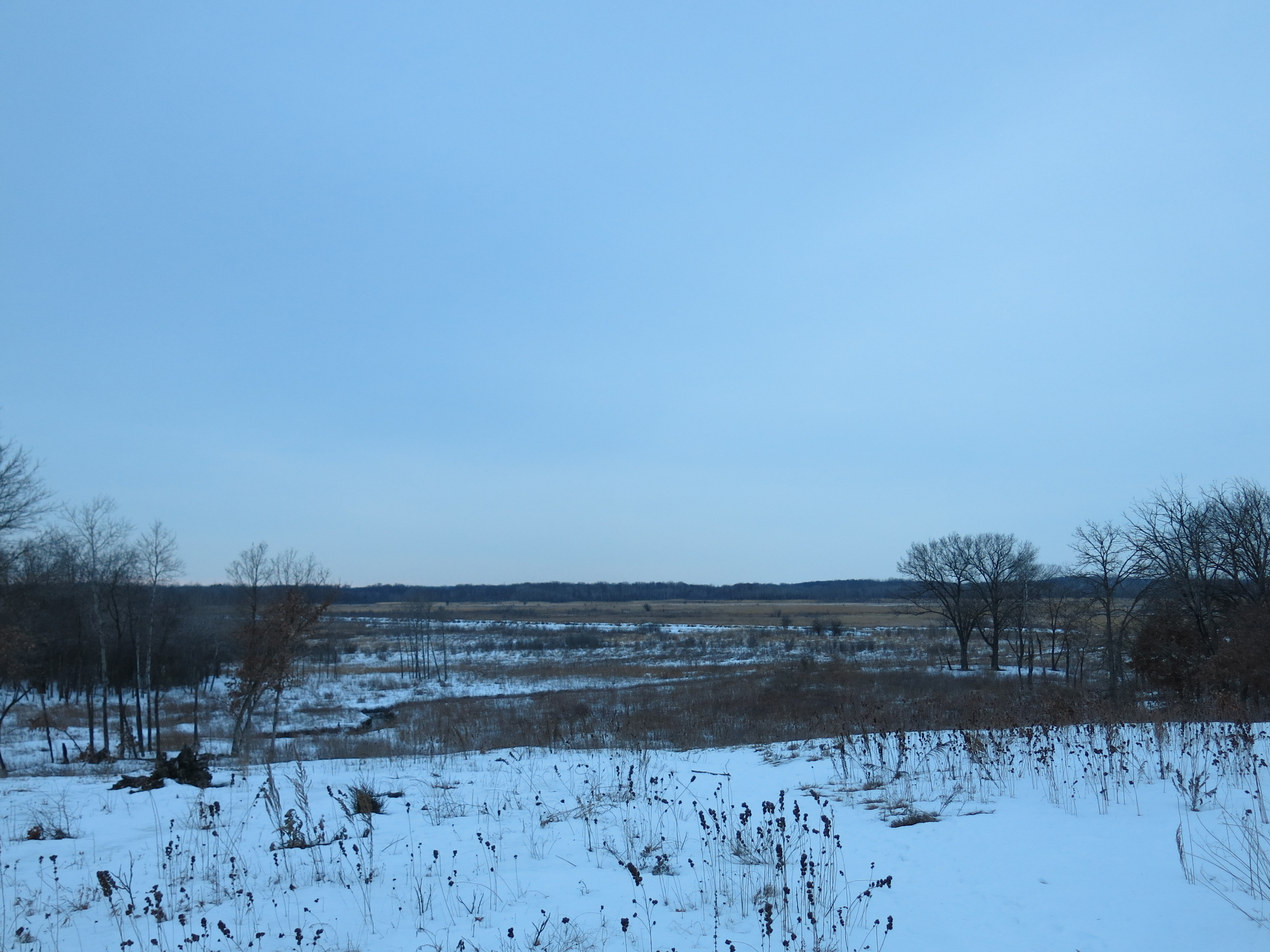
I was too pooped to count the piles, but I’m guessing we lit around 35. Here are a few parting shots from my evening stroll.
Einstein was right; there is no time, there is only a series of present moments and our mission, ‘if we choose to accept it’, is to be fully conscious as we experience them.
I’ve been challenged to intimately share present moments with a dear friend who suffered a stroke and his worst nightmare come true i.e., falling under the control of medical doctors, who rushed to put tubes down his nose, into his arm and up his penis, while infusing him with Seroquel. Yes, he did suffer brain damage, but being infantilized and drugged is what is killing him now. I tried to help — too hard — and only succeeded in aggravating him into a livid rage. I wish I could have been more aware in the present moments that lead to that debacle.
That reminds me of the Moody Blues tune: Don’t You Feel Small.
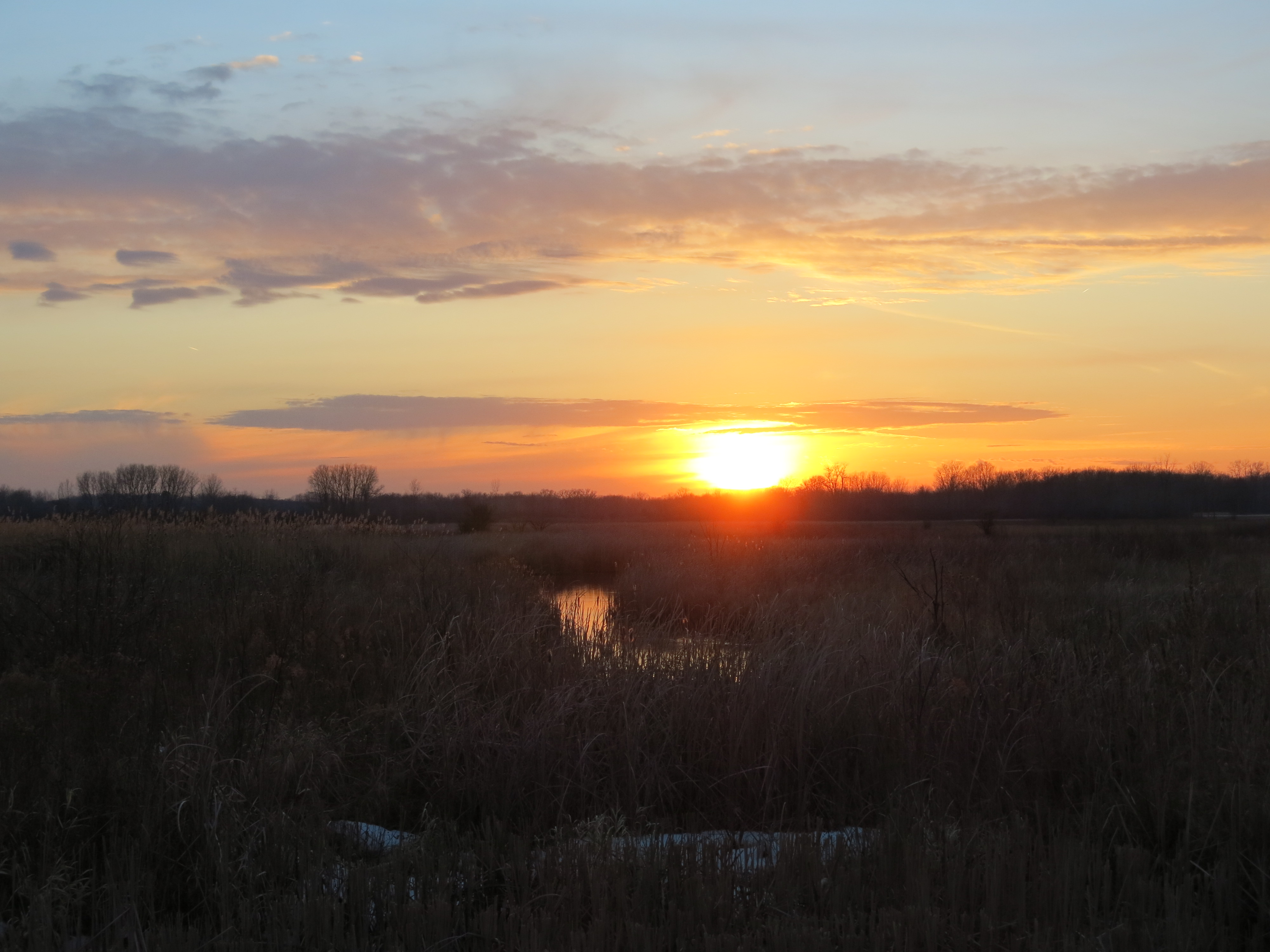
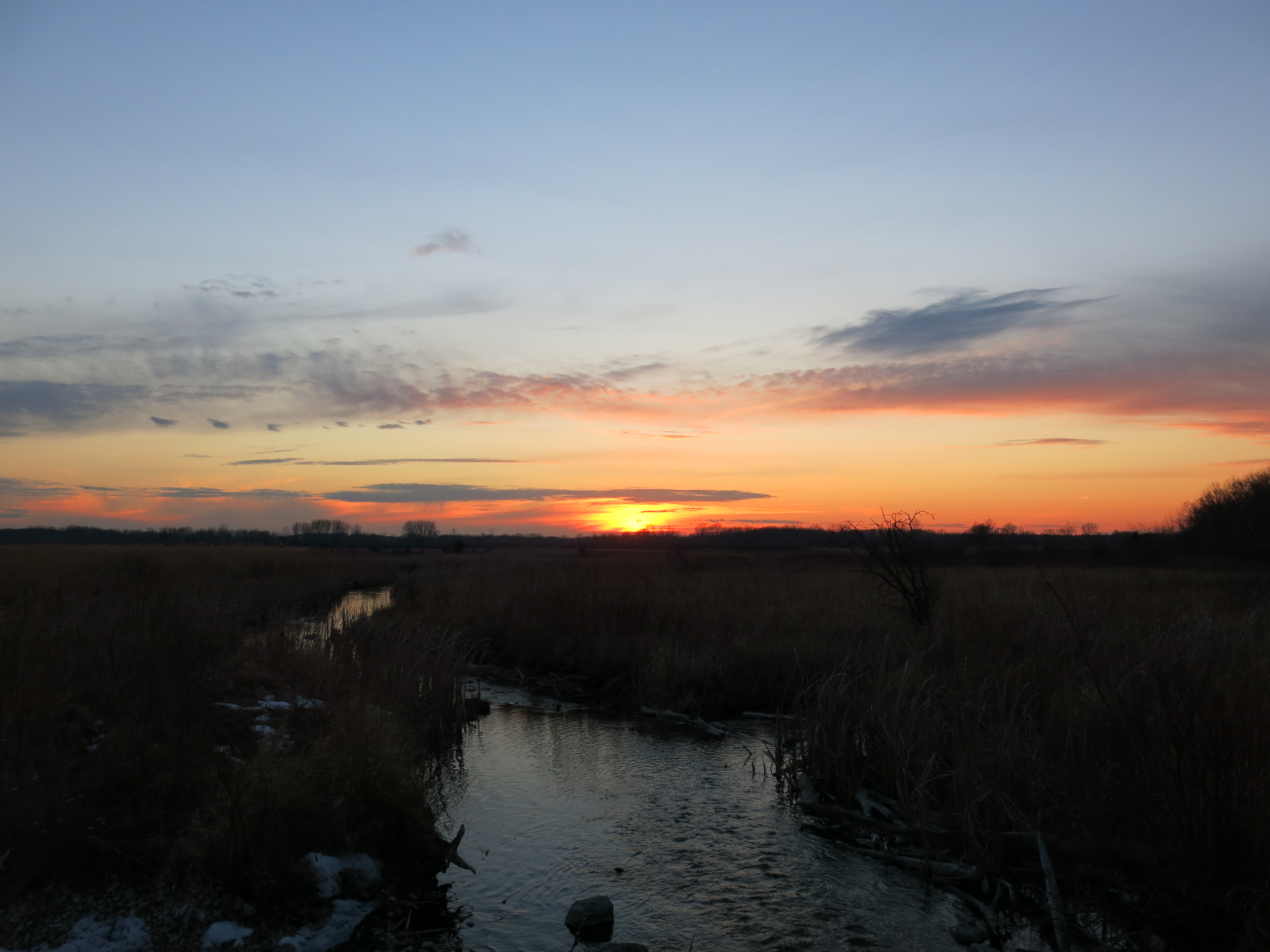
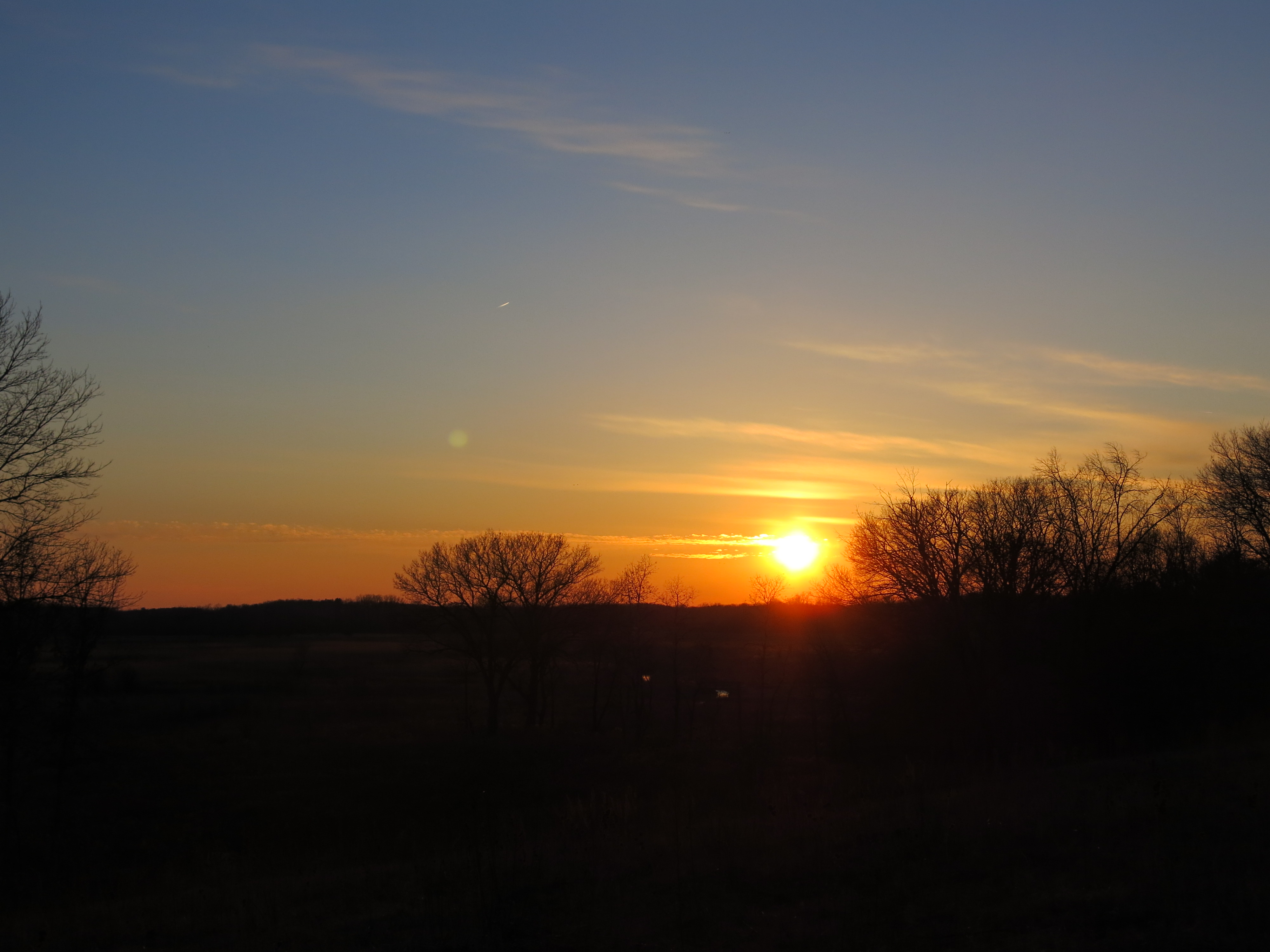
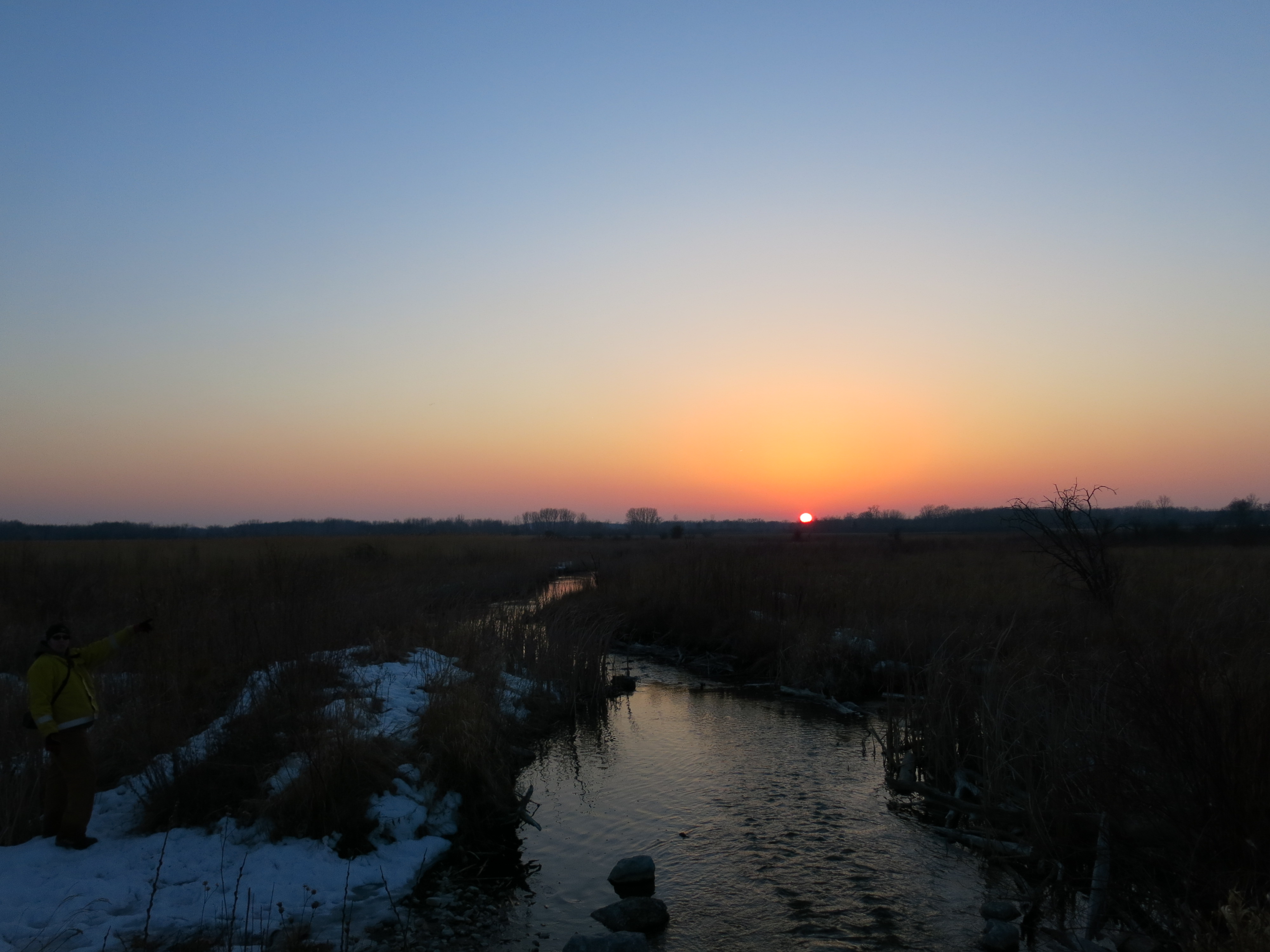
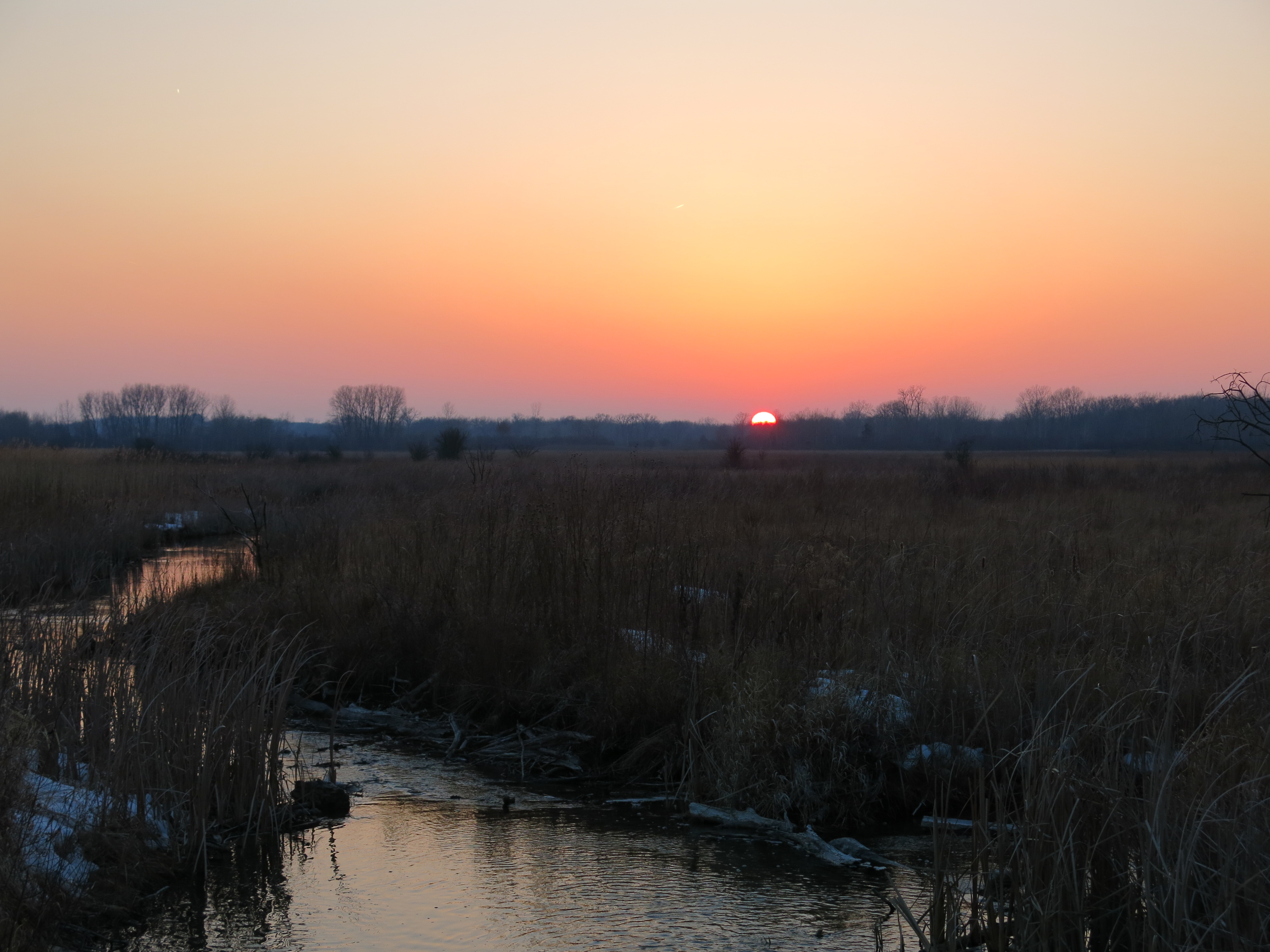
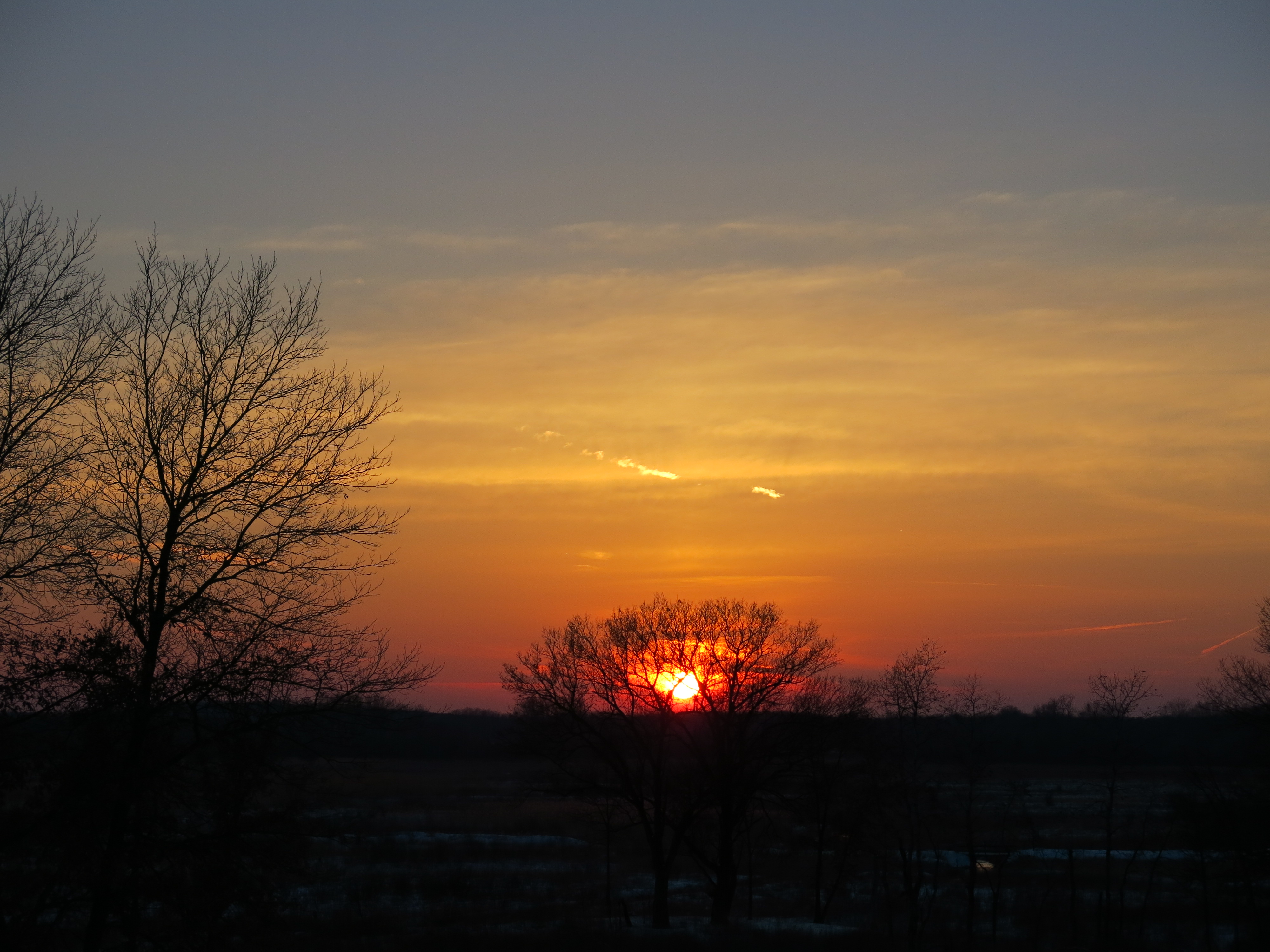
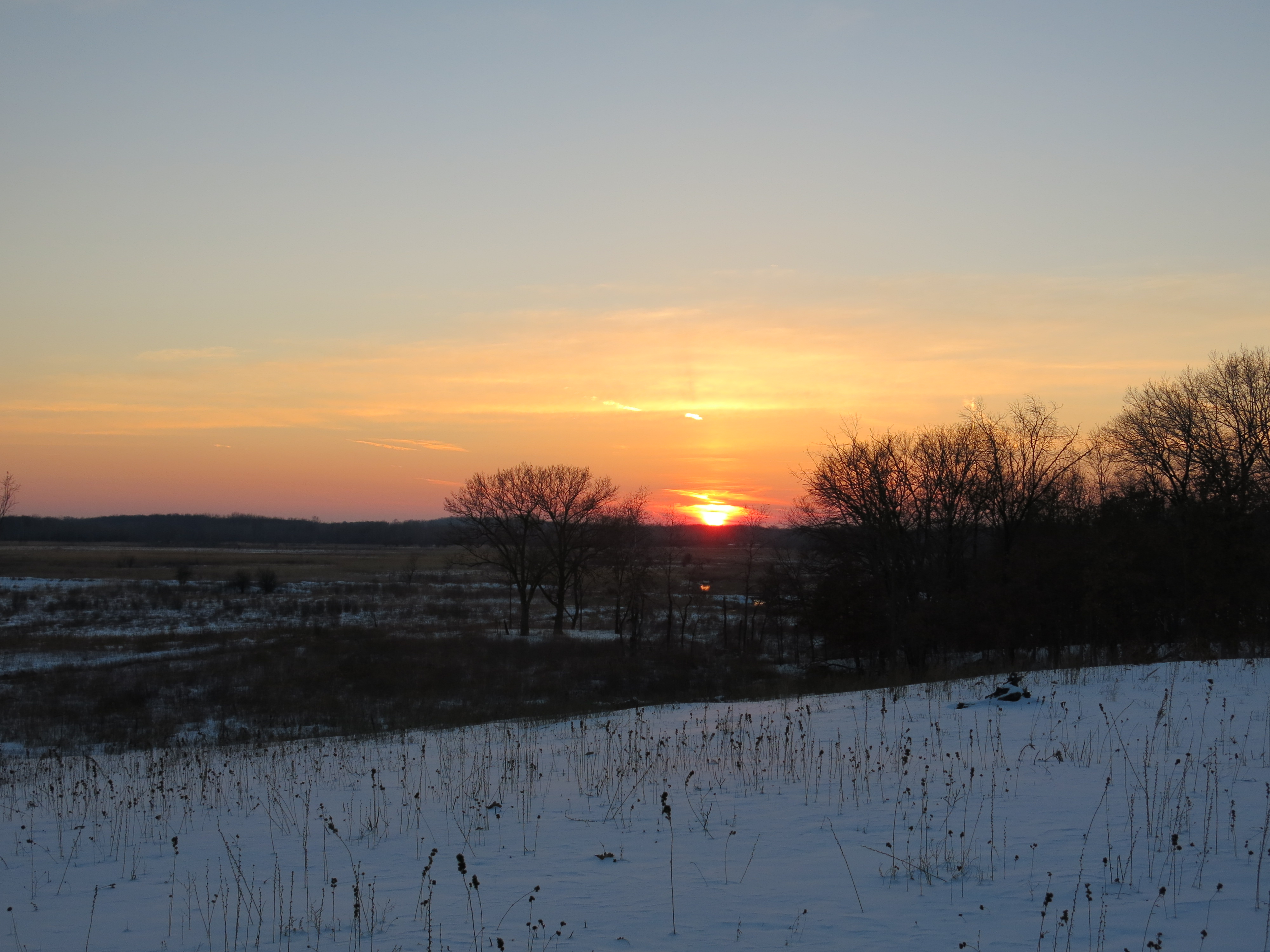
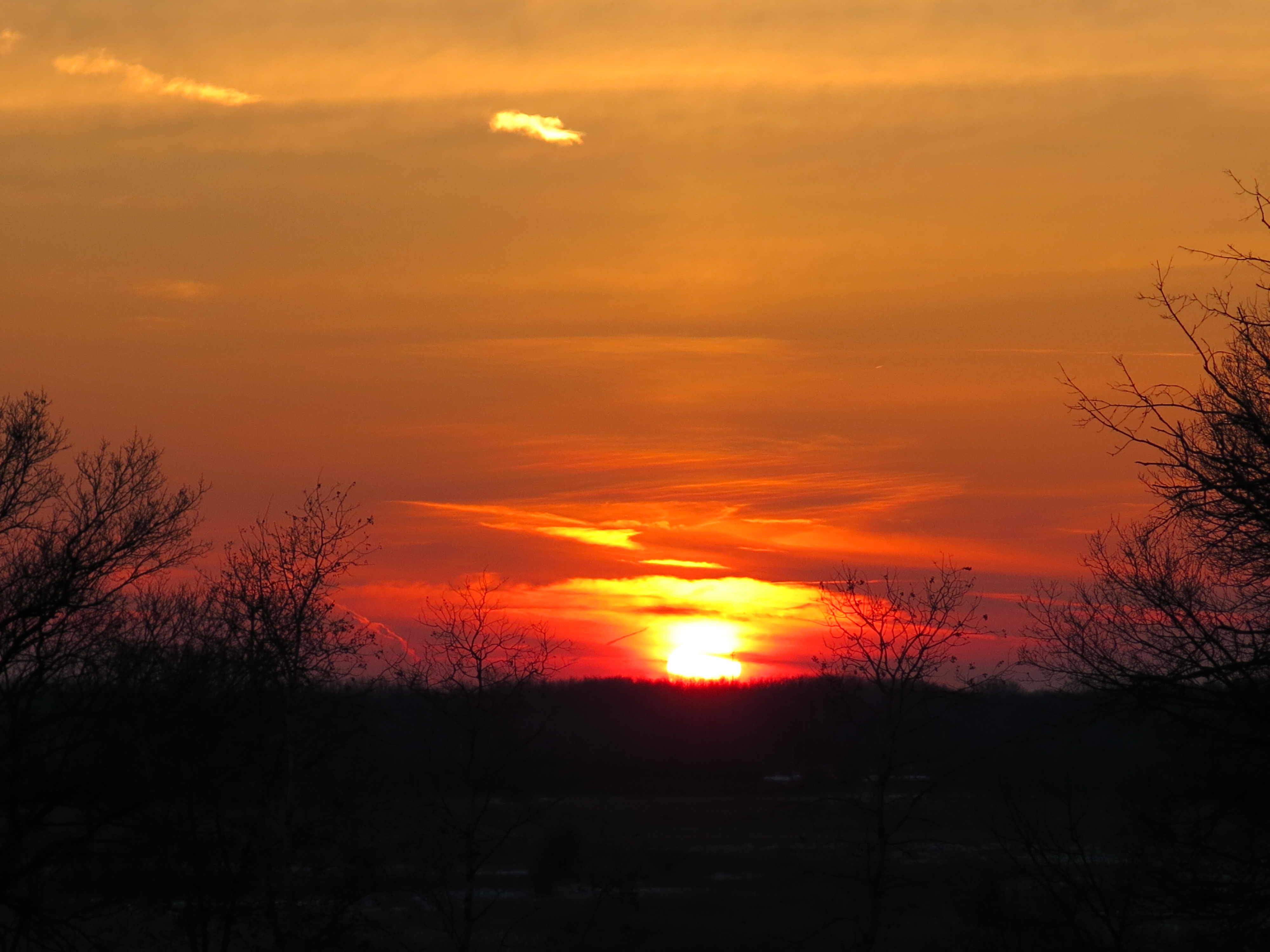
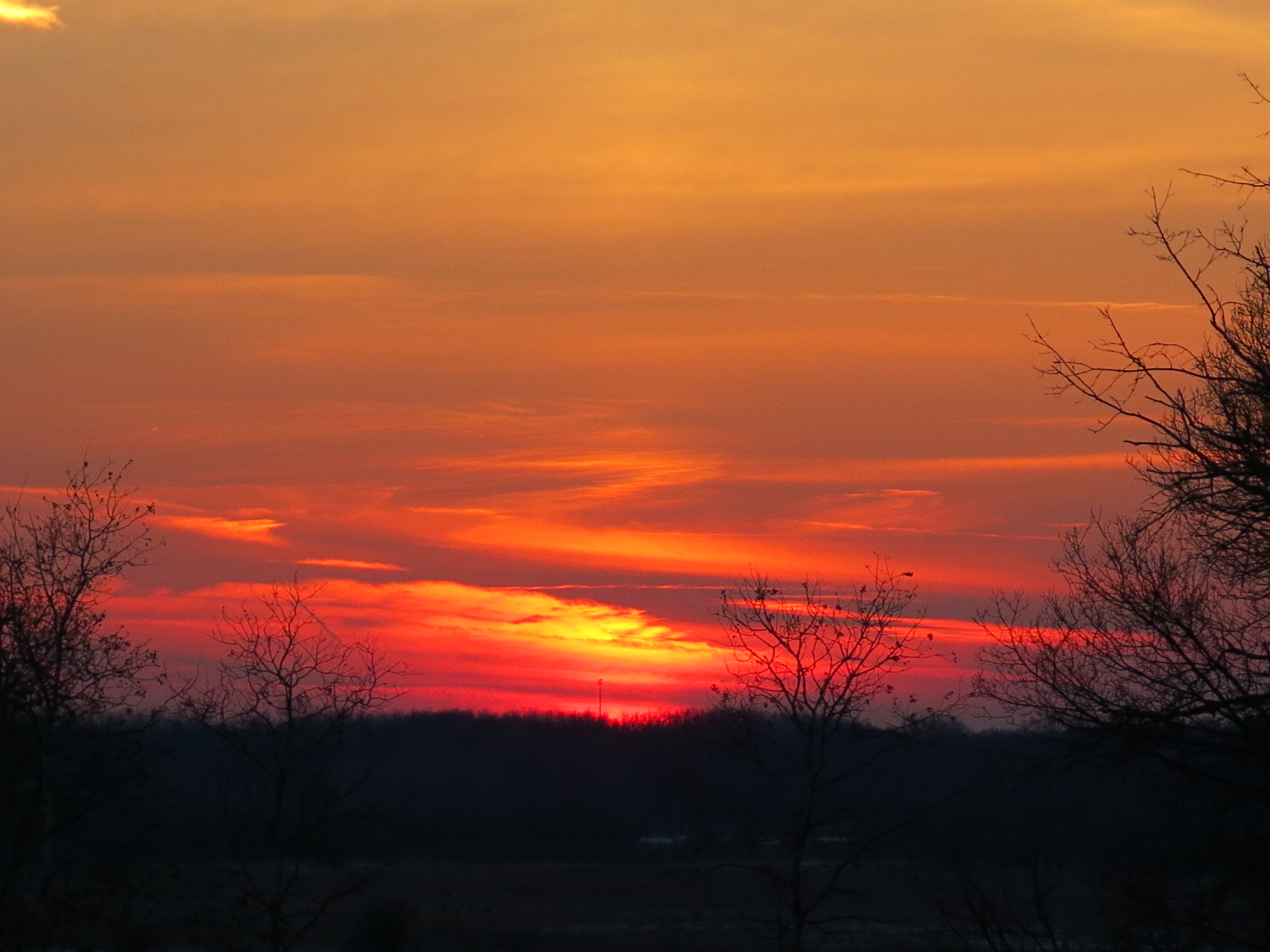
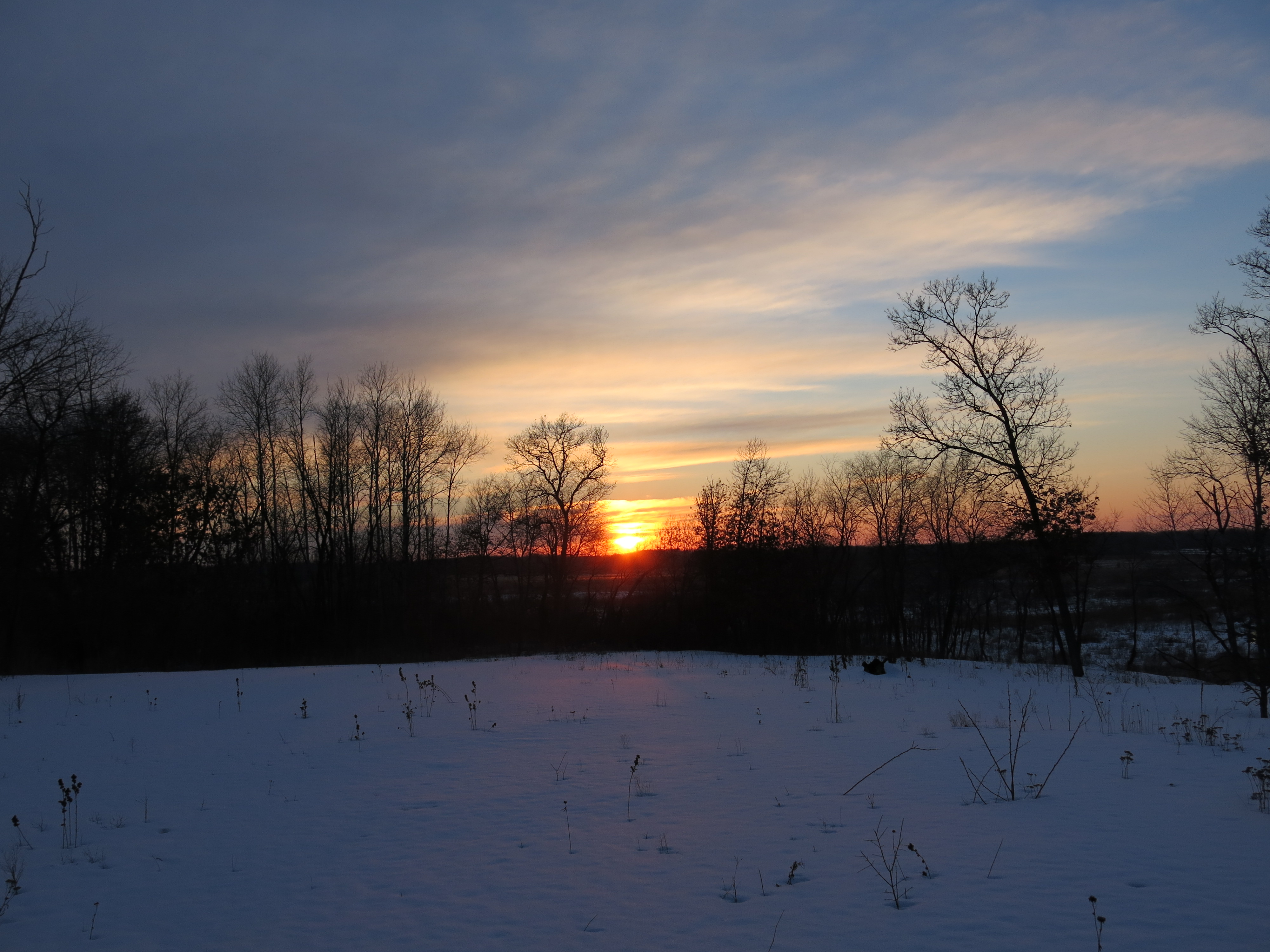
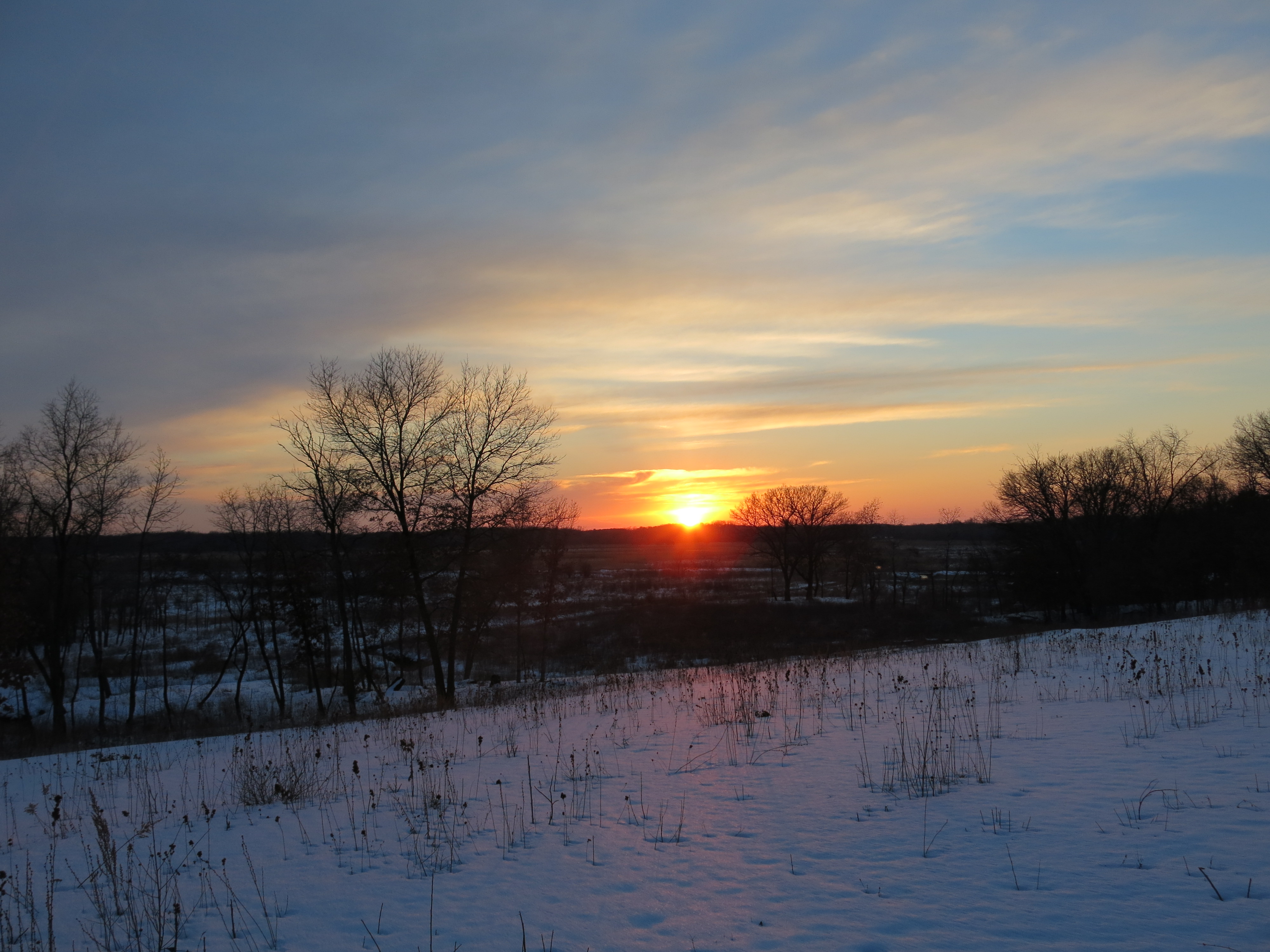
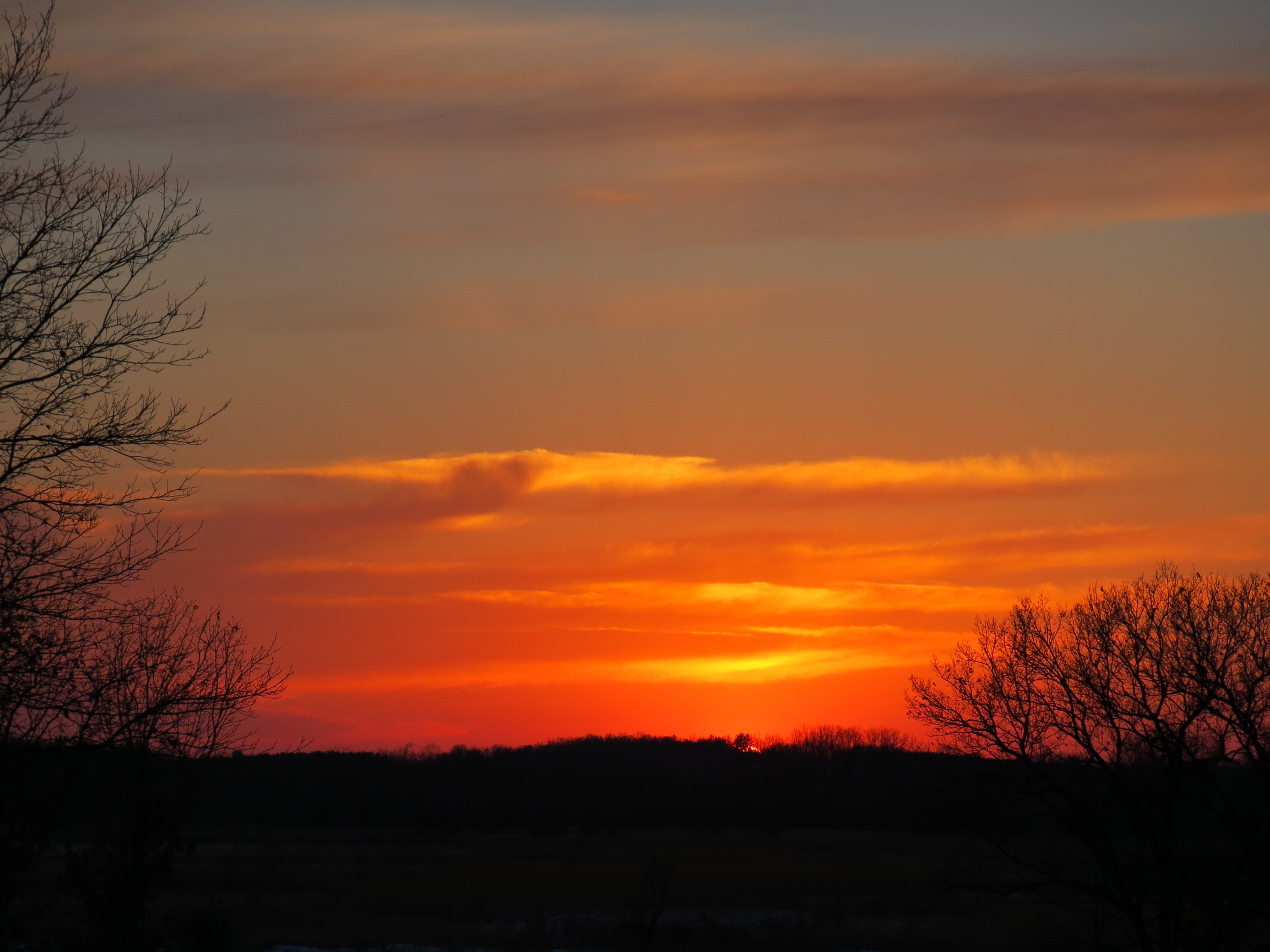
We measure the illusion of time (hows that for an oxymoron?) via the movement of celestial bodies, and I took note on the vernal equinox of the sun’s position on the horizon when it set.
I’m getting a better feel for the earth’s tilt as I watch the sunsets night after night at The Springs and I’m humbled to consider the inductive ingenuity of Copernicus and his fellow astronomers. On the first day of Spring I ran into Melanie Kapinos leading a group of sun worshipers as they observed the season changing ever-so-slowly at The Springs.
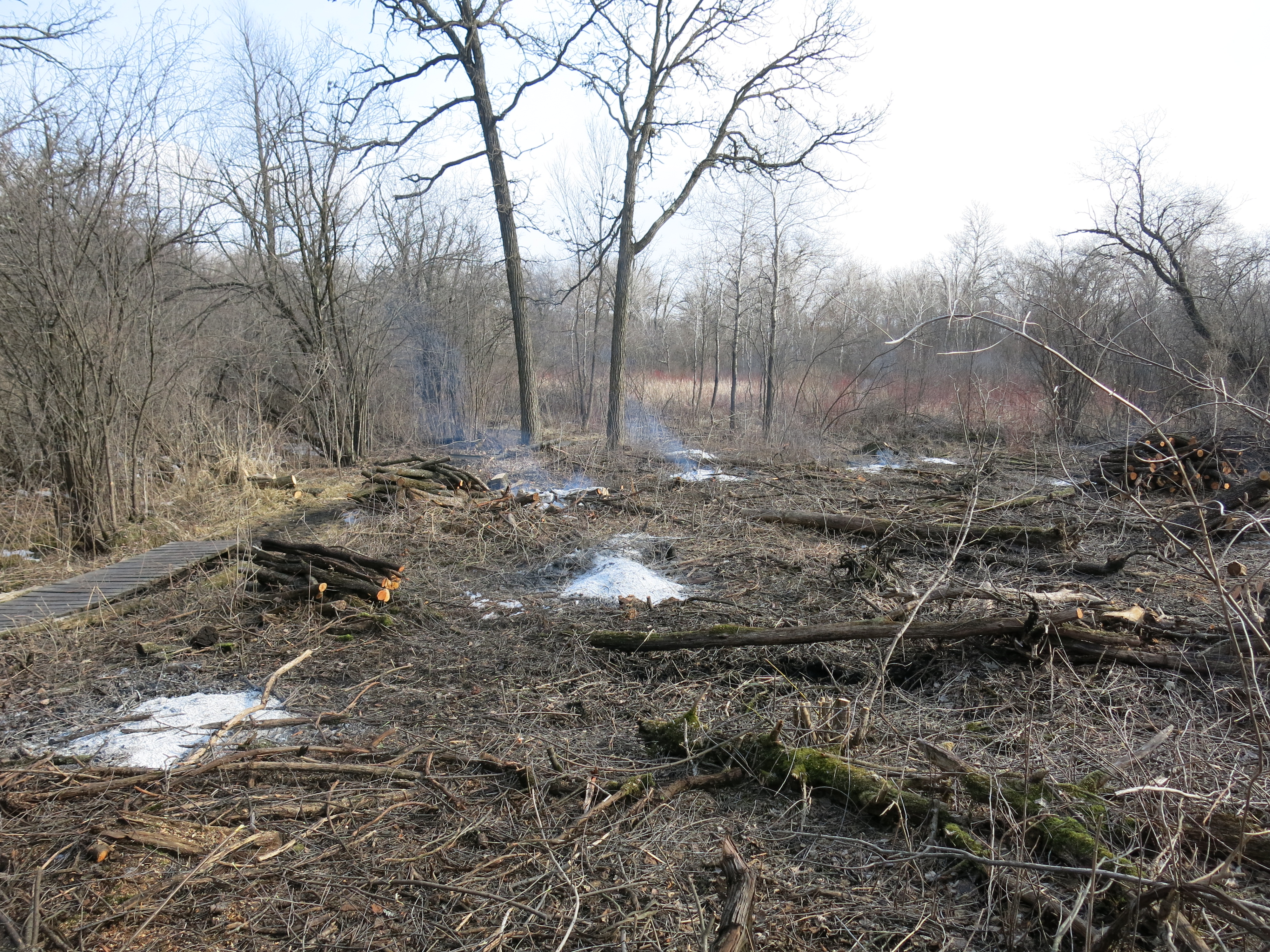
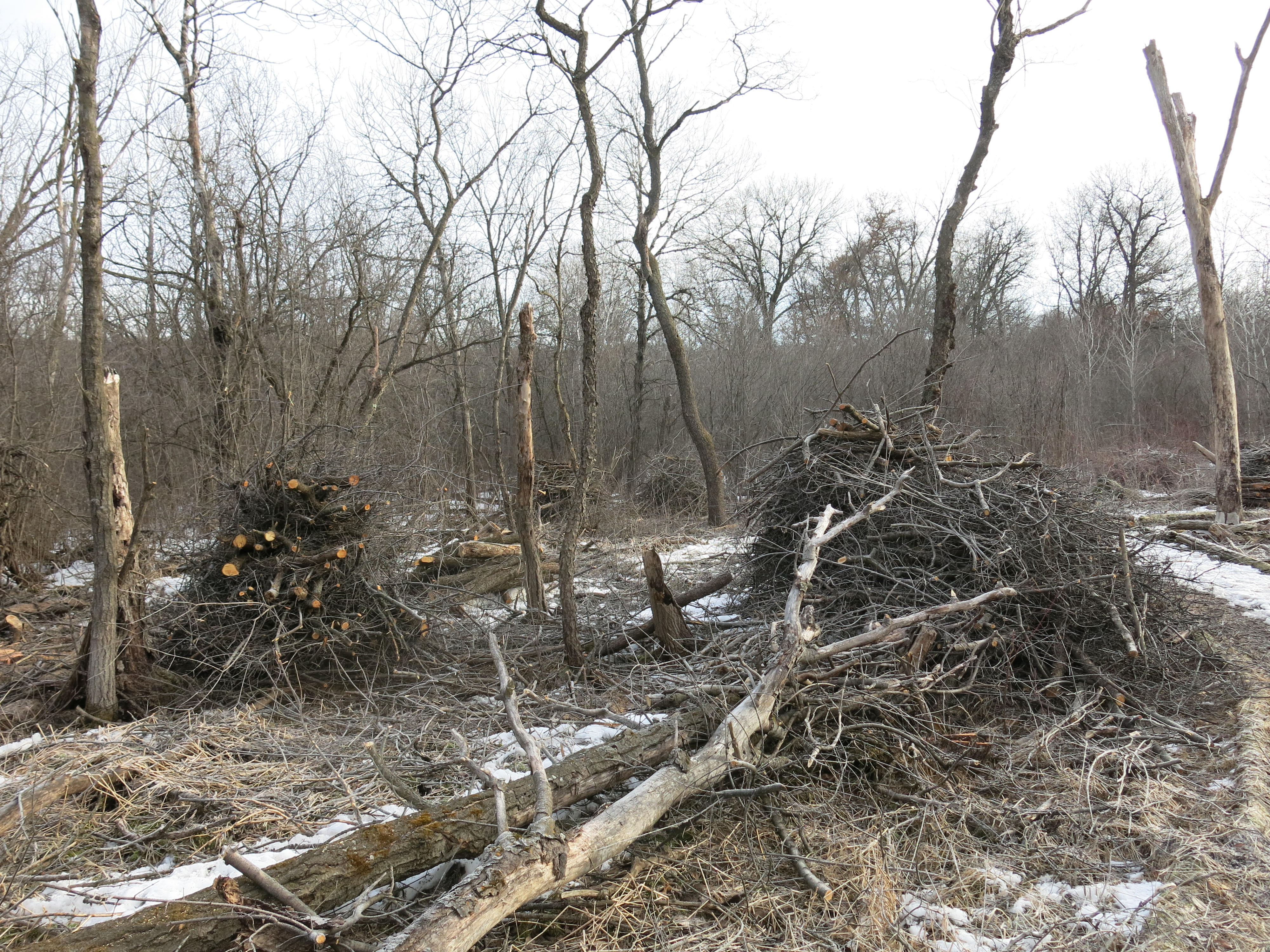
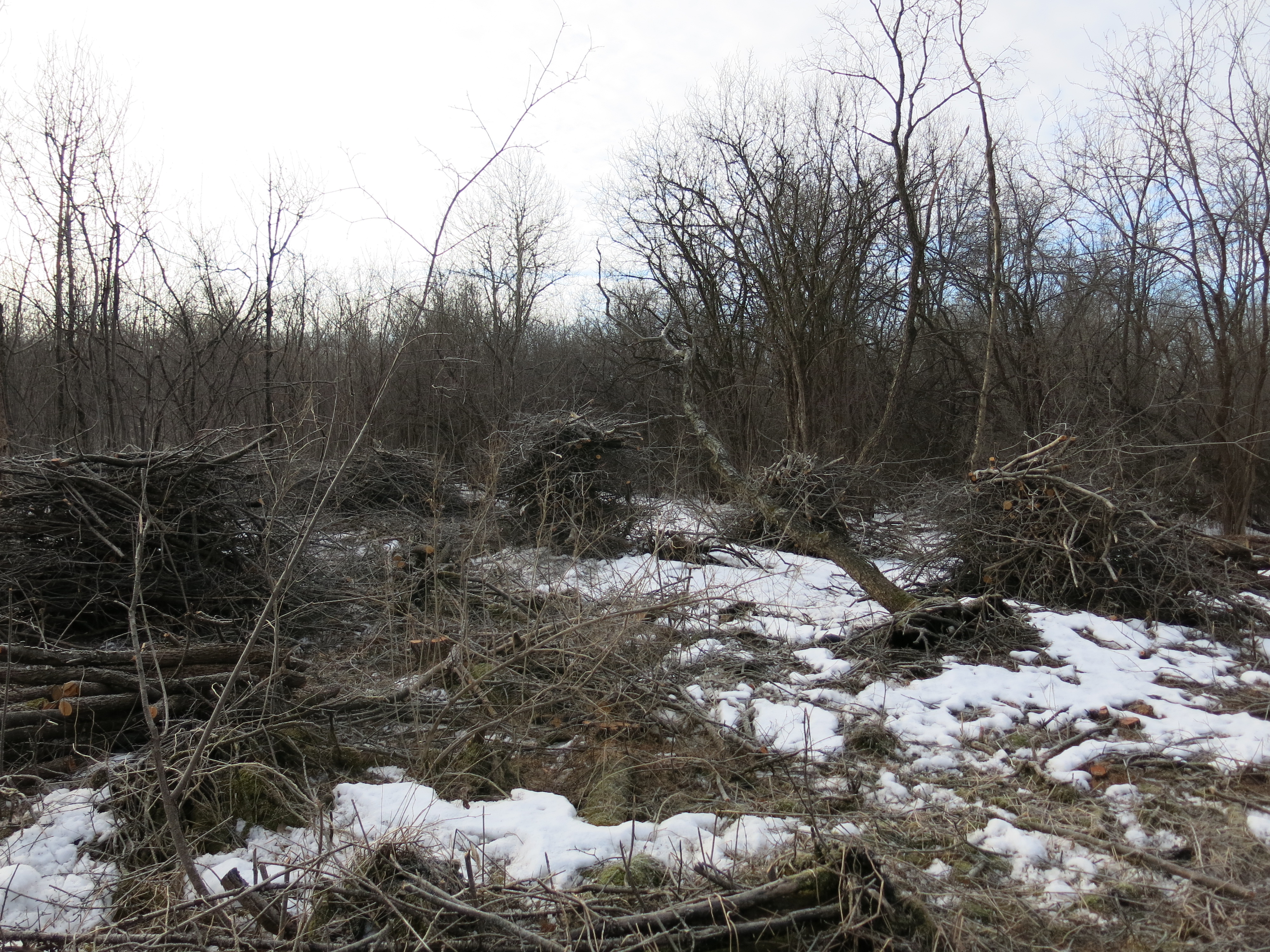
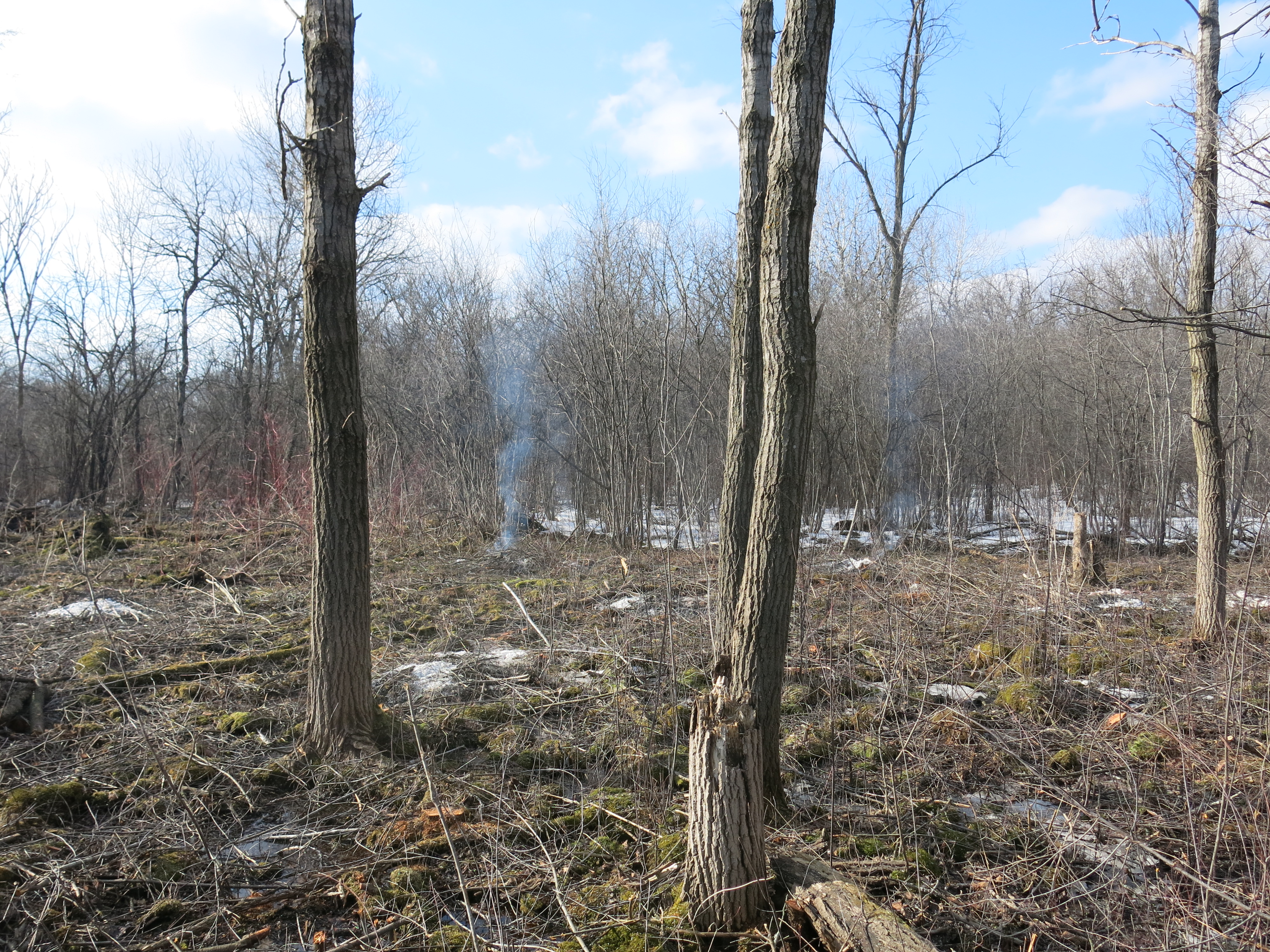
The persistent Winter is my opportunity to burn as many brush piles as I can along the Buckthorn Alley, and I got after it this past Monday and Thursday burning 22 and 25 piles respectively. Here is how it looked when I arrived on Monday.
It was a fine day and I tried to leave my worries behind and focus on igniting recalcitrant brush piles.
I was cheered by the songs of hundreds of red-winged blackbirds as I toured The Springs at the end of the day.
Sundown Monday.
Thursday was a carbon copy of Monday, but it bears repeating! Dick Jenks helped out in the morning by prepping and tending piles.
I was burdened all day with regret about upsetting my bedridden buddy. Hopefully, I’ll be wiser for it.
I always call the Waukesha Sheriff’s Dispatch and DNR trail boss, Don Dane, before and after burning brush piles and yesterday afternoon, Don informed me that he had been working at the south end of The Springs all day mowing the Scuppernong River Habitat area on the west side of Hwy 67 down to Mckeawn Springs.
Little Kestol Prairie is a secret nestled in the rolling moraines and oak savannahs of the Kettle Moraine Oak Opening State Natural Area (SNA). Well, OK, it’s not a secret anymore, it’s outlined by the black circle just south of Young Road on the map below.
Zach Kastern has known the secret of this remnant, dry prairie, for some time and has been working to keep invasive species, as well as fast spreading native woody trees and brush, from overtaking it. So when Jared Urban, the DNR’s SNA volunteer coordinator, asked him for a location for the March workday, Zach was quick to suggest it was time to reveal the Little Kestol Prairie. (Ed. note. After I posted this, Zach commented that the prairie was probably named after Joe Kestol.
The Joe Kestol house on Territorial Road was built when the Kestol family came from Norway about 1846. It has been occupied by Joe Kestol until 1993, when he went to live at a Retirement Home.
Georgia Kestol corrected the history in a comment posted on 5/5/15:
J. W. Kestol refers to the late James Kestol, my father, who was a teacher in Janesville, Wisconsin. The farm, about 200 acres bordered by the state forest, has been in the Kestol family for 105 years. Little Kestol Prairie is named for James Kestol, not Joe Kestol. Joe Kestol, deceased, was James’ brother. He owned the farm on Territorial Rd, a sesquicentennial farm that has been in the family since 1851.
Thanks Georgia!
The Little Kestol Prairie is also mentioned in the Walworth County Land Use and Resource Management Plan.) Listen to Zach share the secrets of this ecological remnant and what he hoped we could accomplish on a beautiful Saturday morning.
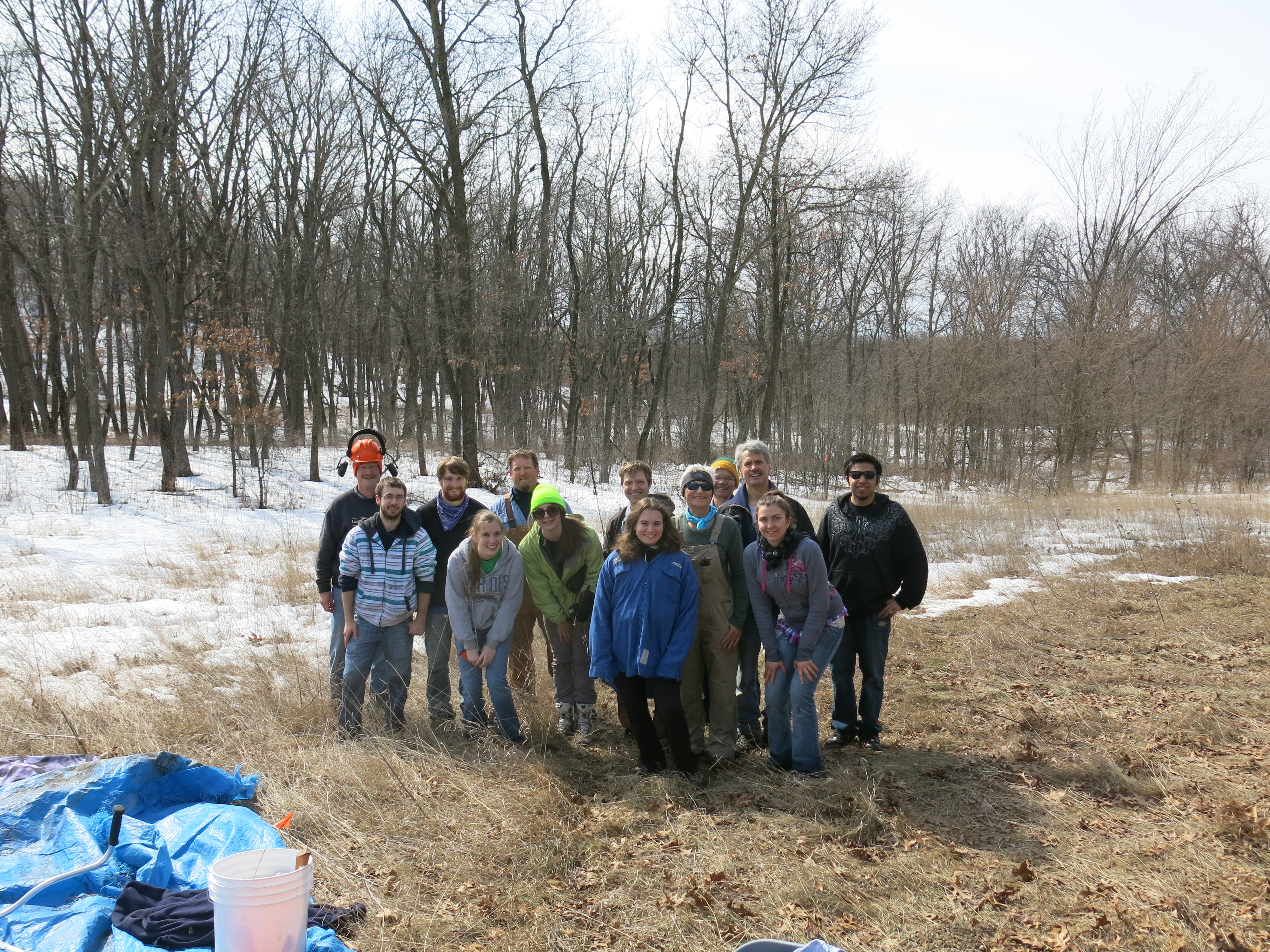
A great crew of volunteers including: members of S.A.G.E. (Students Allied for a Green Earth) at UW Whitewater, the Kettle Moraine Land Trust, and free agents like Don, Brandon and Ginny (thanks for the cookies) contributed to a very successful workday.
My day started at The Springs, where I stopped to get some “world class” spring water to drink.
When I arrived, Zach, Jared and Ginny were reviewing the plan for the day. Below, Zach documents Little Kestol Prairie with some before photos.
Soon we were hard at work on the slippery, snowy, wet hillside.
Herb and Stephanie cleared an area at the bottom of the hill.
I spent the morning following Brandon, who was swinging a brush cutter, with one of Jared’s patented poison daubers, and that was a nice change for me. Zach flagged the hazelnut, hickory, oak and other “keepers” so the brush cutters (Rebecca and Brandon) had to be very discriminating. As the morning warmed up, even the snow on the north side of the hill began to melt. Although many of us got cold, wet, feet, nobody bailed out!
Ginny and Herb double team the brush.
Wrapping up…
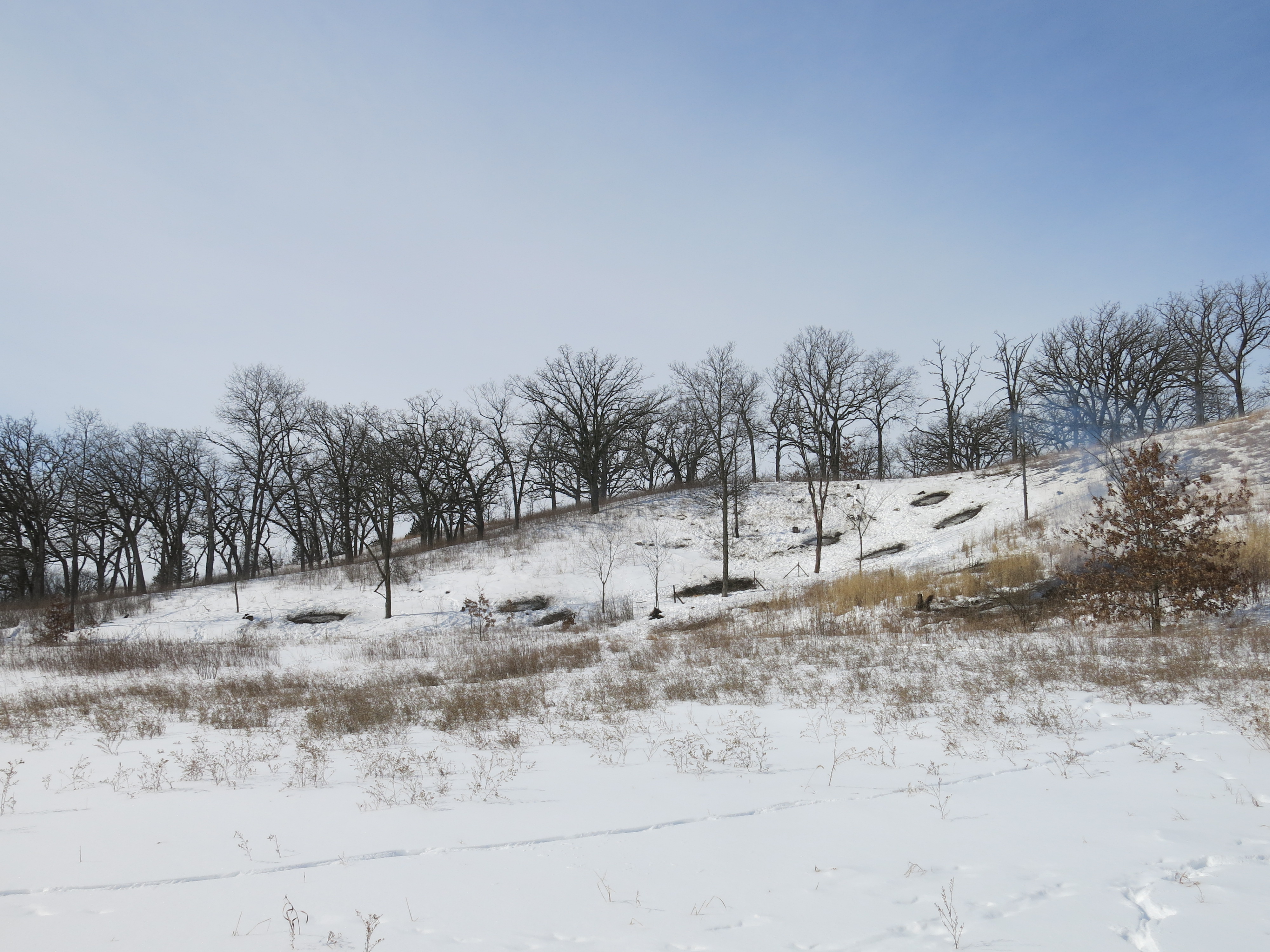
Here are some perspectives from the top of the Little Kestol Prairie.
I spent the afternoon back at The Springs harvesting black locust firewood for my upcoming camping adventures at My Shangri-La.
I ran into Carl Baumann and John and Sue Hrobar, who reported seeing American Woodcocks by the new spring we uncovered in the Buckthorn Alley (I forgot to mention the Sand Hill Cranes returned this past Monday, the 10th.) Carl was picking up some black locust and cherry firewood for his new friend Marty, who lives in the neighborhood and, like many others, ran short of firewood this season. Nice work Carl!
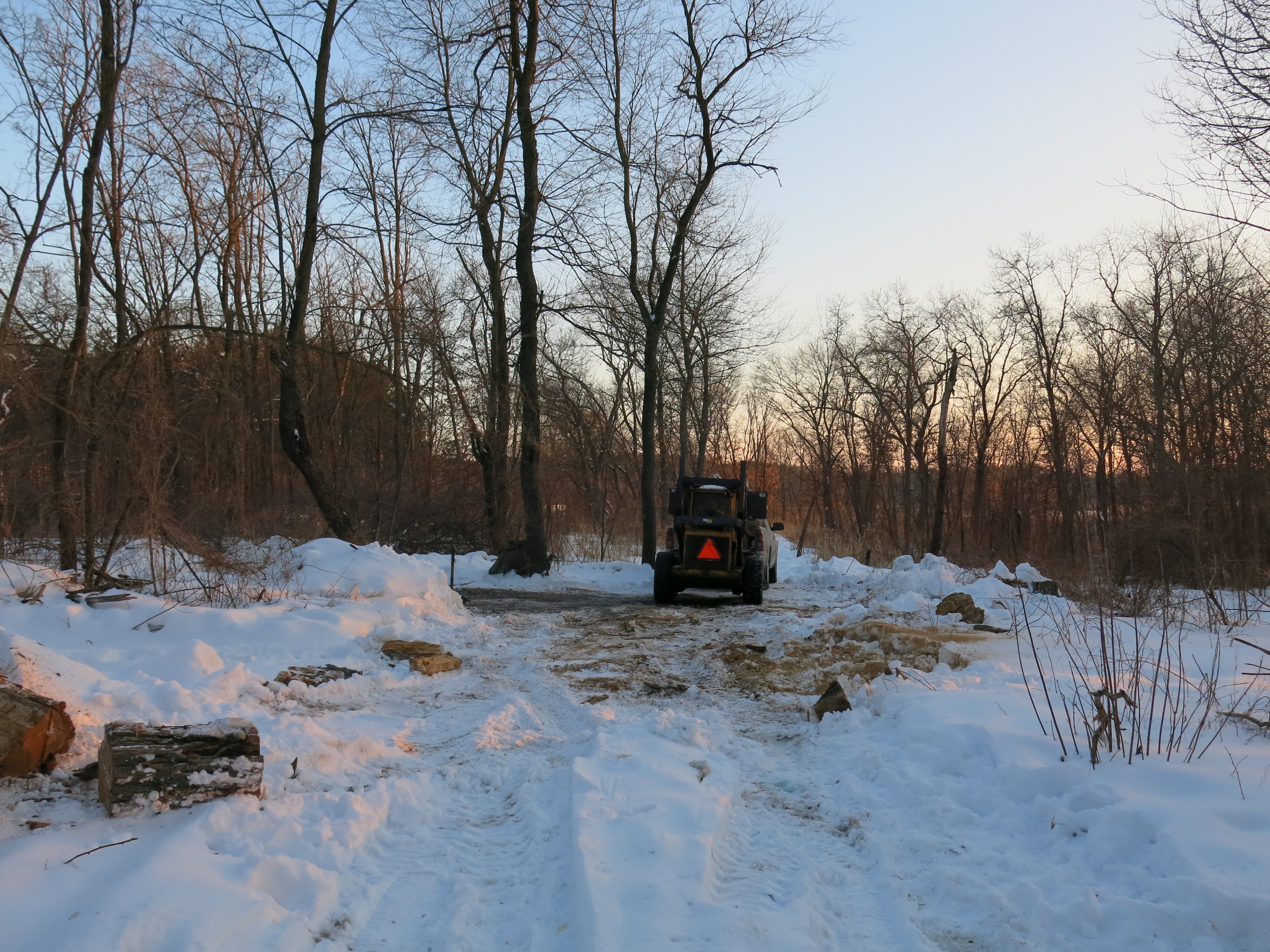
That’s Marty in the skid steer loader and Carl in the back of the truck.
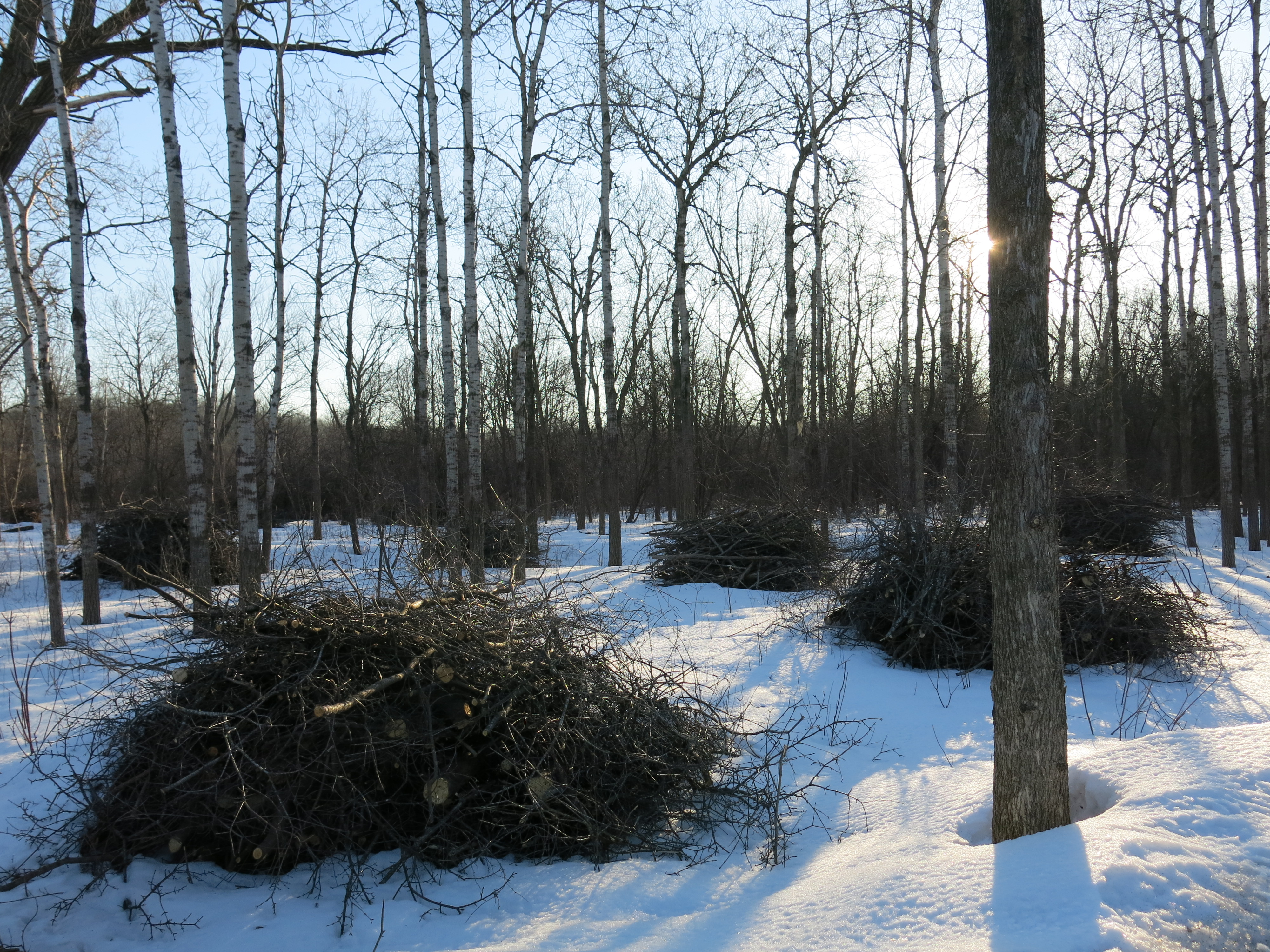
We must have made over 200 brush piles in the Buckthorn Alley since late November; well, Andy Buchta made most of them. Green and wet as they may be, now is the time to make them go away. I don’t want to look through them for 9 months to see past them. The landscape demands a clear view!
I had two opportunities this past week to light up the Buckthorn Alley and it was my great pleasure to be joined by Rich Csavoy, Dick Jenks and Ben Johnson. On Monday we started with piles right at the parking lot on Hwy ZZ.
Rich and I prepped the piles with chainsaws and I did the lighting. Dick helped the fires burn completely by consolidating the burning piles and fanning them with the leaf blower. The snow was soft and deep, and it was an effort to move from pile to pile, but we managed to get 33 lit.
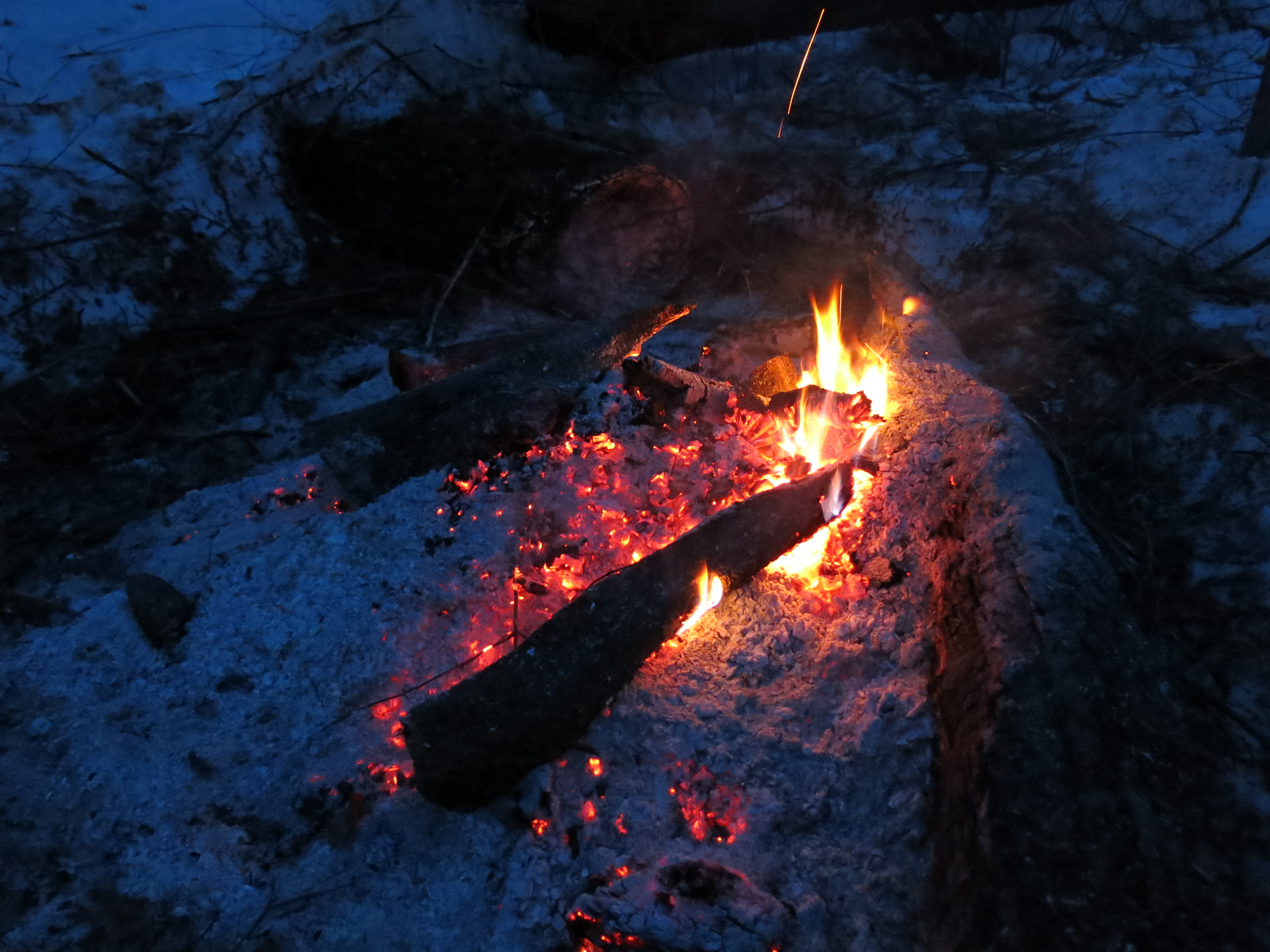
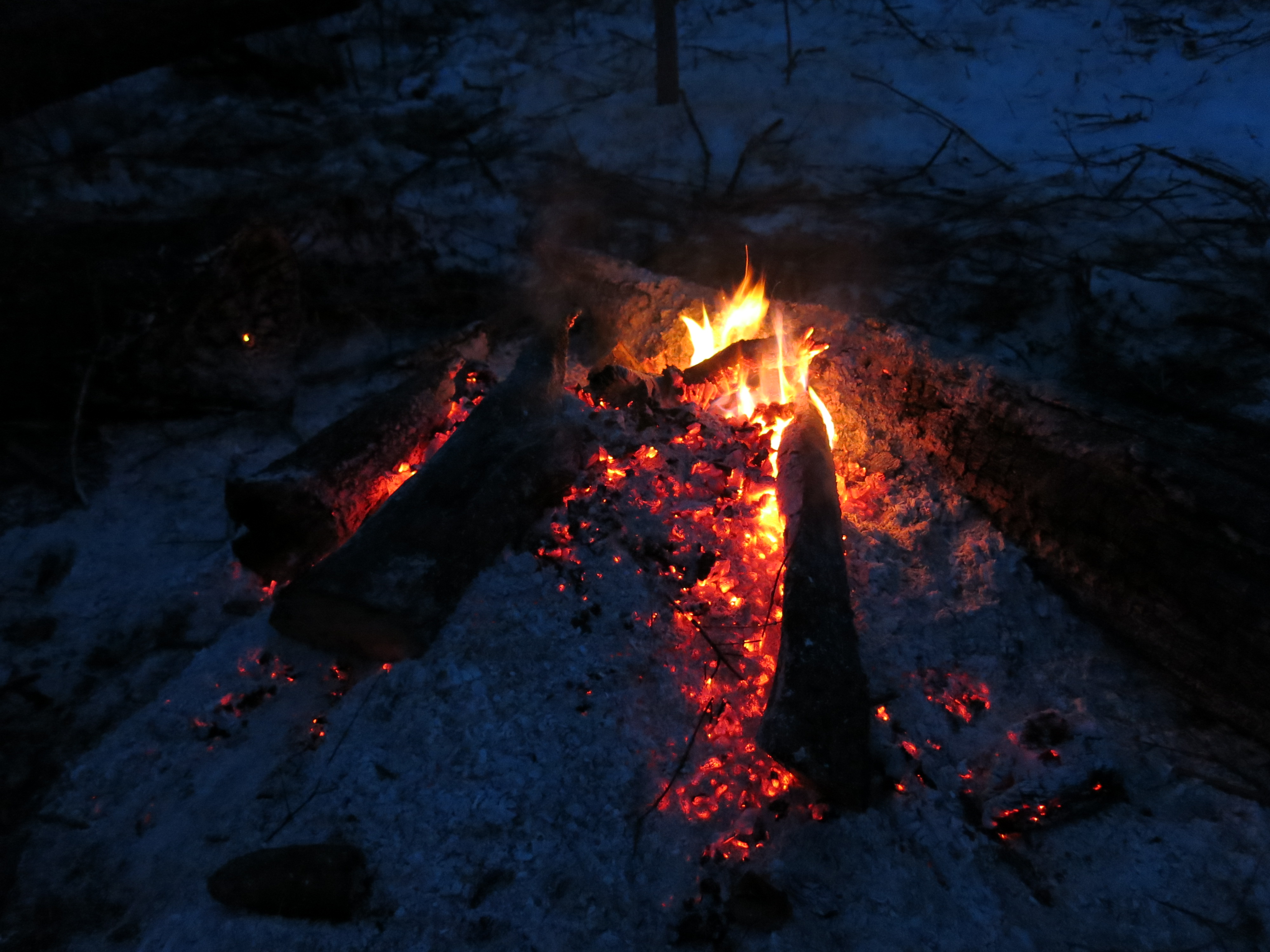
I worked the fires until 5:30pm and used the technique we recently learned from Gary Birch of disbursing the ash piles with the leaf blower.
The sun was on it’s way to set behind a bank of clouds as I made my way up to the Indian Campground. I really appreciated and enjoyed working with Rich and Dick again!
Yesterday, I heard the whine of Dick’s chainsaw shredding the morning stillness as I arrived around 8:30am.
Last November, Dick suggested we save the “nice” buckthorn logs, cut them into firewood, and offer it to Ottawa Lake campers (donations to the Wisconsin DNR are welcome!) He followed up by creating this brochure to advertise…
… and by actually doing the work. Dick, I’ll bring that sawbuck you gave me to The Springs tomorrow!
The air was moving when I began lighting piles and I made good progress initially. Then, I looked up and saw Ben Johnson carrying a 12′ aluminum ladder and dragging a sled full of birdhouses and tools.
Dick split his time between cutting firewood and tending the 25 brush piles I lit, while Ben meticulously scouted sites and mounted 26 bird houses.
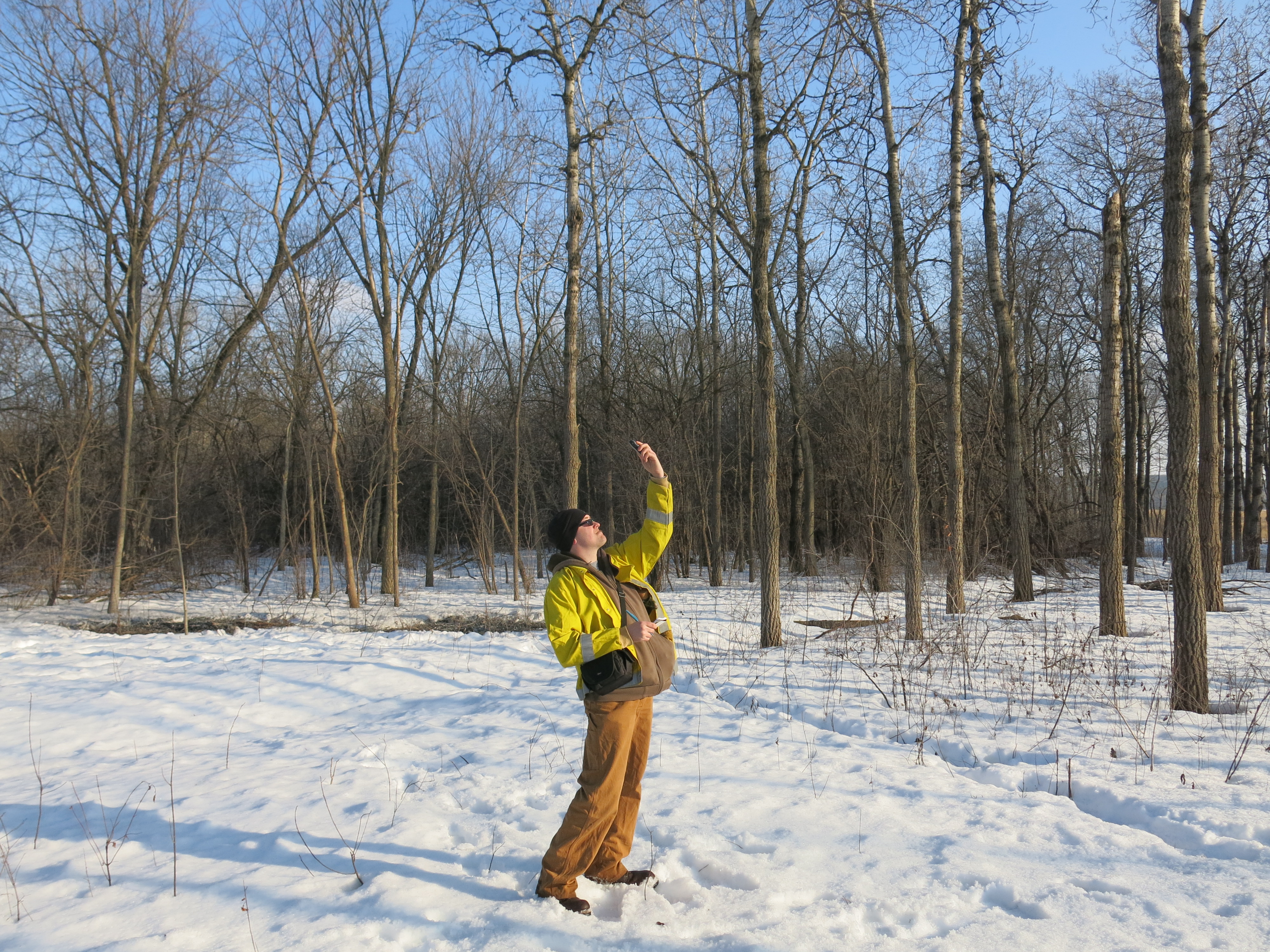
At the end of the day Ben and I retraced his steps and he collected GPS data points for every birdhouse location.
For some reason, the late afternoon light, or maybe it was mother nature herself, cast a most beautiful soft blush on the landscape.
The sun was setting as we arrived on the Indian Campground…
… but I wanted to watch the grand finale from the Marl Pit bridge.
It’s been a hard winter season as measured by local history, but certainly not hard by the standards of arctic explorers or those hardy folks “up north”, who endure much more severe trials. I’m lucky to have a buoyant spirit and to be motivated by desires above the comfort of the physical body, such that this has been a season of opportunity at The Springs, and not one of complaint or stagnation.
You may have noticed a few recent enhancements to the home page of this site such as the Blog Roll where I share websites that offer inspiring and informative content. The Peace Revolution Podcast is one of the most valuable resources I have found to aid in my personal growth and development and the most recent episode (linked above) features a brilliant lecture by Manly Palmer Hall.
This is the food that nourishes and sustains me through challenging times and reinforces my commitment to give my time and energy to rehabilitating the Scuppernong Springs Nature Trail. In the words of Manly P. Hall:
Man represents (more or less) a Soul Power in the material world: the power of inner consciousness, inner dedication, inner understanding and realization to transmute and transform the outer environment into an appropriate and proper place for the development of life.
…The human being is able to take over his own destiny. This is something that sets him entirely apart from every other kingdom of nature. There is no other kingdom that we know that can create a future destiny for itself by intent, that can take the rough materials of life and ensoul them with purposes beyond survival.
And so I carry on at The Springs, through thick and thin, eschewing the accumulation of additional financial “security”, and instead, gaining understanding of real value and creating wealth to share.
Last spring I notice the extent to which Black Locust was dominating the northeast part of the Scuppernong Springs Nature Preserve. The DNR initiated an effort some years ago to check the spread of this invasive tree at The Springs by girdling hundreds of black locust trees in the south section of the preserve. The wood from these standing, dead, trees is a valuable resource as firewood and many of us are actively harvesting it for that purpose. So, with the approach of spring, I decided to spend a couple days girdling black locust while it is still dormant. I didn’t get all of them and will revisit this project again next winter, as even one live tree can propagate a whole new colony.
The area I worked is marked in red below.
I began on Tuesday along Hwy ZZ and turned the corner south and began working along Hwy 67.
DNR Trail Boss, Don Dane, provided the Transline poison I applied to the girdle cuts. The conditions were challenging and I had to dilute the mix with water to keep it from turning to sludge in the cold weather.
Thursday, which was hopefully the last cold day of this winter season, I was back at it continuing where I left off on Tuesday working south all the way to the old barn site.
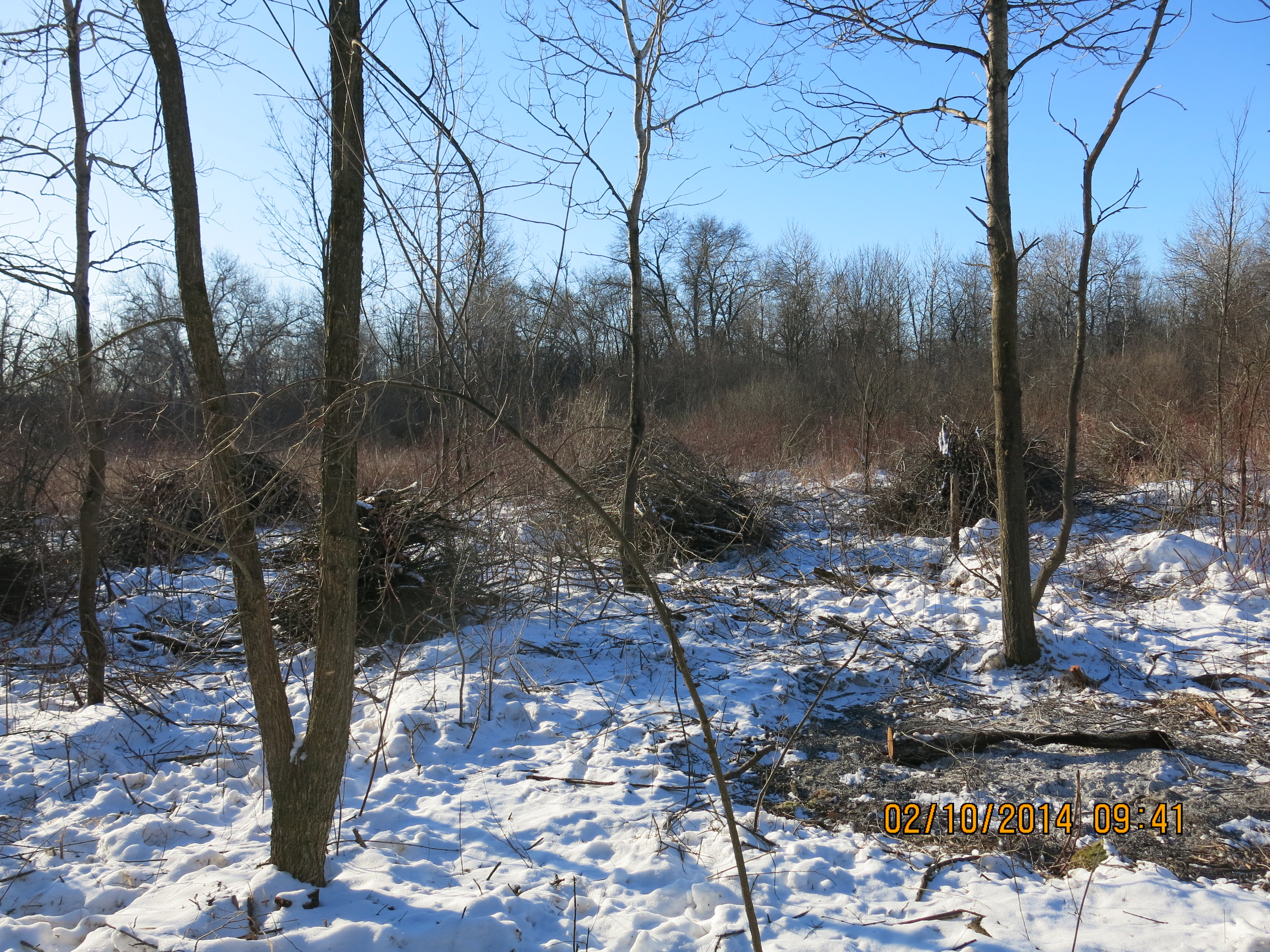
I pulled my sled from the parking lot on Hwy ZZ east along the north side trail (formerly known as The Buckthorn Alley) and noticed that Andy Buchta had again piled all of the brush that I cut the last time out.
Thanks Andy! When I got near the east end of the trail, I cut through the woods to set up my base of operations just below Hwy 67. There is a drainage here carrying water from the opposite side of Hwy 67 that leads down to the abandoned cranberry bog adjacent signpost #13. I had never visited this section of the property before and was impressed by the huge, open grown, oak trees that are being overtaken by the black locust colony.
The cold temperature and deep snow made it a challenge and I was pretty exhausted by the time I ran out of poison around 2:30pm. This will be a multi-year effort, I didn’t get them all, but I want to switch gears and burn as much brush as possible while conditions permit.
I took a walk around The Springs after work and was joined by Ben Johnson. Ben has built dozens of bird houses, with more to come, and we talked about where to place them as we traveled the trails.
It took me two years working at The Springs to get my courage up to tackle the Buckthorn Alley. Or, maybe it was that I was focused on what I thought were the more scenic parts of the Scuppernong Springs Nature Trail that caused the delay. I avoided even walking this section of trail, but, as is typically the case, ignoring the problem did not make it go away.
In April 2013 I made a start at it, but the weeds of summer came early and I discovered the advantages of following their phenology to identify the best ways and times to attack them. Finally, in late November 2013, I returned to the Buckthorn Alley with Ben Johnson, Andy Buchta, Dick Jenks, Jim Davee and Zach Kastern determined to change the status quo. Now, after 3 months of consistent, team effort, we have finally, reminiscent of our efforts on the “Lost Trail” in the fall of 2012, broken through to the other side.
When I arrived yesterday, it was really great to see that Andy Buchta had piled all of the buckthorn that I cut the last time out, and the table was set for me to get right to work.
The end of the Buckthorn Alley in sight.
This long, cold, winter season has been perfect for working in this very wet, marshy area. I’m not going to cut anymore along the trail here for now and will focus, while the snow cover lasts, on piling and burning what has already been cut. So, here are the final results along the buckthorn alley for this season. In the fall, we’ll work on the north side of the trail to reveal the oak groves there.
I was able to significantly broaden the clearing between the north side trail, aka, the Buckthorn Alley, and the cut-off trail, aka the “Lost Trail”. The downward pointing blue arrow below indicates the newly cleared area and the upward pointing arrow represents the perspective from the cut-off trail shown in the video below.
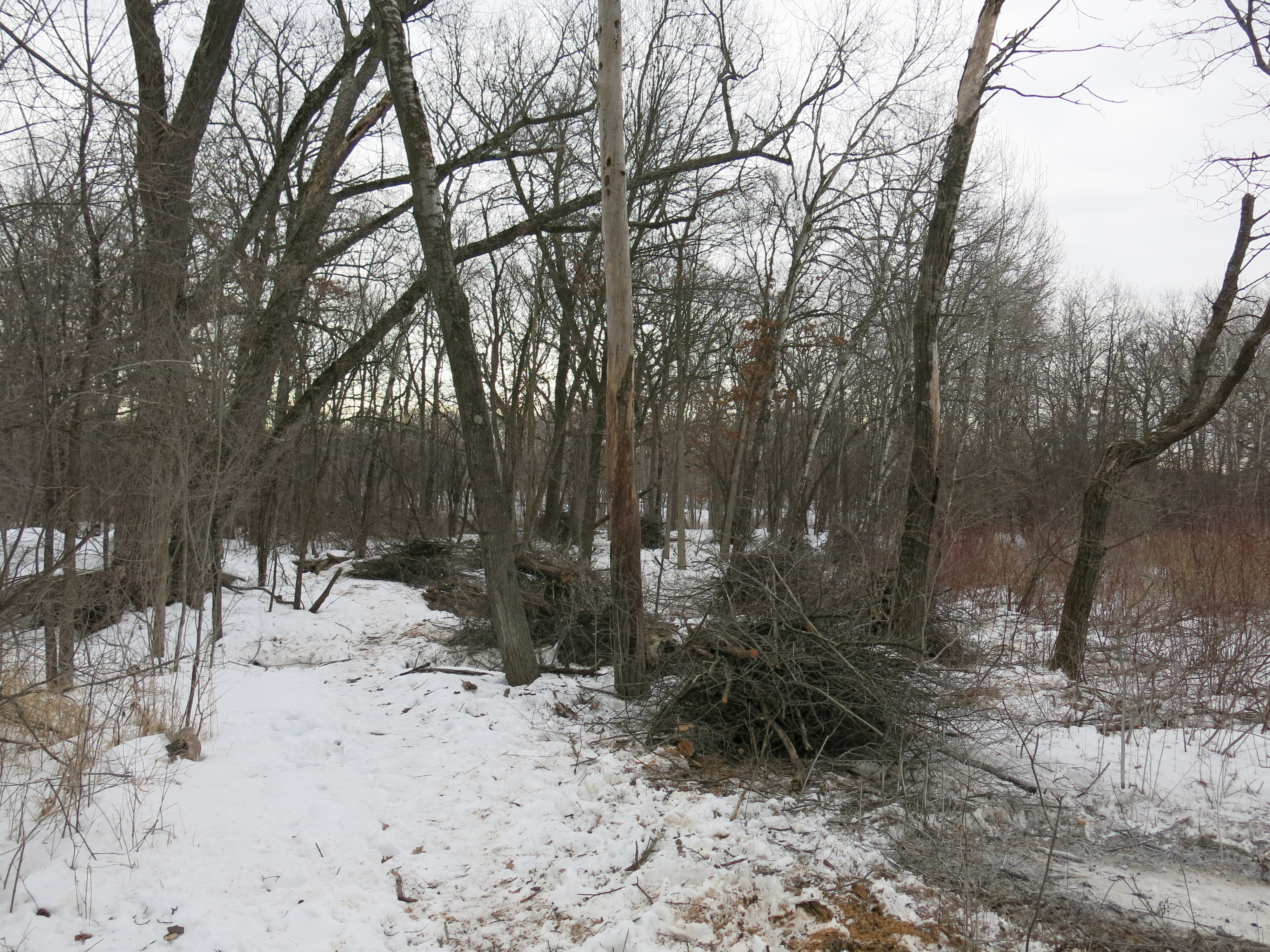
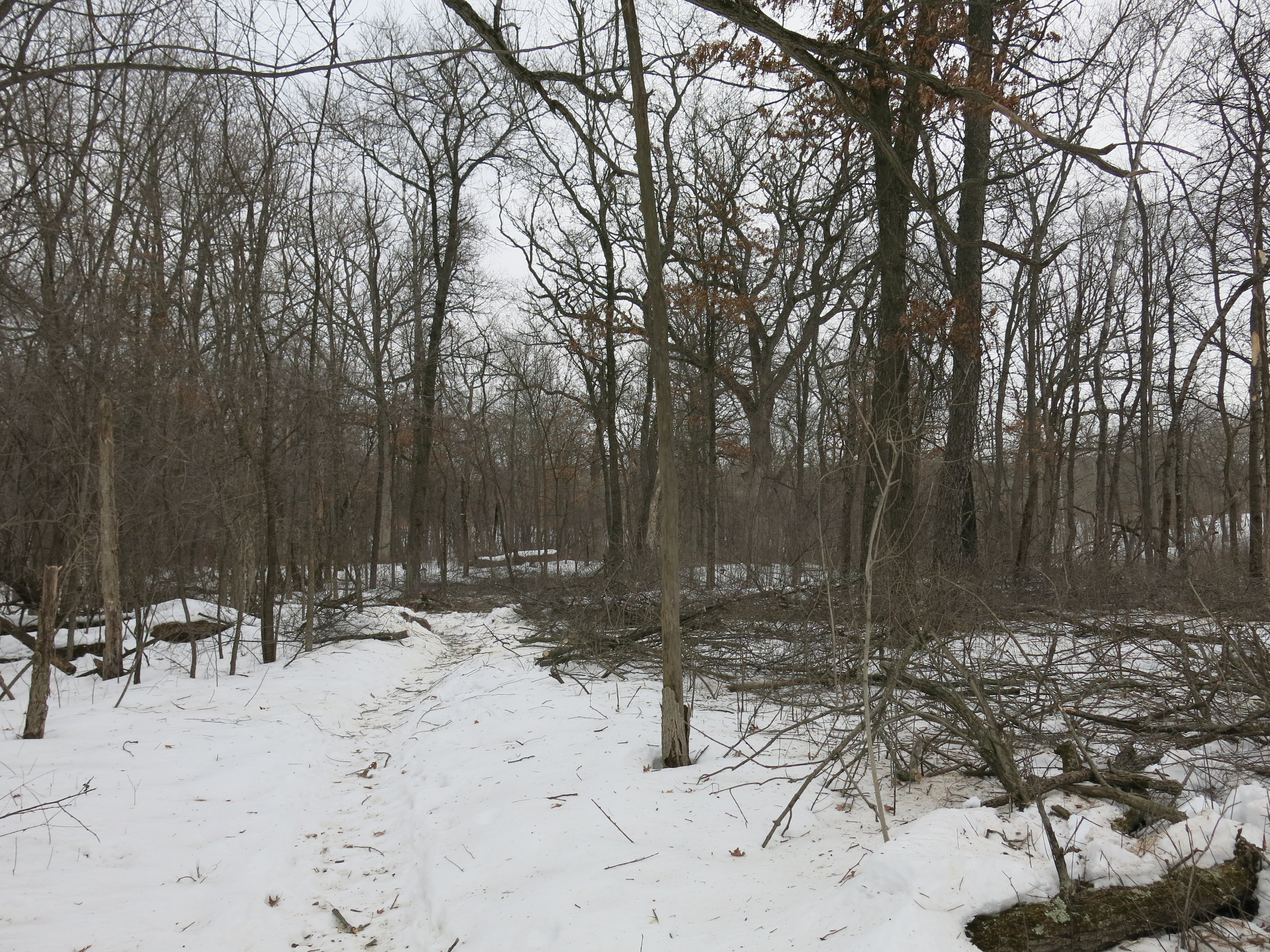
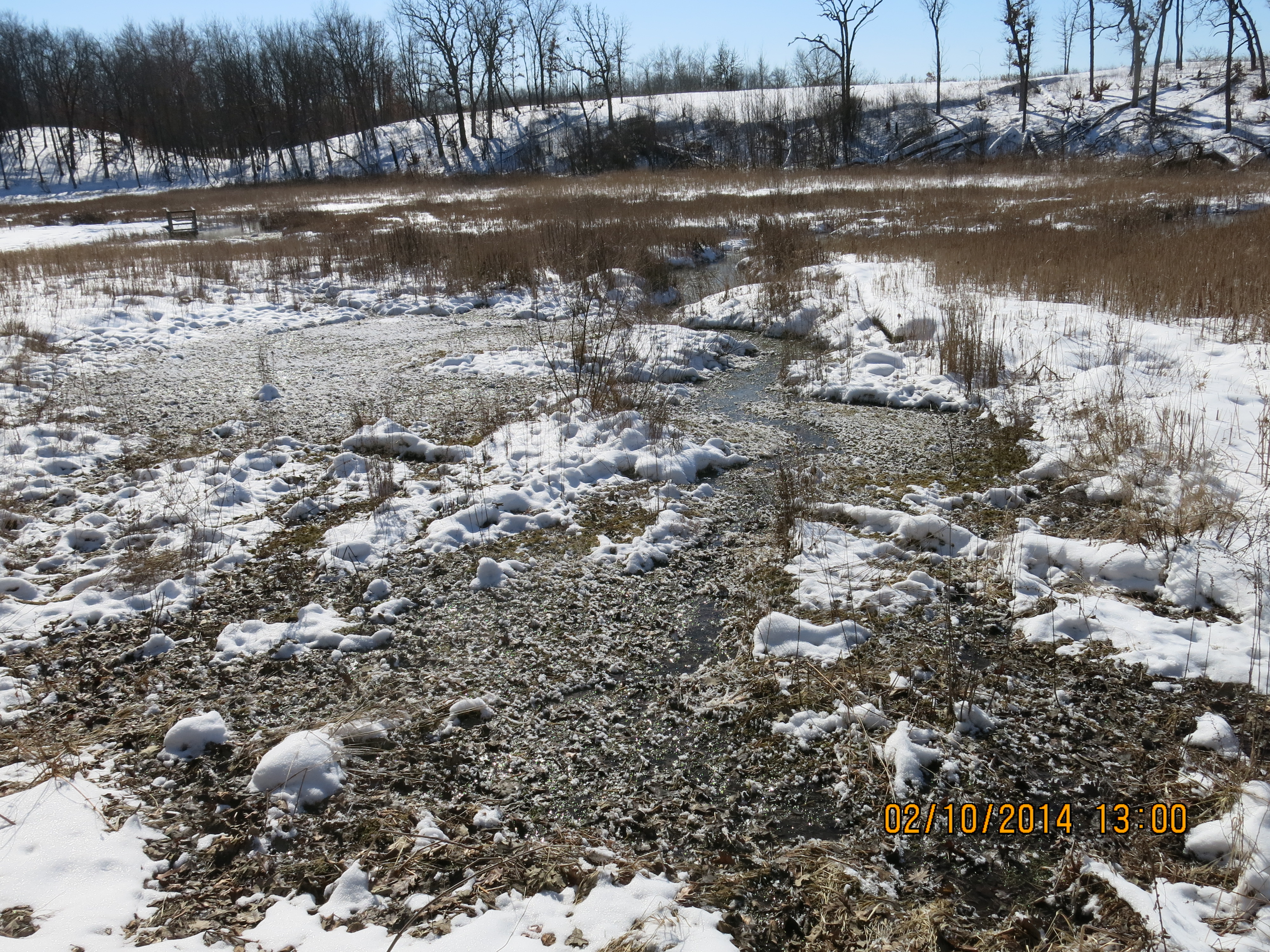
Here are a couple of views of late winter at The Springs.
Well, it’s that time of year. No, not when you start to go crazy anticipating spring weather, it’s Tax Time. What? You haven’t started working on your taxes yet? Pati and I sat down today to collect the numbers and I was reminded of how critical the support of the Kettle Moraine Natural History Association (KMNHA is on Facebook) is to the restoration work we are doing at The Springs. Oh, and the brand new pair of steel-toed muck boots I wore yesterday working in the Buckthorn Alley were also a great reminder as well.
The Kettle Moraine Natural History Association is a nonprofit organization dedicated to helping preserve the features of outstanding interest in the Southern Unit of the Kettle Moraine State Forest. The Kettle Moraine Natural History Association generates financial support through gift shop sales, donations, and membership dues. It has provided matching funds for Stewardship grants. (Kettle Moraine State Forest Southern Unit)
Ron Kurowski — Retired DNR Park Naturalist; champion of the Scuppernong River Habitat Area restoration project; editor of The Scuppernong Journal.
Marlin Johnson — Retired UW-Waukesha biology professor and currently the property manager at the UW-Waukesha Field Station. Marlin is also on the board of directors of the Waukesha County Land Conservancy and was instrumental in acquiring the 26 acre Minogue property at the Hartland Marsh, where Pati and I still serve as caretakers.
Joicelyn Schwager — Retired Finance Director/Treasurer for the Village of Hartland and the one who signs my checks! The KMNHA pays for all the gear and supplies I use at The Springs and I couldn’t do it without their support.
The KMNHA is a great organization and their, always entertaining and informative, annual meeting is coming up soon. Reach out to Ron Kurowski at:
Kettle Moraine Natural History Association
S91 W39091 Hwy 59
Eagle, WI 53119
or, visit the Kettle Moraine State Forest Southern Unit headquarters to pick up an application, and join the KMNHA and you’ll receive their excellent quarterly publication The Scuppernong Journal. Here’s a sample to wet your appetite.
With all the rain we had this past Thursday, I was glad to have on my new pair of muck boots yesterday; the slush was just an inch or two below the surface of the snow. I’ll try to contain my excitement as I describe the work on the last stretch of the Buckthorn Alley (well, the last stretch of the south side of the trail that is.) The first thing I noticed was that Andy Buchta had piled all of the brush that Ben, Zach and I cut last tuesday.
I really appreciate the way Andy just sees what needs to be done and does it. That enabled me to get right to work on the trail.
The blustery weather continued all day and blew the clouds away.
I cut a swath through the woods to open views to the hills on the south side of the Scuppernong River.
I couldn’t wait to drop my gear off at the truck and take a walk on the cut-off trail to see the effects of the days work from another perspective. In the center of pictures below you can faintly make out the wetland adjoining the Buckthorn Alley trail, where I spent the day and where we have been focused for the last couple months.
Here are a few views from my favorite spots along the loop trail.
I’ve never been in a street fight, but I imagine it might leave one feeling like I did this morning. Yesterday, Ben Johnson, Zach Kastern and I picked a fight with gang of mute, motionless, defiant and ultimately, defenseless, buckthorn that had invaded “our” territory at The Springs. Their thorny branches and stout, gnarly, trunks were no match for our sharp, steel, chains and our saws whirred their death knell in three part harmony.
“One of the penalties of an ecological education is that one lives alone in a world of wounds. Much of the damage inflicted on land is quite invisible to laymen. An ecologist must either harden his shell and make believe that the consequences of science are none of his business, or he must be the doctor who sees the marks of death in a community that believes itself well and does not want to be told otherwise.”
― Aldo Leopold, A Sand County Almanac
Fortunately, we’re not working alone at The Springs, and a team of dedicated volunteers is coalescing to undo the damage that has been inflicted on this “world class site”. I’m energized and encouraged by the growing level of commitment — the fresh blood (no pun intended) — that all of the new volunteers bring. It’s going to be a great year!
God, give me grace to accept with serenity the things that cannot be changed, the courage to change the things which should be changed, and the Wisdom to distinguish the one from the other. Reinhold Niebuhr
I returned to the buckthorn alley yesterday determined to “change the things which should be changed!” There is a relatively thin curtain of buckthorn separating the trail here from a good sized wetland.
I started one of Andy’s brush piles on fire and was soon joined by Ben Johnson and Zach Kastern. We got our saws in tune and they began to sing.
John Hrobar, who has quite a voice by the way, joined the chorus and stoked the fire with freshly cut brush while Sue corralled this wild unicorn that was roaming north of the old barn site.
When the rumble was finally over, and slain buckthorn littered the alley, we gathered round the fire to savor and celebrate our success.
We left enough daylight to take a walk around The Springs, enjoy the scenery and catch the sunset.
The river bend.
The big valley.
Pati joined us for the sunset at the Indian Campground.
We finished the day walking the north end of the loop trail from east to west scoping out the last stretch of the buckthorn alley and hanging out by the fire…
A lot of ingredients go into a successful land restoration recipe and you’ll always find persistence as the base stock. Our chef Saturday, February 15, at the Kettle Moraine Oak Opening SNA chilly bowl, was noted Oakologist and Wisconsin DNR Conservation Biologist, Jared Urban.
Jared likes to spice up workdays with unique mixes of people, locations and activities and Saturday’s stew pot included burning brush piles and cutting and poisoning buckthorn, honeysuckle and other brush on the sunny south side of an oak covered moraine just northeast of the intersection of Bluff Road and County Hwy H. Enthusiastic volunteers from the Ecology Club, and S.A.G.E. (Students Allied for a Green Earth) at UW Whitewater, the Kettle Moraine Land Trust, and others, provided the meat and potatoes for the savory stew but Jared’s “secret ingredient” was Gary Birch.
Gary has dedicated his professional career (first with the Wisconsin DNR and currently with the Wisconsin Department of Transportation) and a lot of his personal time to nurturing, protecting and researching the flora and fauna in Wisconsin. Here is a small sample of Gary’s diverse activities:
Recipient of the 2002 Wisconsin DNR Volunteer Of The Year Award (along with The Buckthorn Man).
Researching the Karner Blue Butterfly for the U.S. Fish and Wildlife Service from his perspective as a Wisconsin Department of Transportation Biologist/Ecologist.
NR40 establishes classification of invasive species and regulates certain categories of plants. The BMPs (Best Management Practices) identify measures that ROW (right-of-way) managers can take to minimize the introduction and spread of invasive plants by applying maintenance resources effectively. A growing concern for more than 20 years, experts point to invasive species as a threat to ecological balance and the economic value of Wisconsin’s lands and water.
…
Gary Birch, an ecologist with the WisDOT Division of Transportation Development, says the department is reviewing the impact of NR40 on its policies and mowing directives for state highways. WisDOT also is working with the DNR to create programs on invasive species management for use around the state. Birch hopes to circulate the DNR Field Guide at future workshops, part of “a monumental effort” to help road maintenance managers and crew members recognize problem plants and what methods to use, when.
Gary’s life’s work epitomizes persistence, which is the key to any “monumental effort”. His latest tip is to check out the Pleasant Valley Conservancy SNA, which I plan to do soon! Thanks for everything you do Gary!
Meanwhile, back at the Oak Opening, Jared led a crew of brush cutters, stump poisoners and brush haulers and I led a team to set the piles on fire..
Zach Kastern led another team clearing brush along the horse trail.
Jerry took one for the team.
Herb Sharpless, with the Kettle Moraine Land Trust, led another crew working farther north along the horse trail, but they were in brush so dense that I didn’t see them!
It was another wonderful and satisfying day working at the Kettle Moraine Oak Opening SNA!
It was a clear and cold morning at the 2014 Scuppernong Springs Olympics.
In, perhaps the biggest upset in Olympic history, Andy Buchta…
…surprised the pundits and walked away with the gold medal in the PilingStyle event. In his first appearance at the Olympics, Buchta, a roofing professional by trade, impressed the judges with his flawless technique and flair for the dramatic as he created tall, compact and uniquely expressive piles from the scattered, snow-covered, buckthorn brush. Andy flew under the radar all week as most eyes were focused on three time gold medal winner, the Russian brush piler, Boris Maksmopilenovitch.
(I turned on the camera’s date-time function by mistake!)
The Buckthorn Man surveyed the field just before the competition began.
While Andy experienced the thrill of victory, The Buckthorn Man suffered the agony of defeat. All week long in training The Buckthorn Man set new records for slashing and burning in his signature ChainsawStyle event. He was notably loose; joking with teammates, and seemed to have put his failure to win gold at the 2010 Hartland Marsh Olympics behind him. But on the big day, he bolted upright at the 5:30am alarm and it was game on.
Unfortunately, and indeed, heartbreakingly, it was not The Buckthorn Man’s day. The hose on his Red Dragon Torch cracked and spewed propane gas preventing him from lighting it and starting a brush pile on fire. Then, without a heat source, he was unable to keep his poison sprayer from freezing up, despite the fact that it contained only anti-freeze and triclopyr. When we ran into The Buckthorn Man at the trailhead, he was inconsolable; refusing, or perhaps incapable, of answering any questions.
We located this transcription of a discussion of The Buckthorn Man’s disappointing performance between Bob Costas and Cris Collinsworth on the internet (no wonder it was not televised live!)
Costas: I’ll be frank with you Cris, I think it is highly suspicious that The Buckthorn Man’s Red Dragon torch failed just when he needed it the most. I suspect the Russkies and, given his background in the FSB, that Putin was behind it.
Collinsworth: Ahh Gee, I dunno Bob. The Cold War is over isn’t it?
Costas: Not so fast Cris. Do you really think those evil commies have given up their dream of overthrowing monopoly capitalism and replacing it with a socialist paradise?
Collinsworth: But Bob, according to Antony C. Sutton’s seminal work Wall Street and the Bolshevik Revolution, WE funded the Bolshevik revolution and helped Trotsky and Lenin win recognition for their fledgling revolutionary government.
Costas: That sounds like a bunch of conspiratorial drivel to me Cris. Why would Wall Street support the Bolshevik Revolution?
Collinsworth: Bob, have you never heard of the Hegelian Dialectic, you know, thesis/problem, antithesis/reaction, synthesis/solution? The problem for the monopoly capitalists was that the masses were beginning to recognize how badly they were being exploited and how the rich were getting richer and the poor were getting poorer. So the financial oligarchs in the west created the reaction in the form of the evil communist empire to scare the people into believing that their liberties and freedoms were being threatened. Since Wall Street, via it’s interlocking relationships with the central banking systems across the world, was controlling the finances of both the “West” and the “East”, their solution was to play one off against the other, thus keeping the military industrial security complex fed and causing both the U.S. and the USSR to go deeply in debt TO THEM.
Costas: That is total Bullshit Cris. Cut his mic! (Costas, storms off the sound stage.)
Although he might have been able through shear force of will to persevere and get some work done, The Buckthorn Man decided to take the day off, relax, and enjoy The Springs.
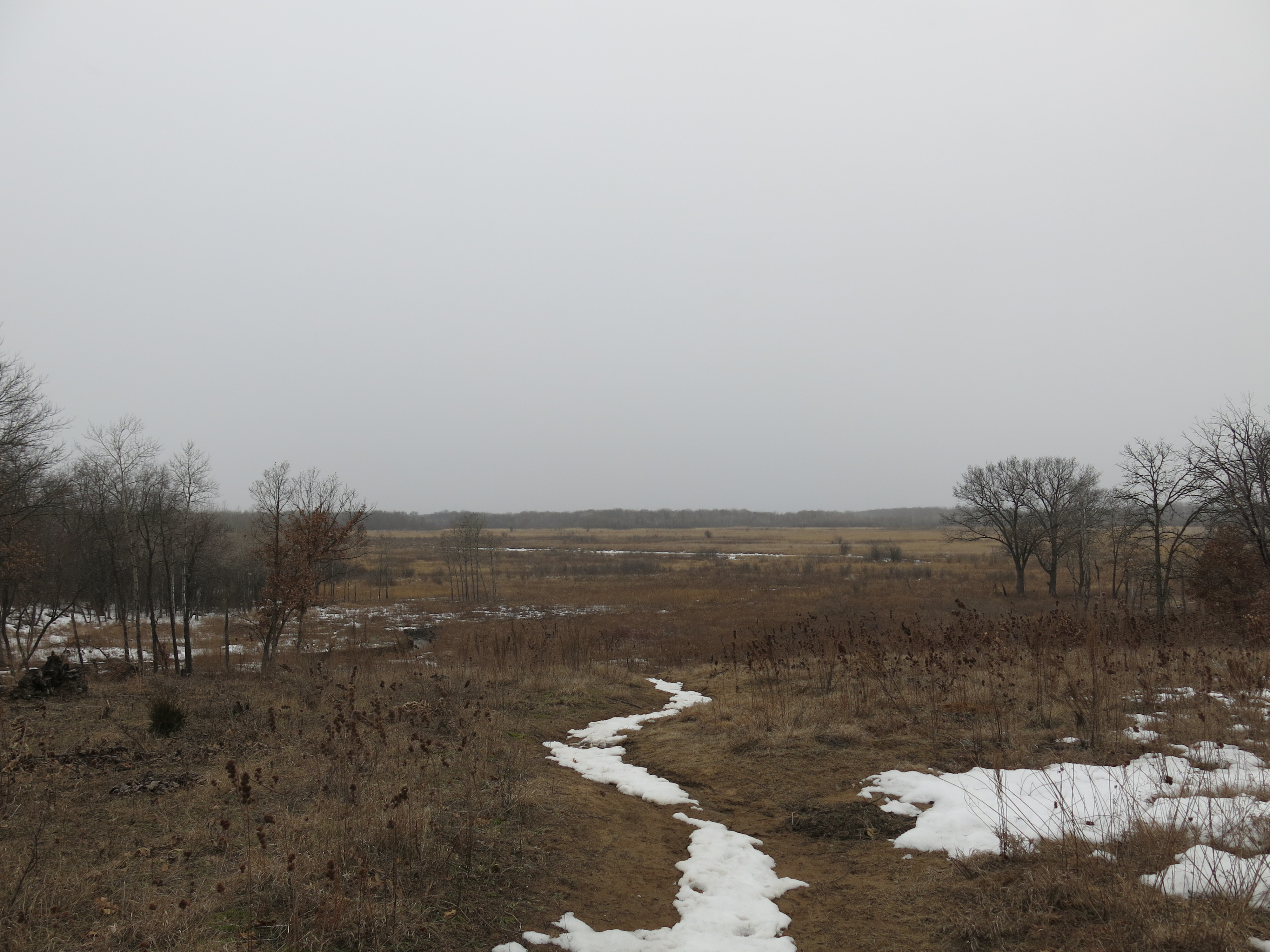
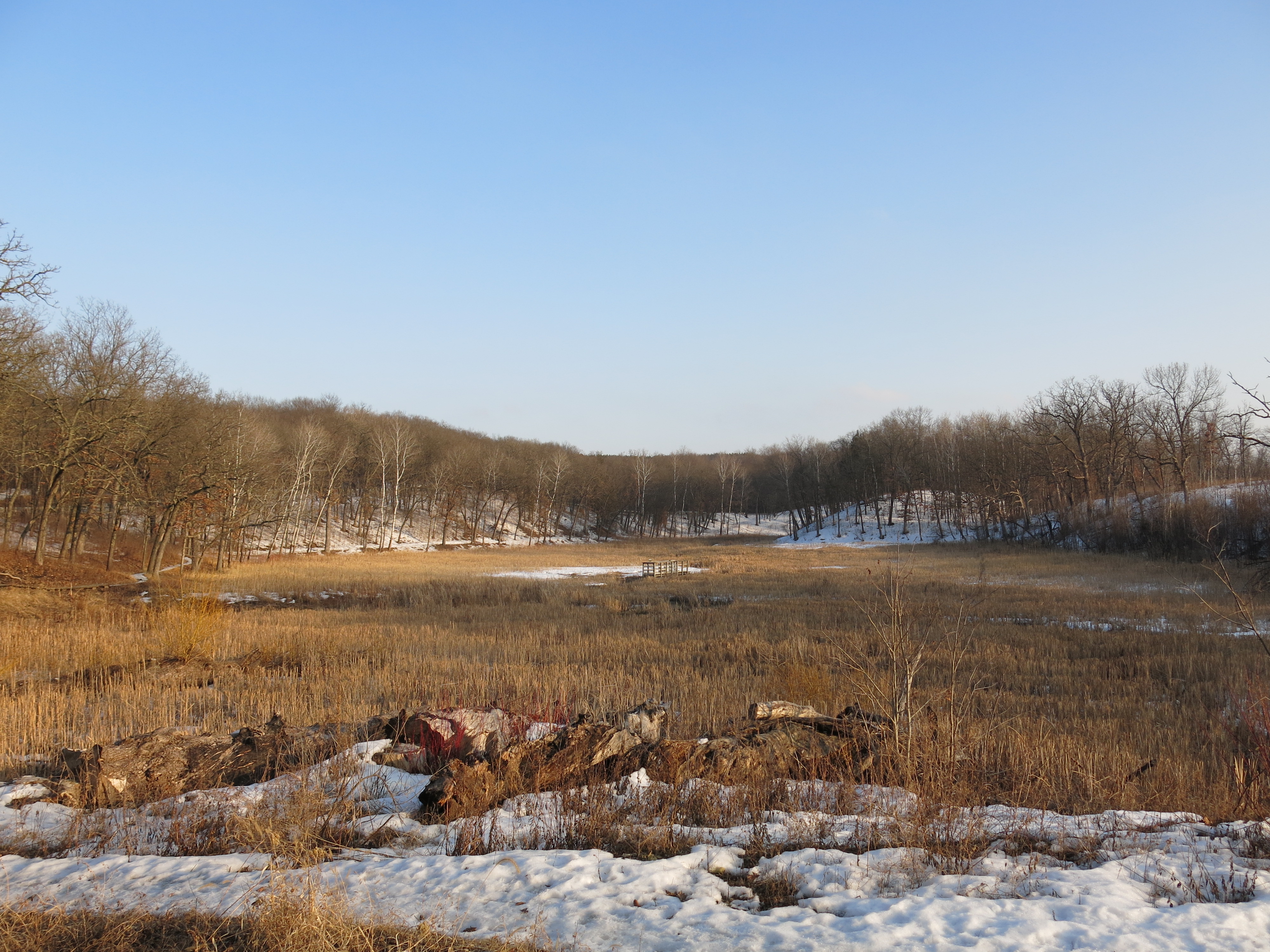
When I emerged into this view of the prairie, I was stopped in my tracks by how quiet it was. I’ve been so busy at The Springs — I haven’t taken as much time as I should to look and listen.
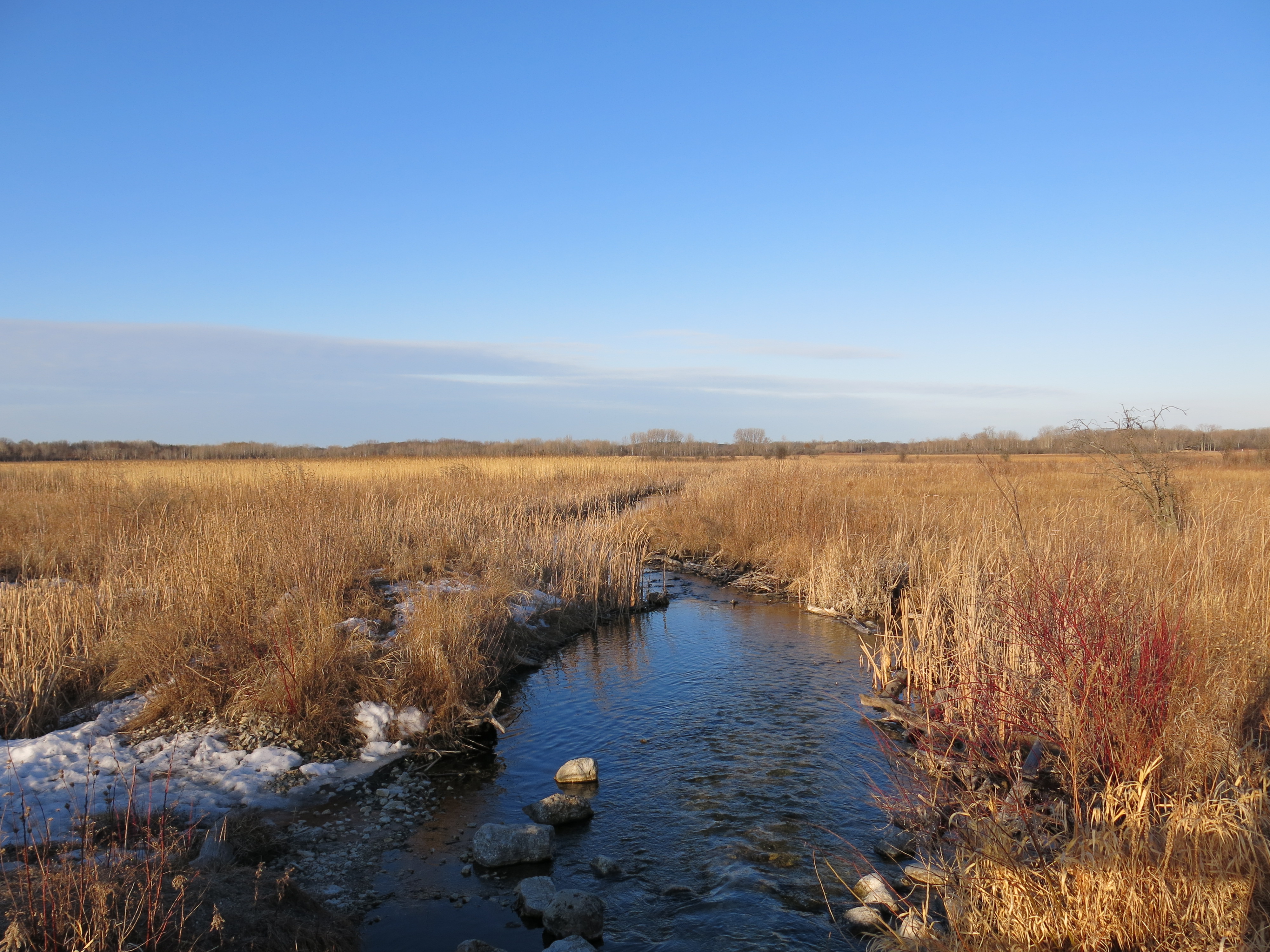
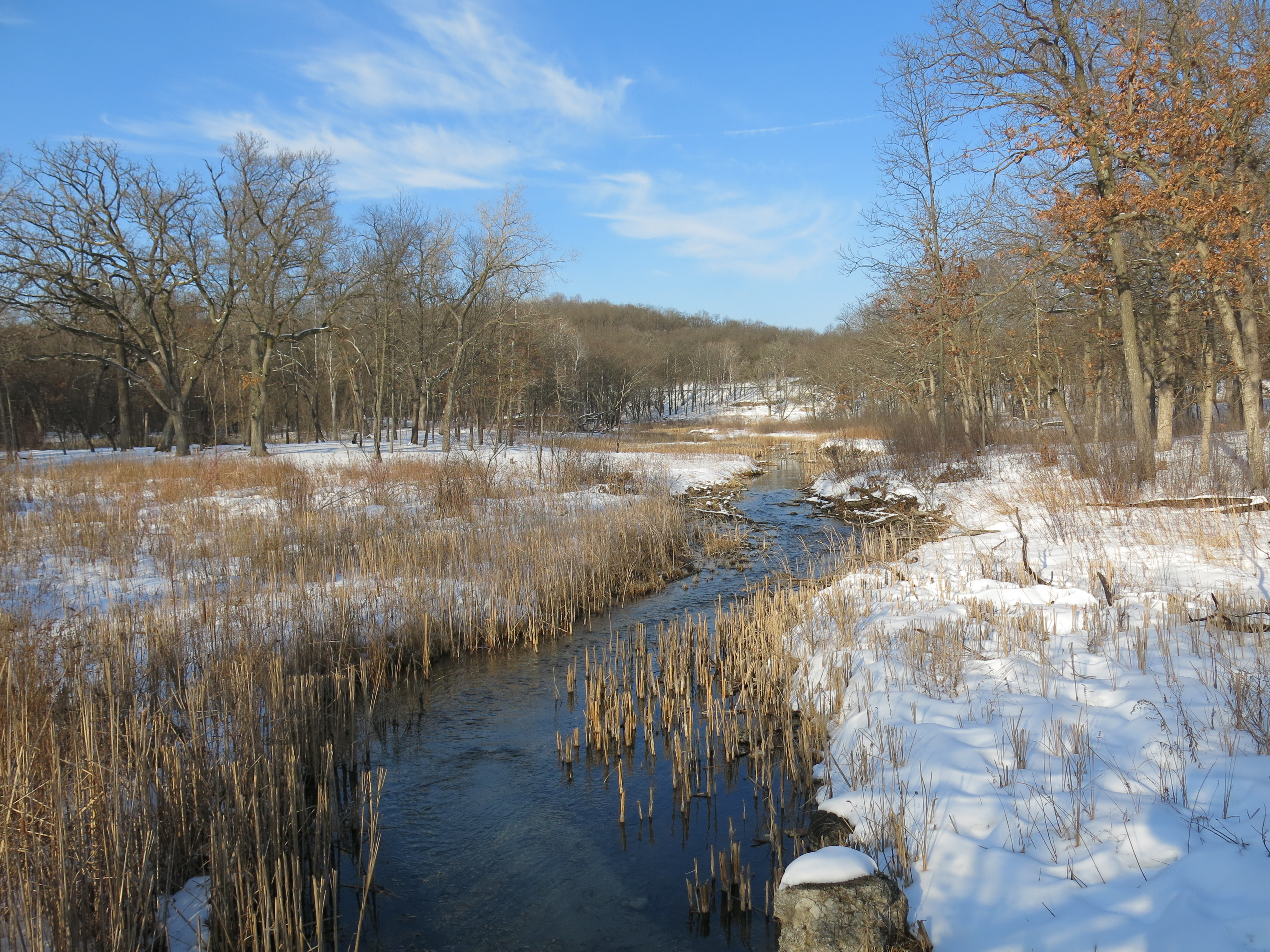
Here is the view from the Marl Pit bridge, where I stopped to listen to the river.
The view from the gaging station bridge.
The Indian Campground.
The Indian Spring channel.
The Scuppernong Spring.
The Hillside Springs.
The Hidden Spring.
This one doesn’t have a name. How about the Robin’s Spring?
I left The Springs early and bought a new Red Dragon torch on the way to the Hartland Marsh, where I picked up a load of seasoned buckthorn for the party this weekend and spent the rest of the day wandering.
If you are, or want to become, a SuperFriend♥ of The Springs, or you just love The Springs, or you just want to help the Buckthorn Man celebrate his birthday, then come to our open house in Milwaukee on February 16th from 2-8:00pm. If you have not already received an invite via email and want to come, please contact me! Pati is going to make some crazy good food and we’ll have beer and wine and a roaring buckthorn fire outside on the patio. We hope to see you on the 16th!










































































 Scuppernong Springs Nature Trail