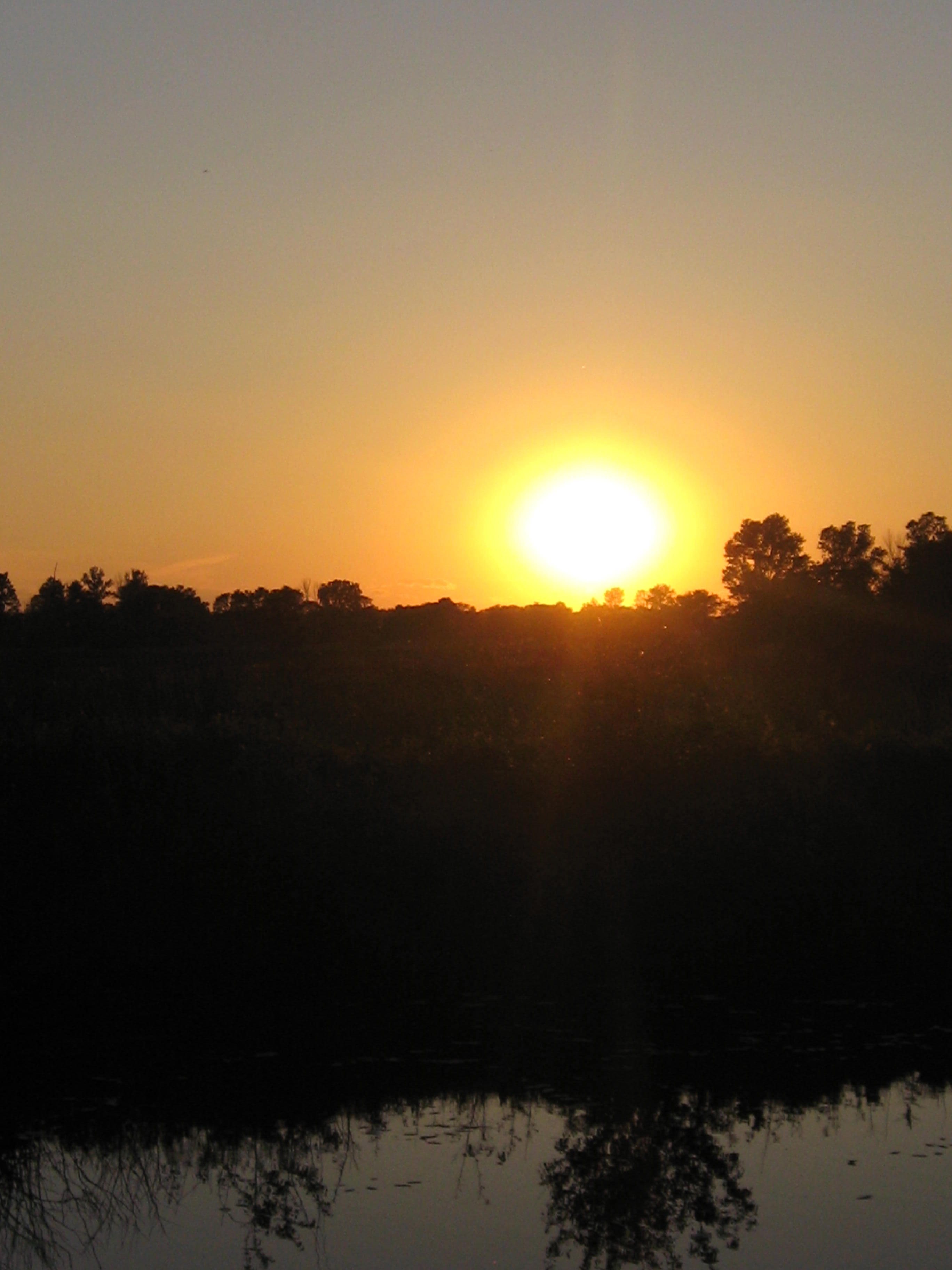
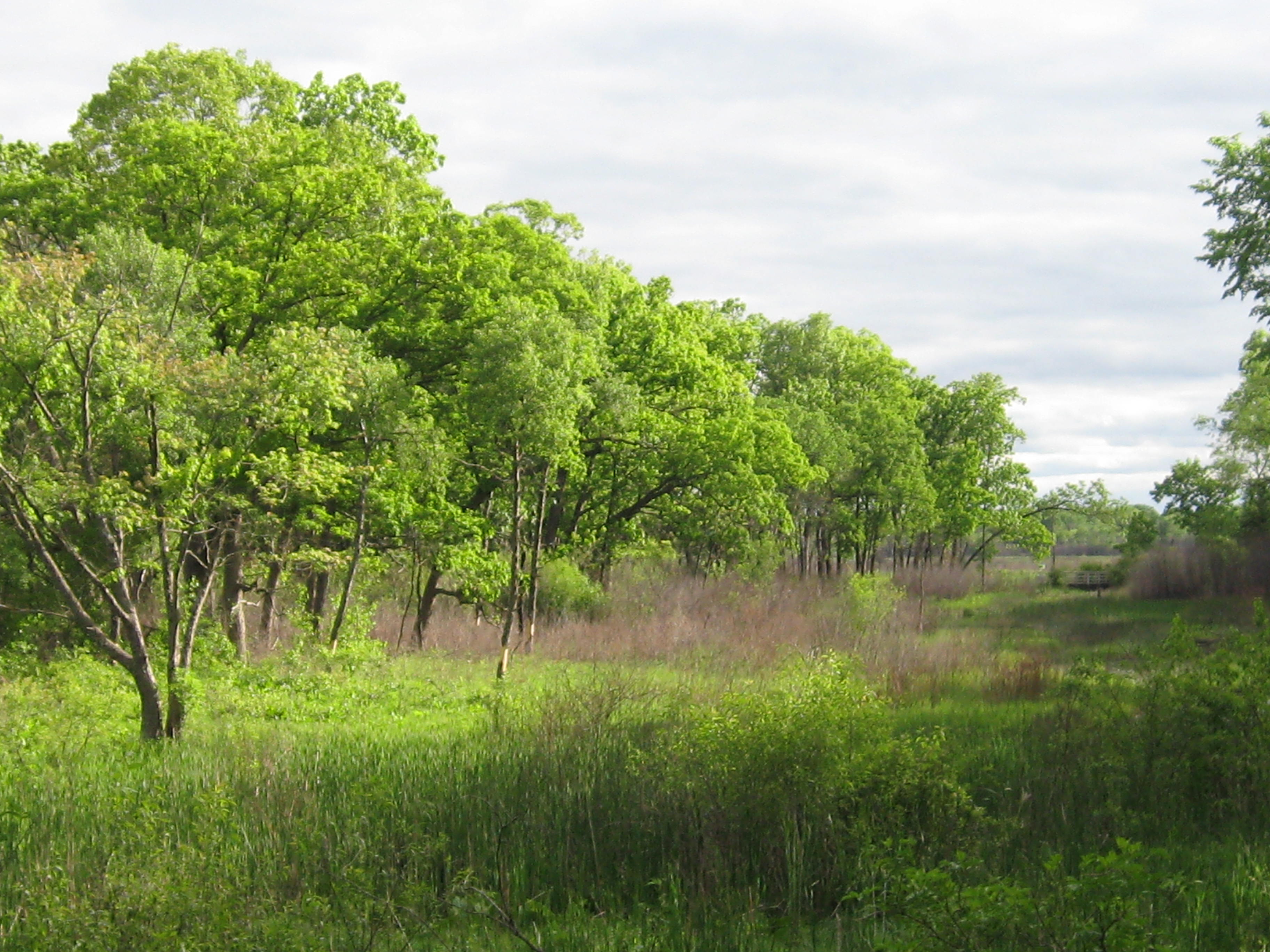
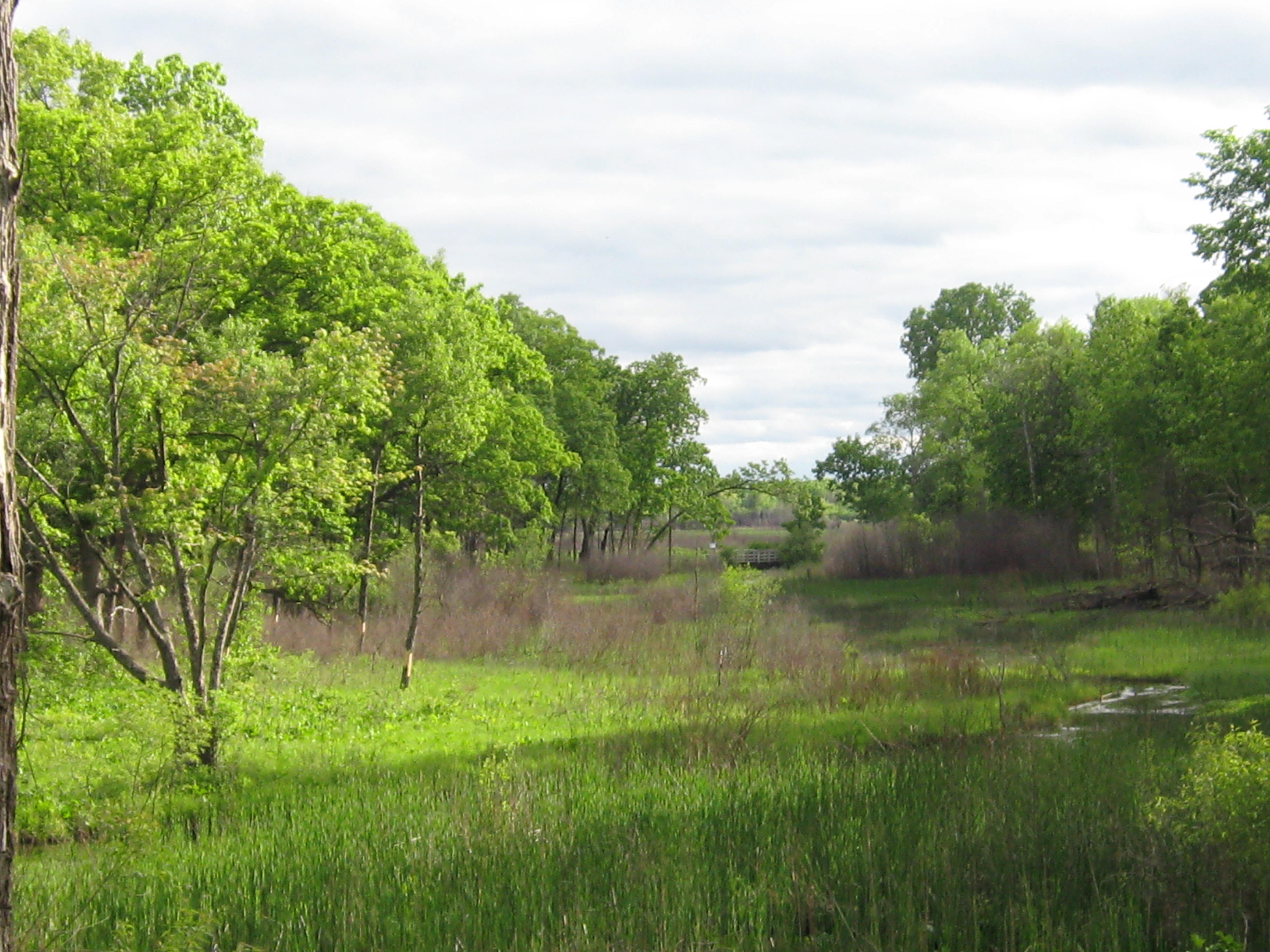
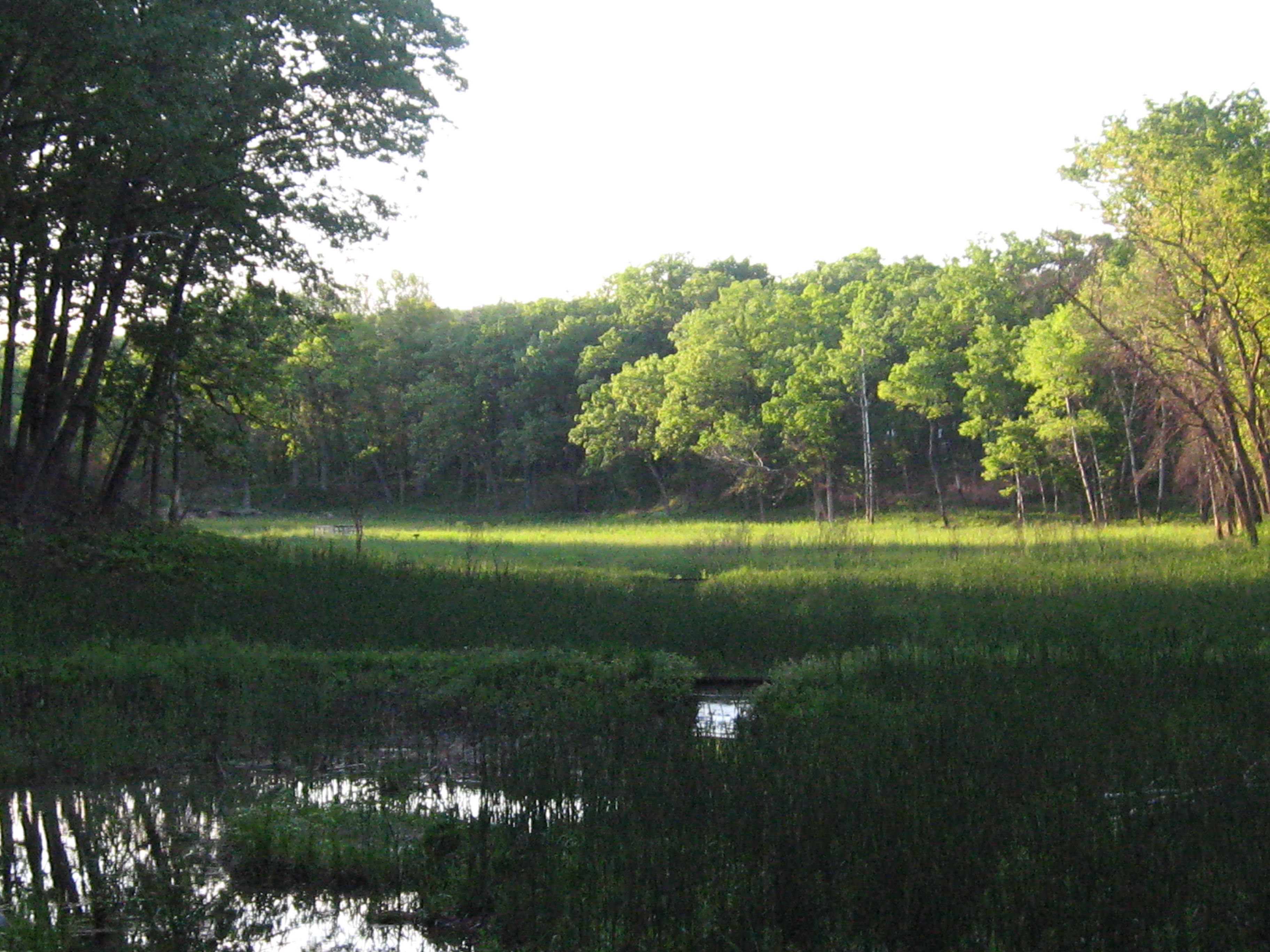
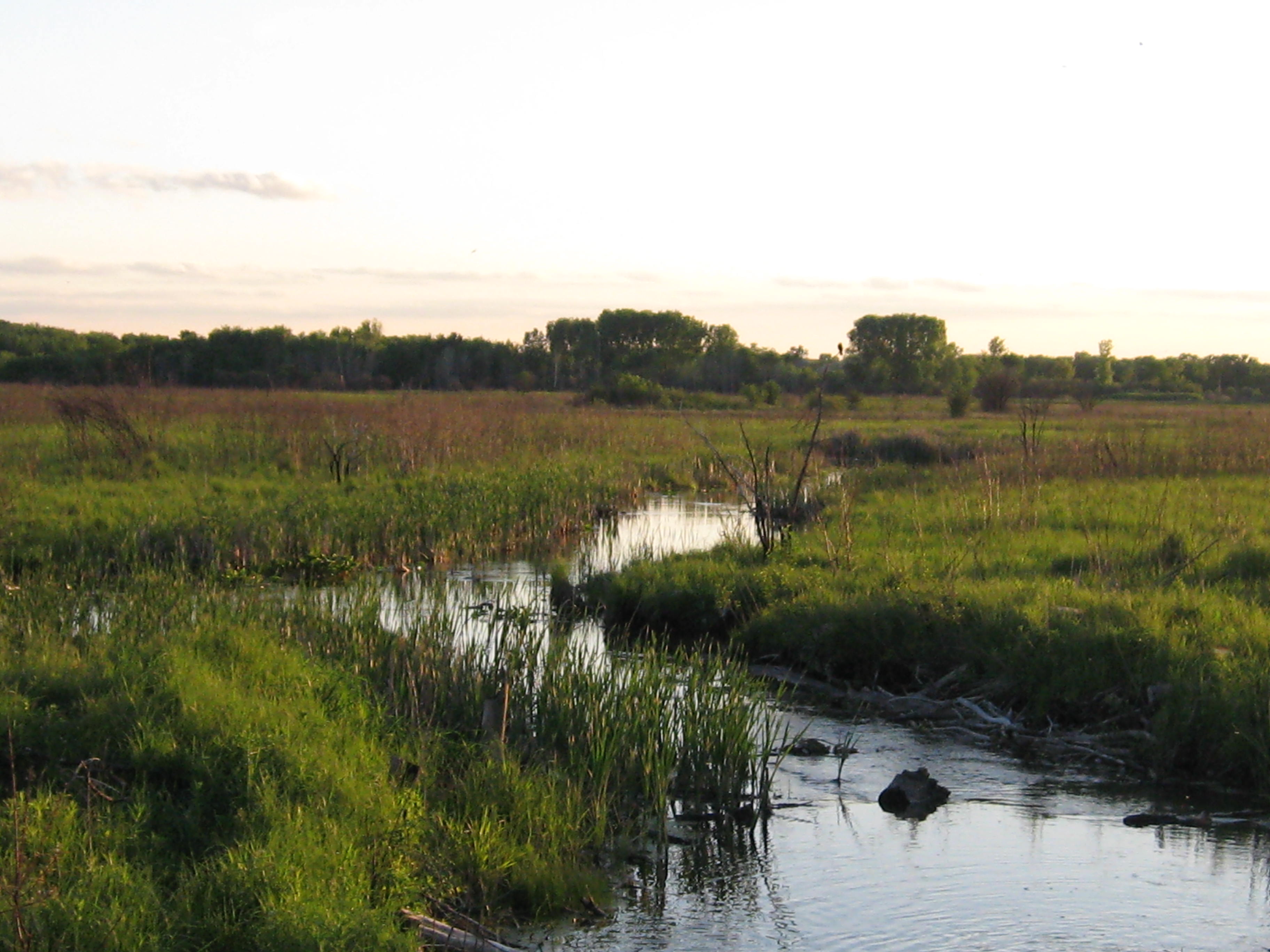
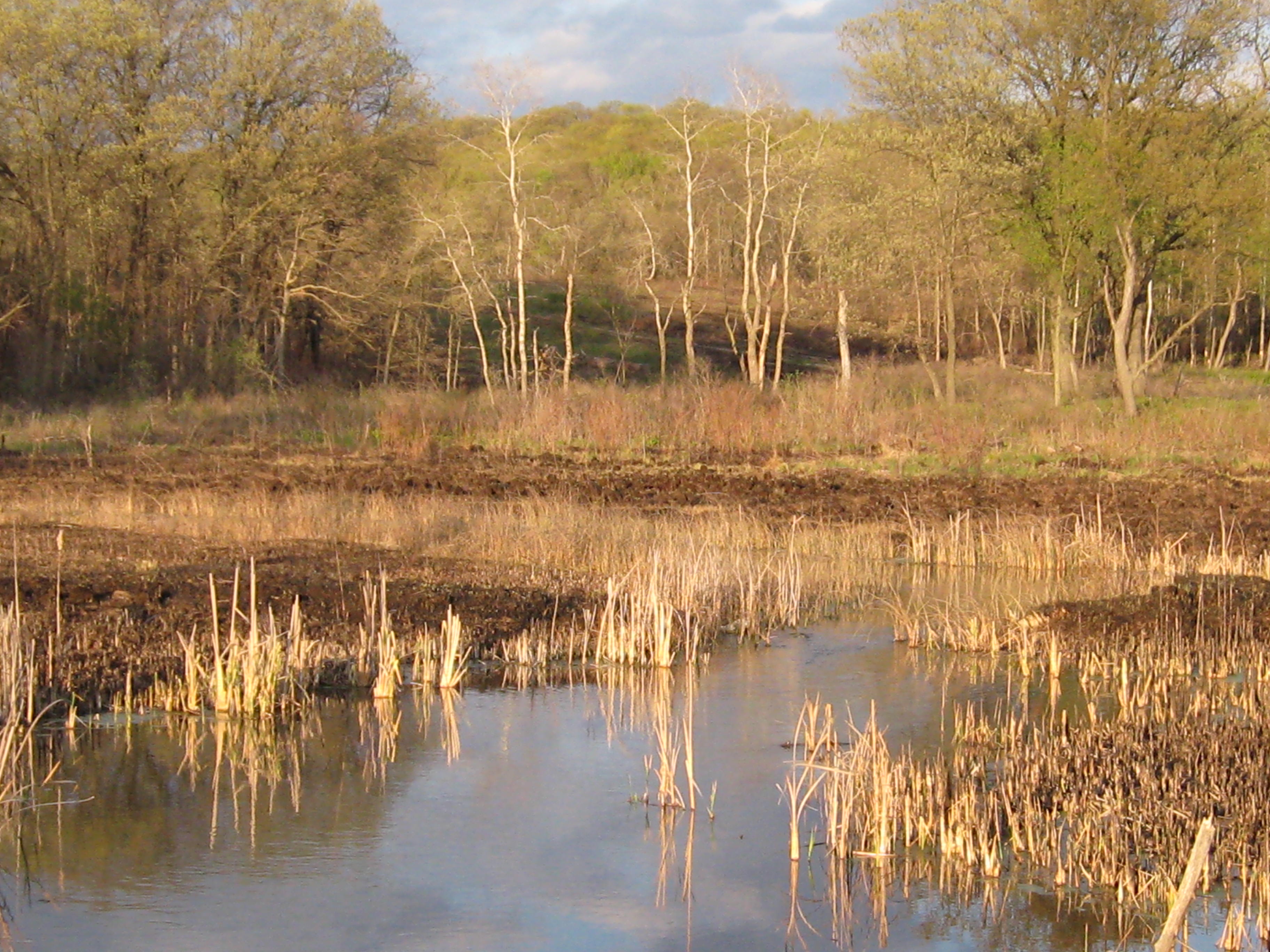
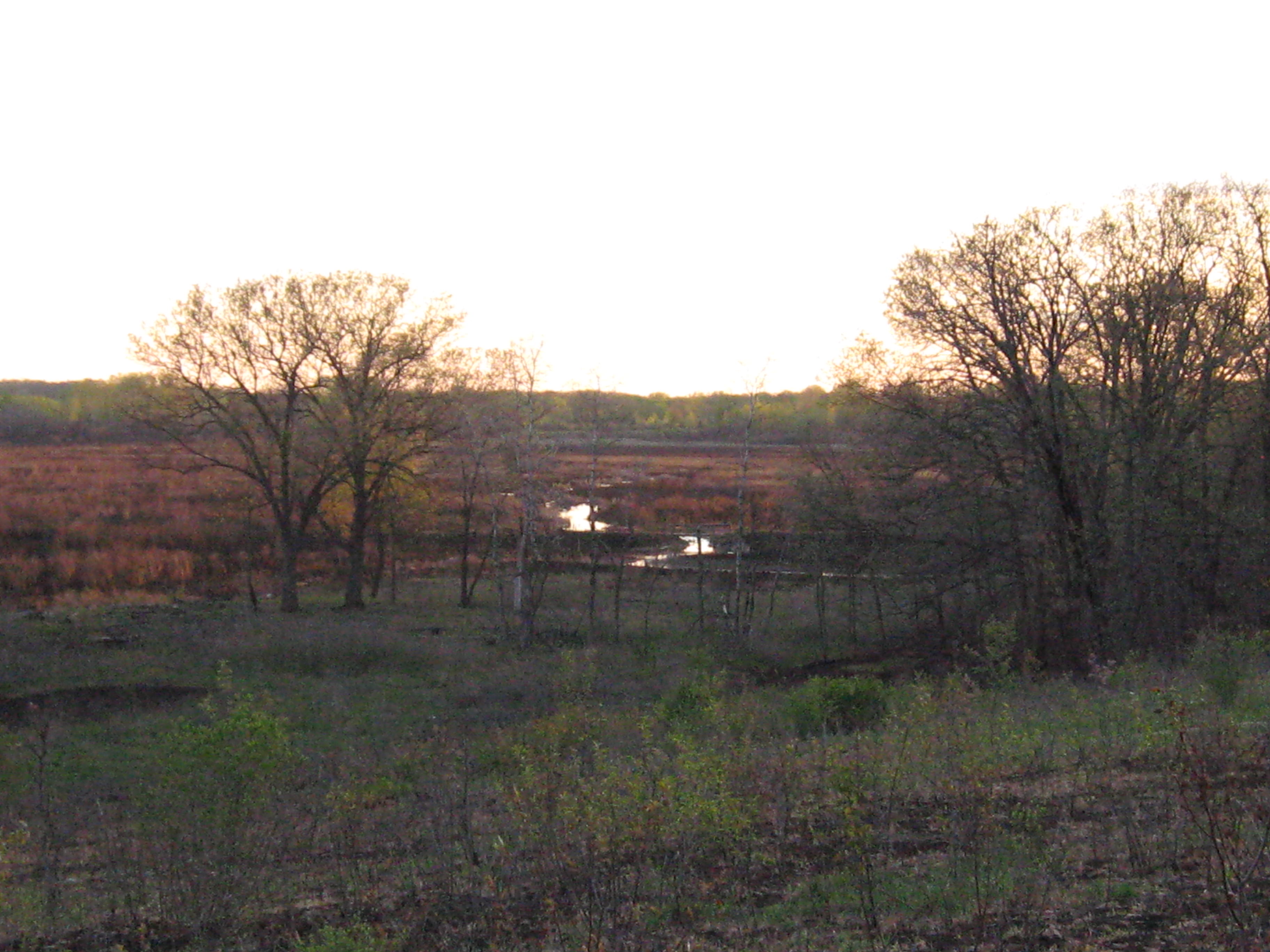
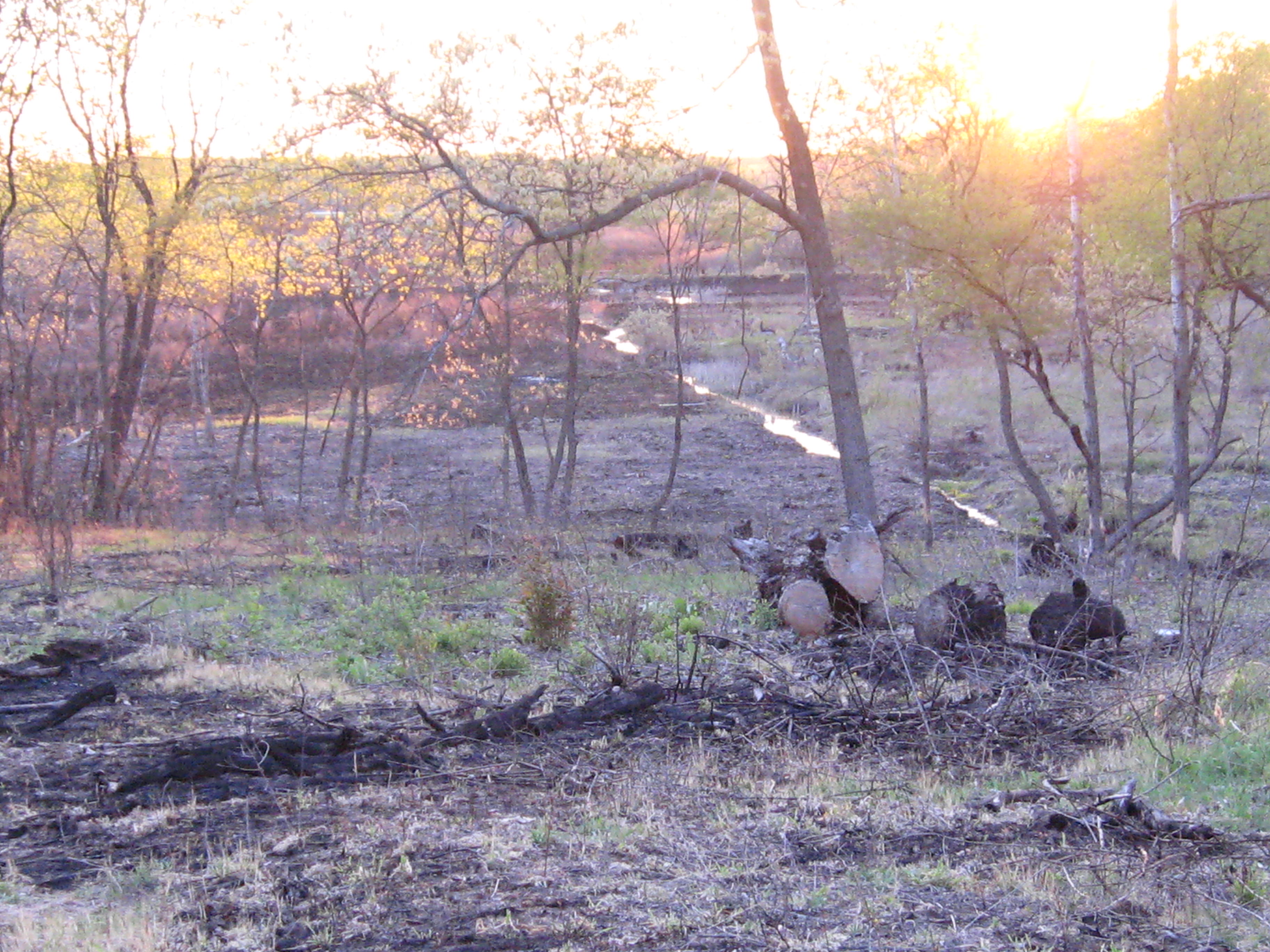
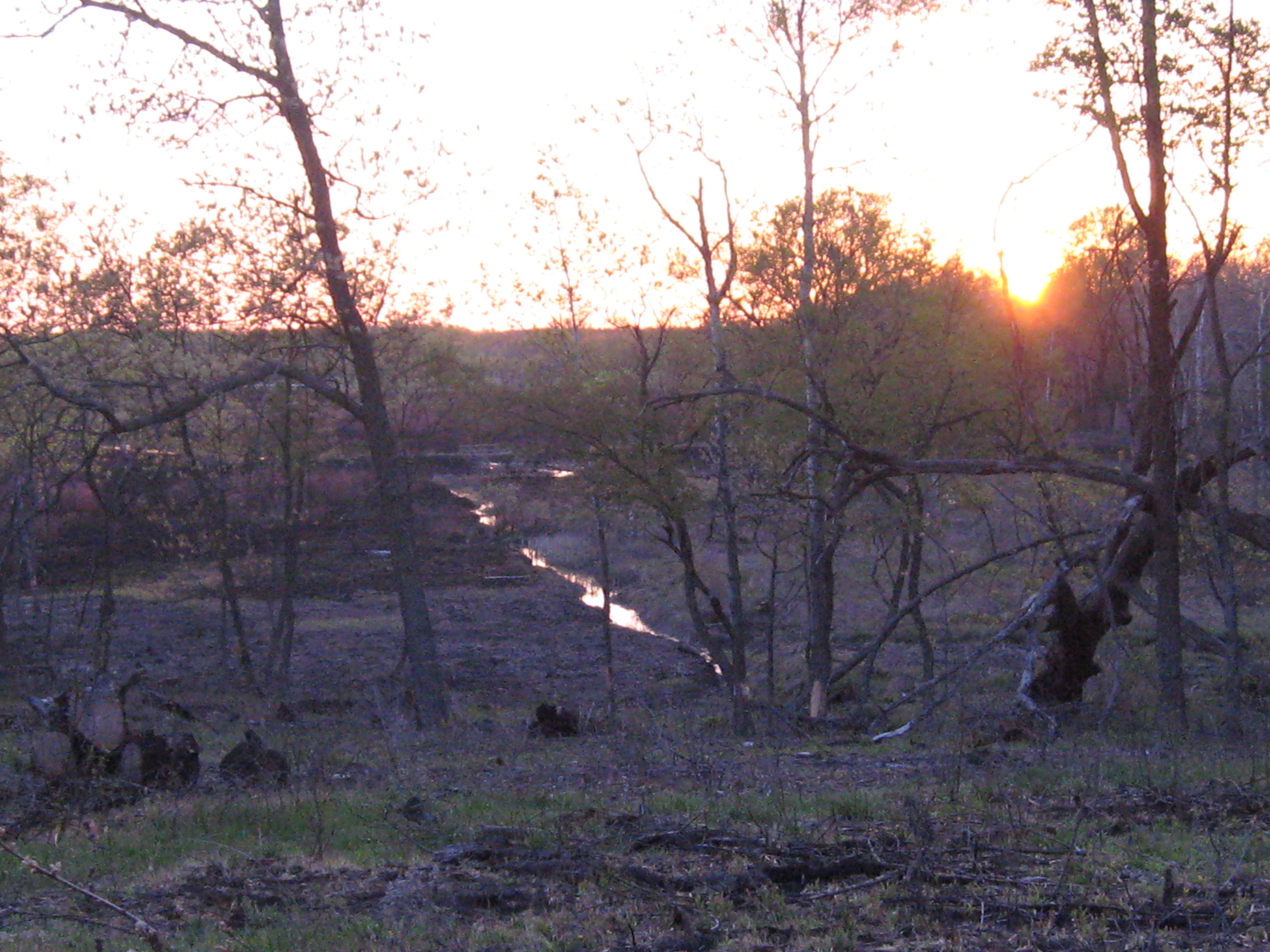
You have to walk a ways down south along the marl pit canal to get a good angle on the sun as it sets farther and farther north on the horizon. The rate of change in the amount of daylight increases as we approach the summer solstice and it is dramatically evident in the big sky country at The Springs. The trees, grasses, flowers and weeds, have responded luxuriantly to the sun and rain and the land is vibrant with myriad shades of lush greens. The Burn back on May 6th was definitely the highlight; a dramatically pivotal punctuation to Spring, 2013.
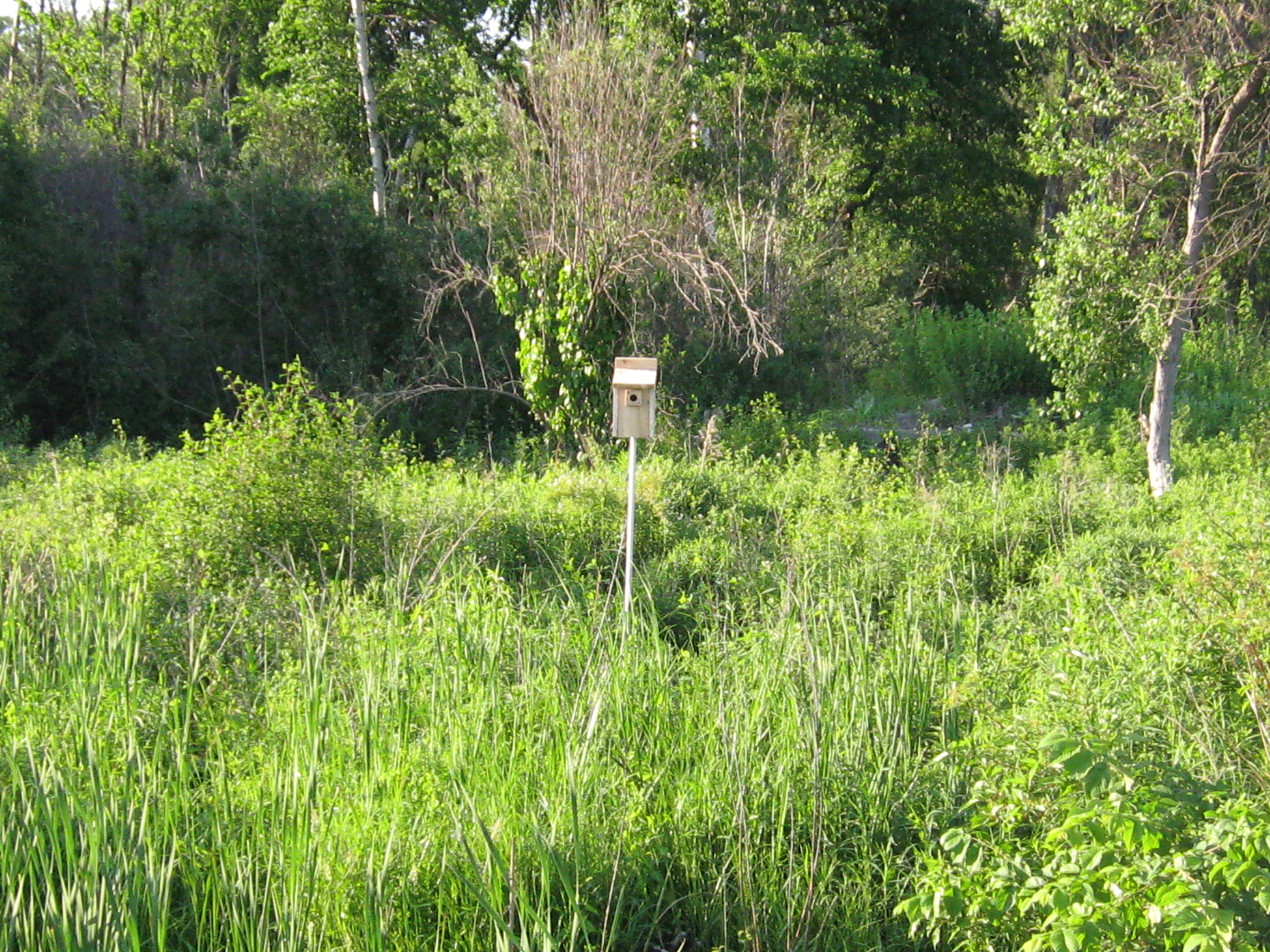
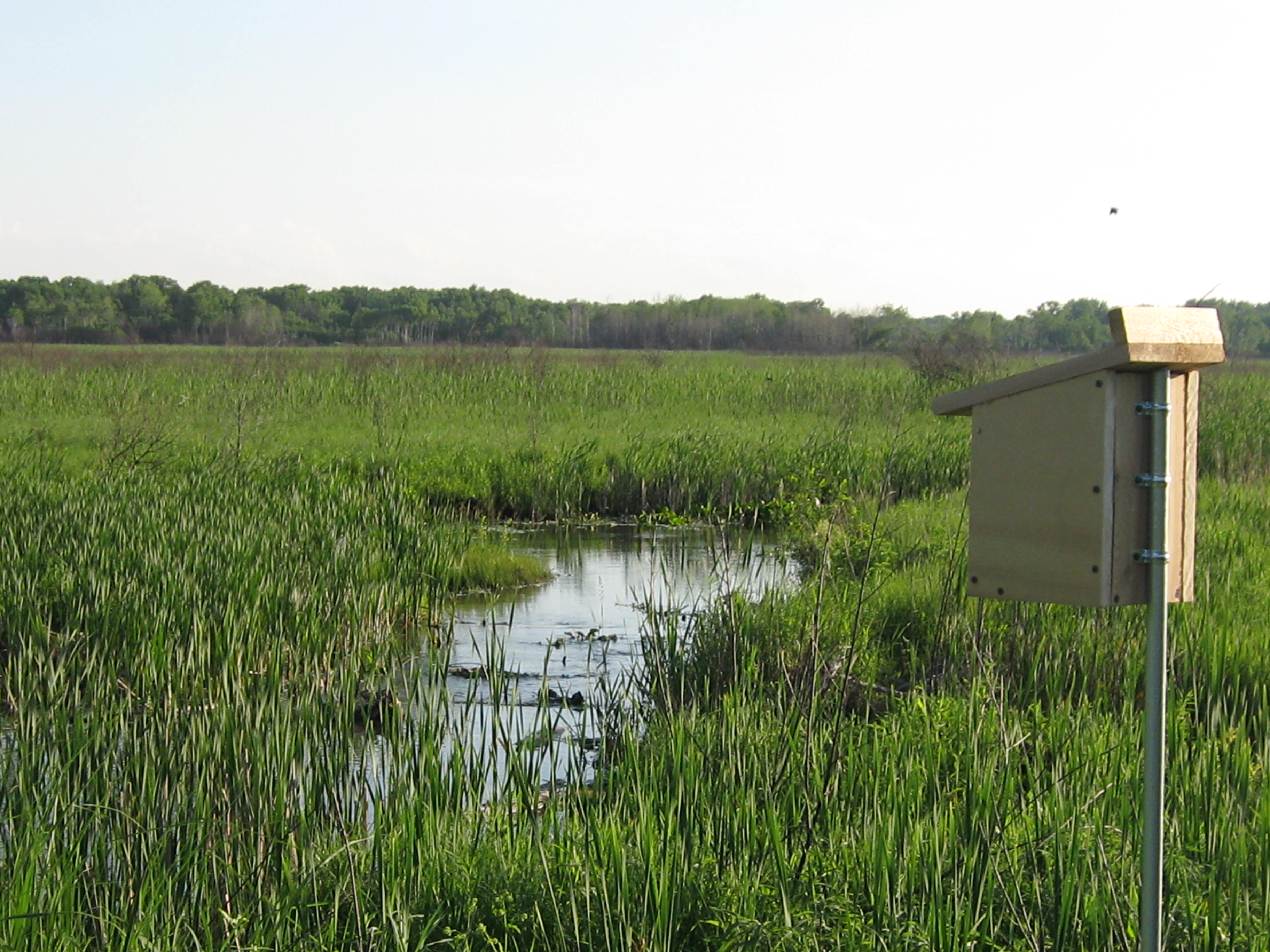
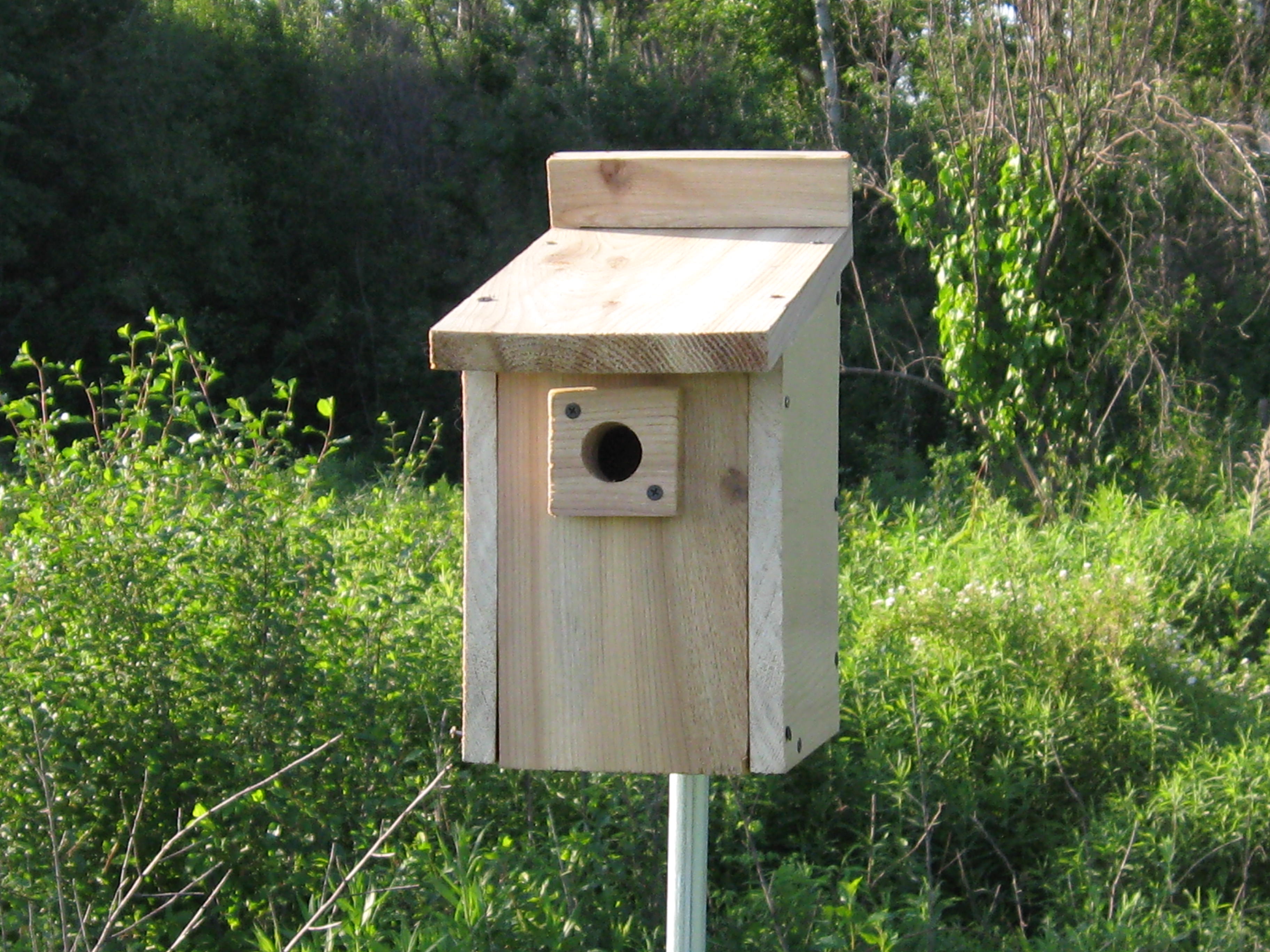
The Scuppernong Springs are a “world class site”, per former DNR Naturalist Ron Kurowski, and getting more and more well deserved love and attention these days. Spring Lover, Jon Bradley recently erected this beautiful, custom built, tree swallow house near the marl pit bridge.
Thanks Jon! It should be occupied in no time.
Amanda, Melanie and their crew of volunteers continued to install the new interpretive signs that Don Dane made. They look pretty darn good!
I was out at The Springs yesterday and sprayed some spotted knapweed on the Sauk Campground and some garlic mustard, creeping charlie and burdock between the old hotel and barn sites. “What is a weed? A Plant whose virtues have not yet been discovered.” — Ralph Waldo Emerson (more good weed quotes here). Rich Csavoy taught me another weed, white cockle, which is in full bloom on the Sauk Campground. Reed Canarygrass is already going to seed amongst the many springs in the river valley. Isn’t it ironic that Cannabis Sativa, one of the most versatile plants on earth, goes by the nickname “weed”?
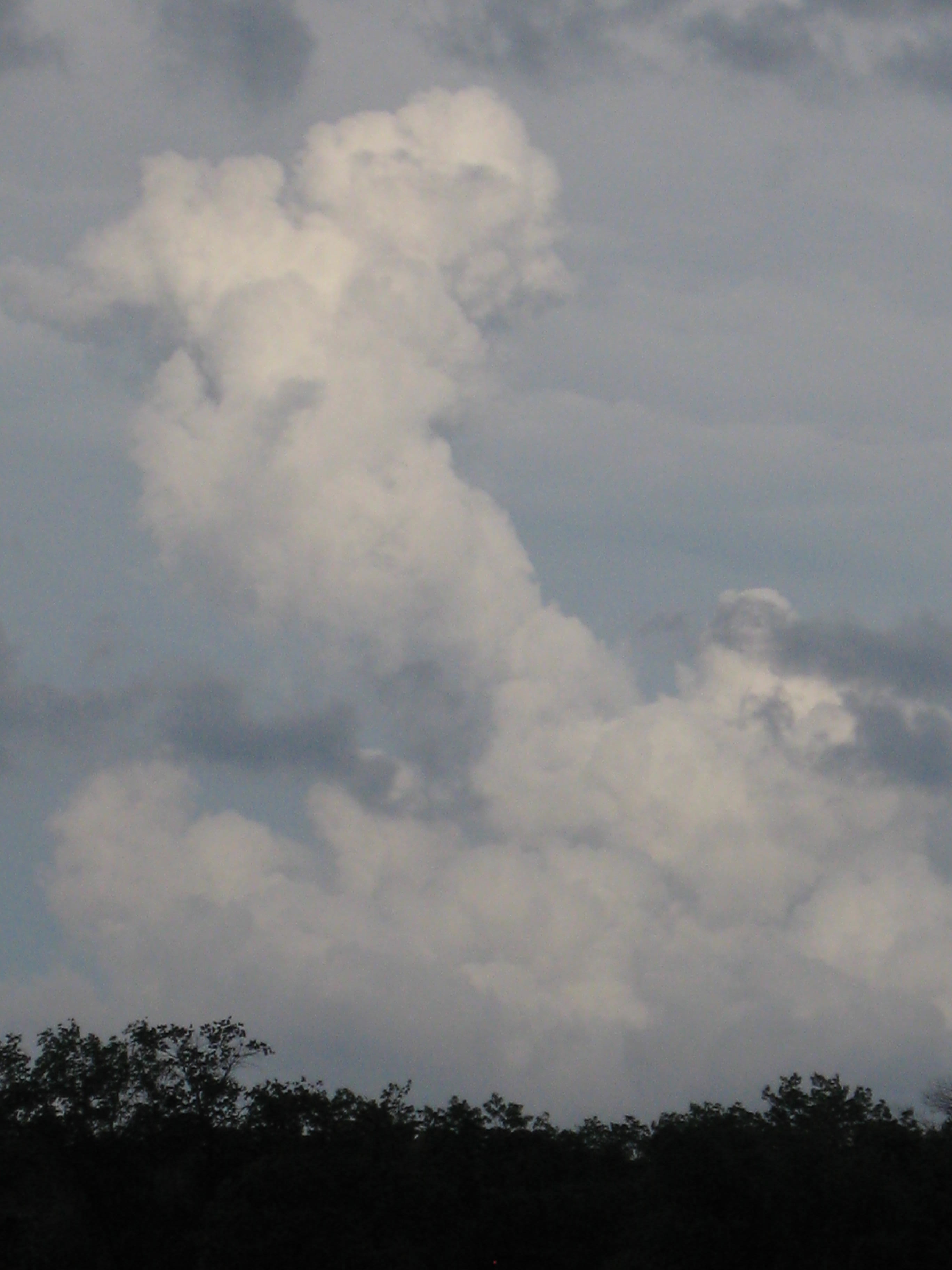
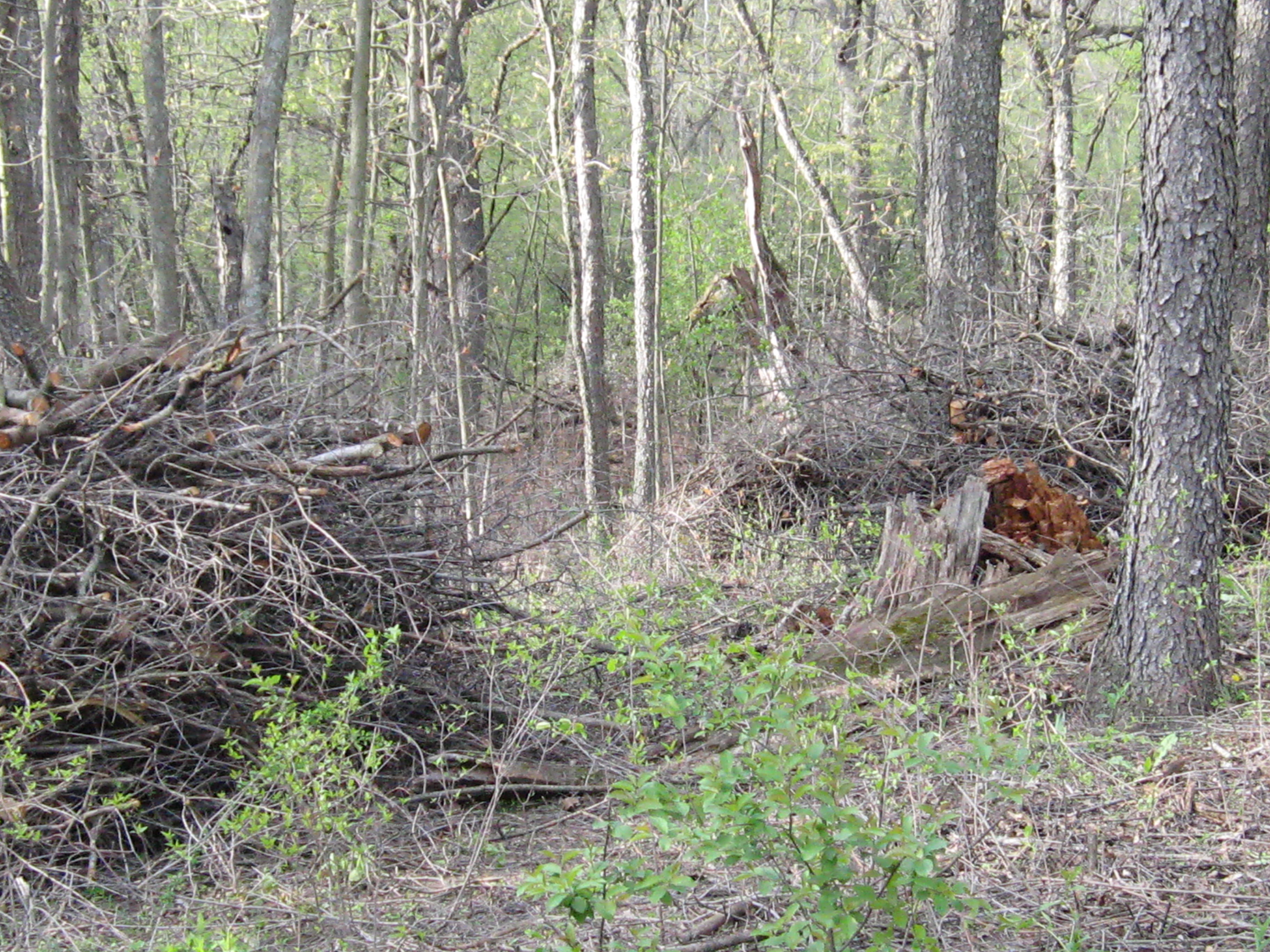
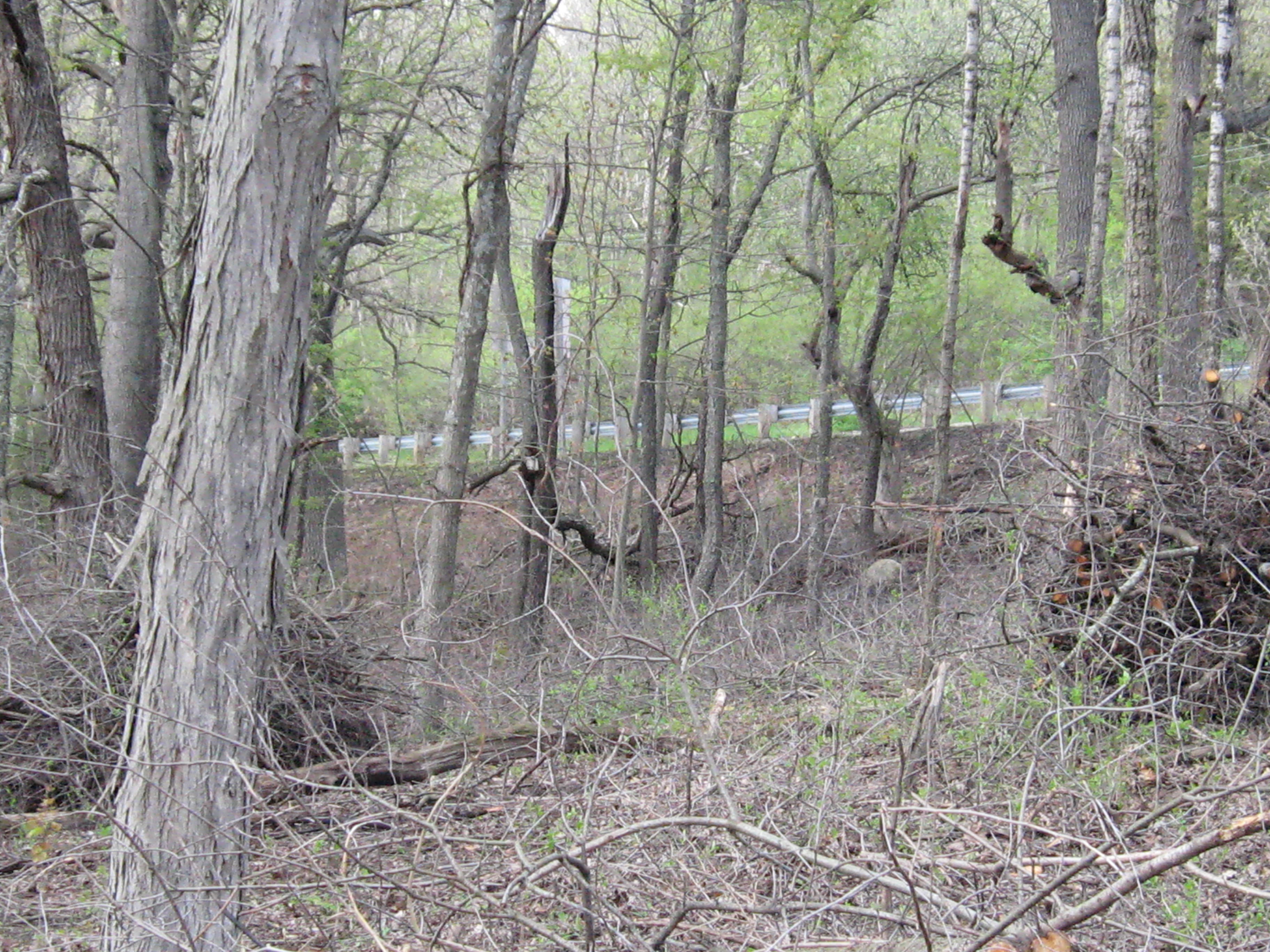
It was a beautiful afternoon with a refreshing north breeze, deep blue skies and cauliflower clouds sailing by. I cut a curtain of buckthorn and prickly ash between the cut-off trail and the river on a little peninsula where Carl Baumann took some serious cuts last winter. Here is how it looked when I got there.
Five hours later…
A view from the gaging station bridge.
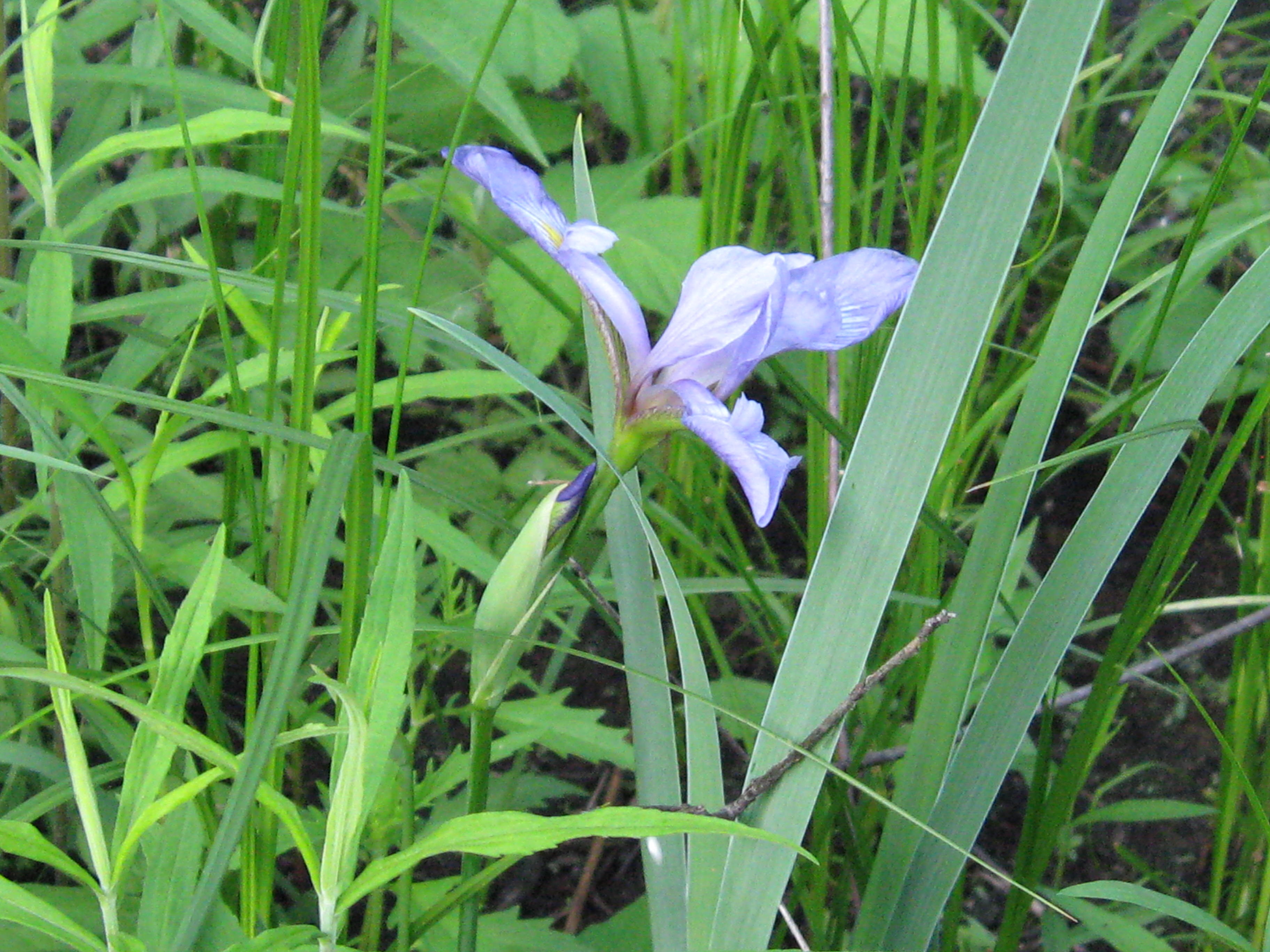
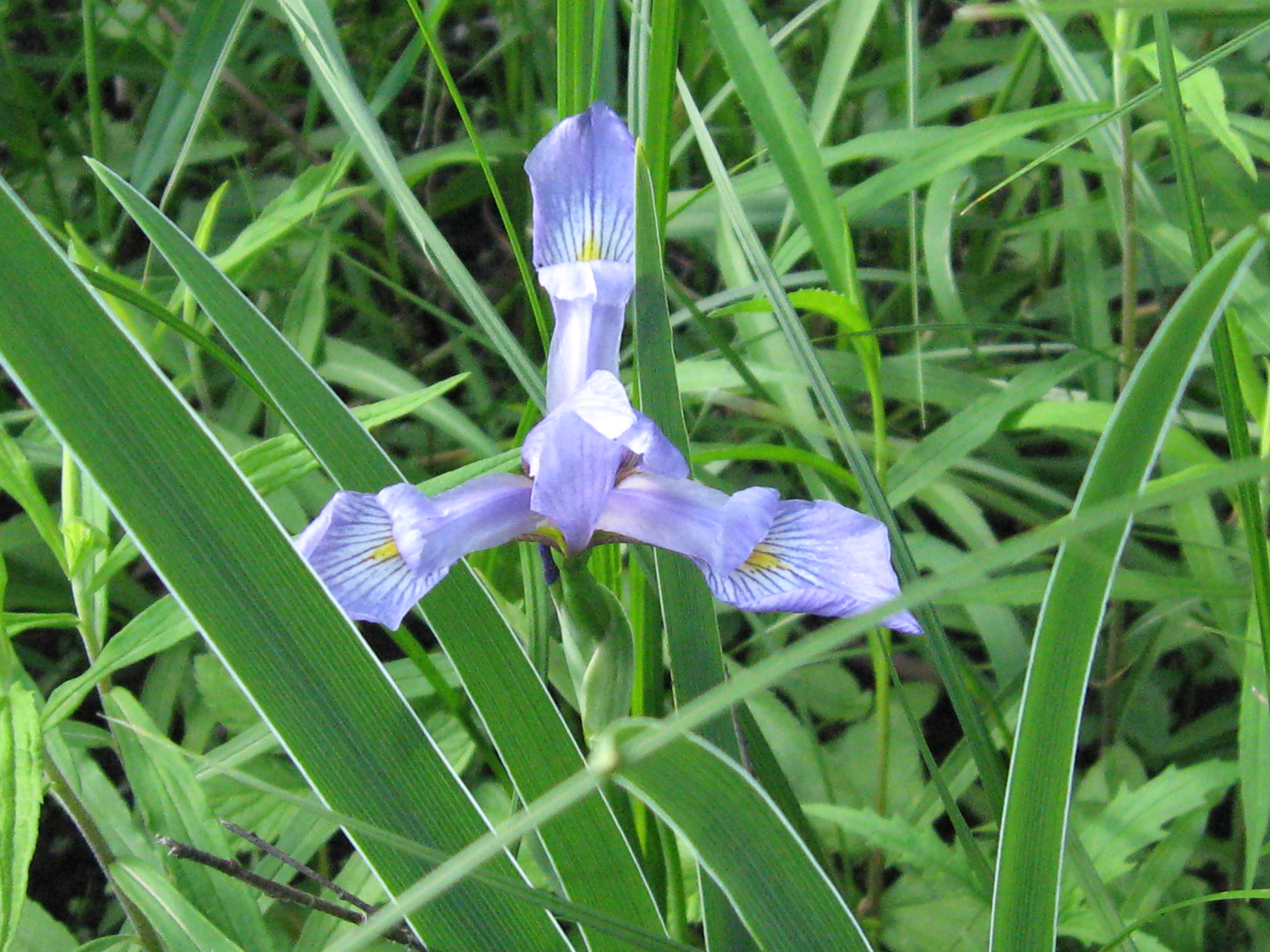
I saved a couple of wild plum trees amongst the buckthorn and found a patch of blue flag irises.
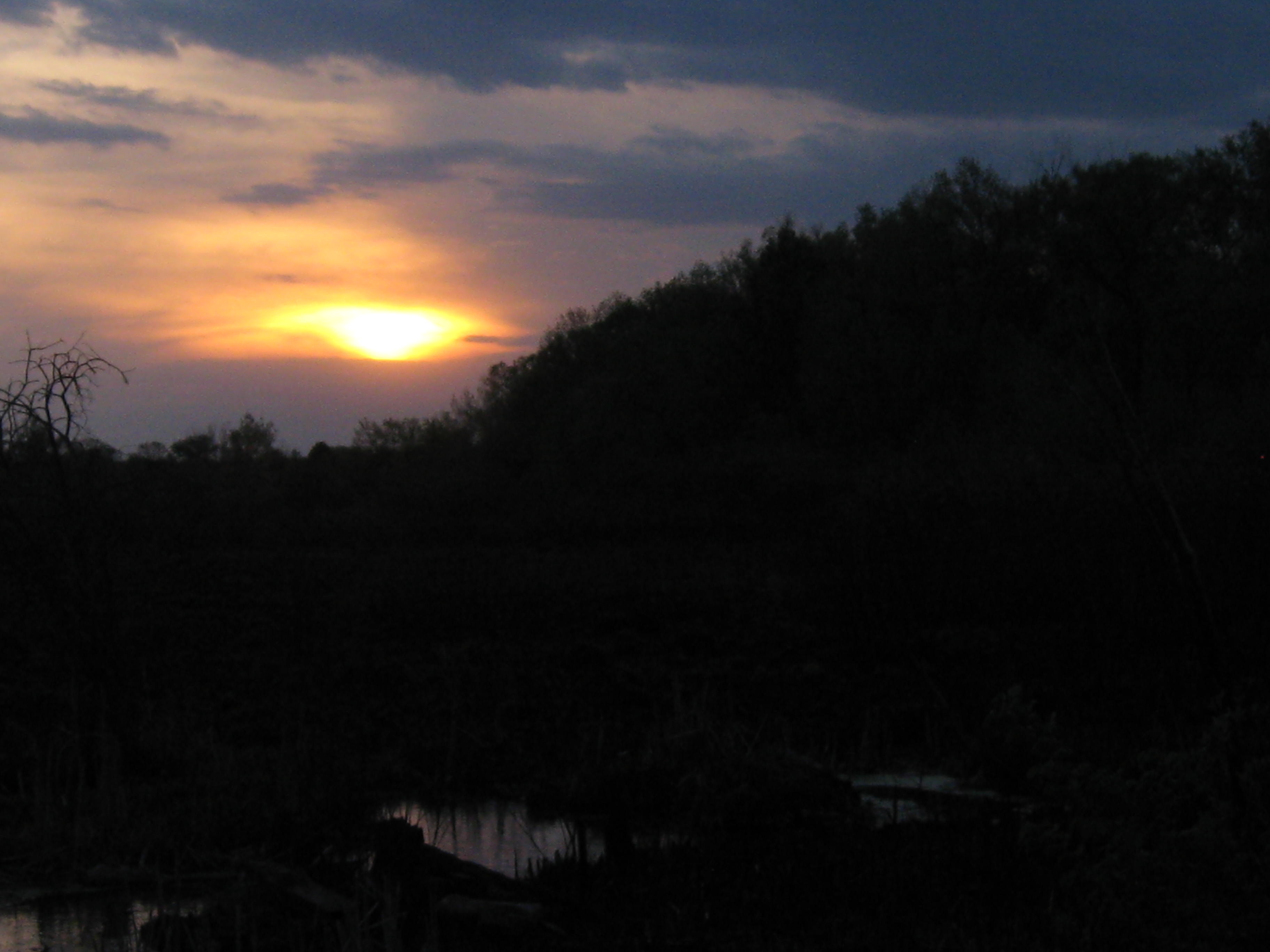
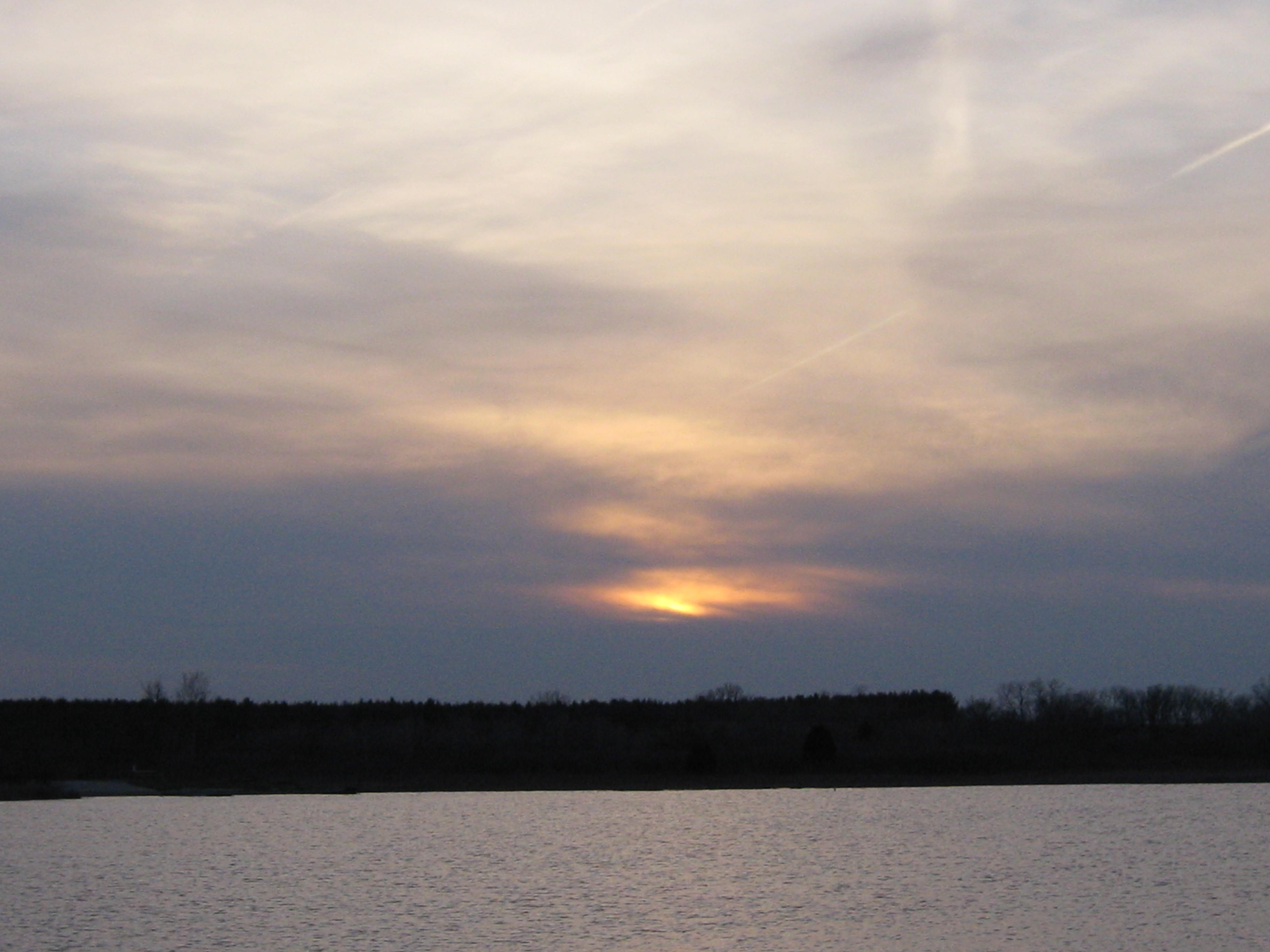
I did some serious relaxing at the marl pit bridge in the evening and wandered down the canal a bit to get these shots of the sunset.
“I’m more ‘here’ when I’m here, partly because I’ve learned more about the river.”, that is how Milton Bates described his deepening present moment awareness in his fantastic book, The Bark River Chronicles. We drew inspiration from Mr. Bates to embark on our own Journey Down The Scuppernong River, and it has been a wonderful, enriching and, unfortunately, a bit disturbing, learning experience. From the pristine headwaters at the Scuppernong River Nature Trail to the final, completely degraded, drainage ditch, that passes through the mud farms west of Hwy 106, the journey has taught us a lot about natural history and the impact of white settlers with their insatiable, often short-sighted, desire to convert natural resources into money — which continues to this day.
On our journey downstream we tried to document all of the tributaries and water sources that feed the Scuppernong River but we missed one of the most significant; the South Branch of the Scuppernong River. I remember now exactly when we encountered it on the second leg of your journey, as we approached an abandoned farm just east of Hwy Z, and I assumed at the time that it was just an irrigation canal.
I even mentioned in a previous post the brook trout that were released into the south branch, but it did not register:
Waukesha SOUTH BRANCH SCUPPERNONG RIVER BROOK TROUT 83
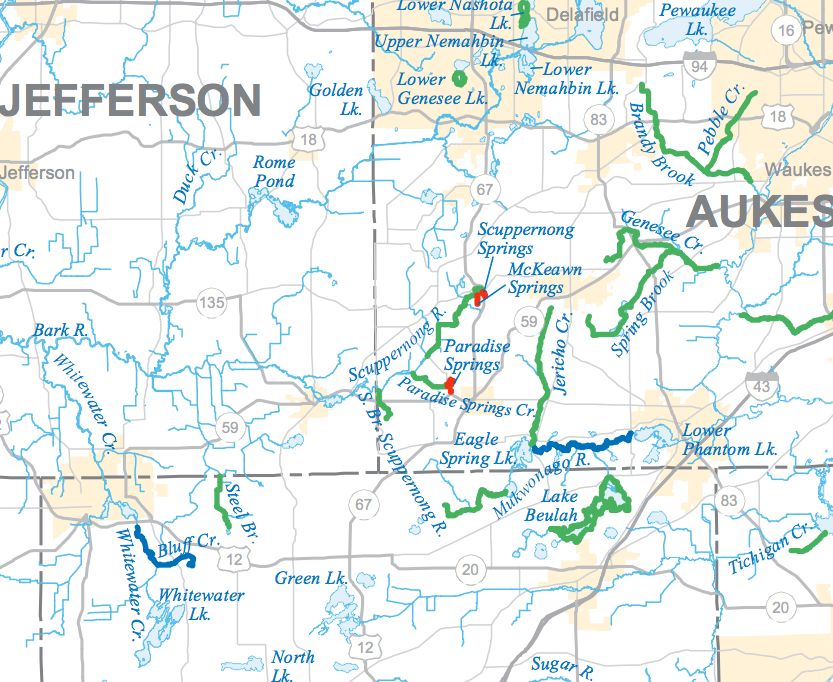
John and Sue Hrobar visit The Springs often, and we discuss, fish, flowers and the pros and cons of intervening to attempt to restore native habitats. Lately, our discussions have focused on what has happened to the brook trout in the stretch of river near the headwaters since we have begun clearing the springs and river. John concludes, because we don’t see trout in the river like we used to, that our efforts have disturbed a critical balance making the river unsuitable for trout. The major change being the removal of water cress, which was literally damming the river and causing it to overflow its banks, but which may have been providing the habitat for bugs and insects on which the trout depend. He suspects that our clearing of all the feeder springs has not increased the flow of water and has only released more mud and sediment into the river. I respect John’s ideas and I’m trying to understand what is going on with the fish. What is good trout habitat and what should a healthy, natural, spring-fed river look like? Here is what the WDNR considers suitable habitat for trout fishing on the Scuppernong River and its tributaries.
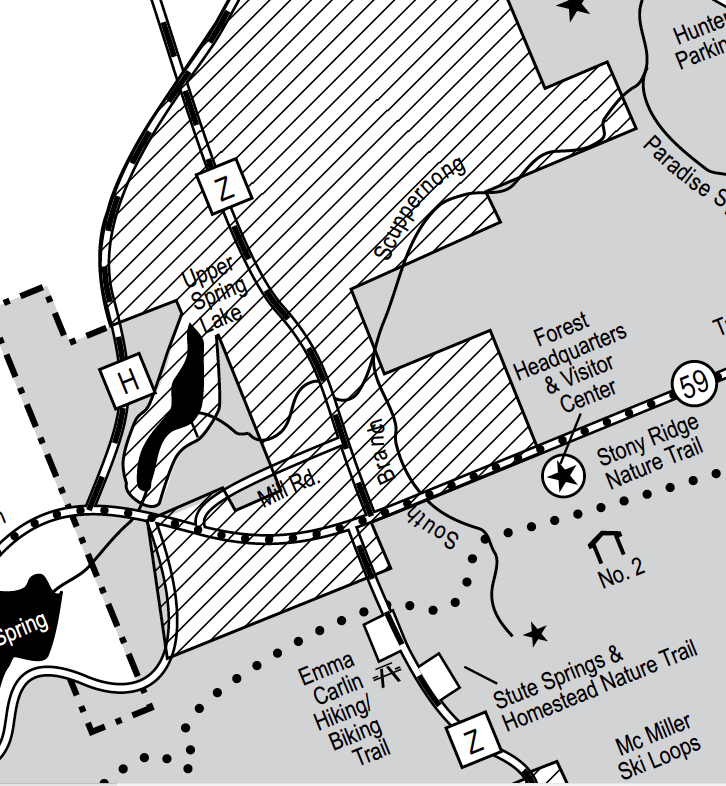
John and Sue enlightened me as to the existence of the South Branch of the Scuppernong River and I really appreciate that. The source is the Stute Springs, just south of forest headquarters. You can follow its course north and west by zooming into this map:
It was really peaceful yesterday morning when I arrived at The Springs and encountered this wind blown cherry tree blocking my access to the parking area at the terminus of a DNR, 2-track, access road at the south end of the trail.
Coincidentally, this happened to be an area where some black locust stumps where protruding in the road and I shaved these as well as removed the downed tree. I continued spraying first year garlic mustard seedlings on the south end of the loop trail using a 2.34% solution of glyphosate and then proceeded to the north side of the scuppernong river to girdle some aspen.
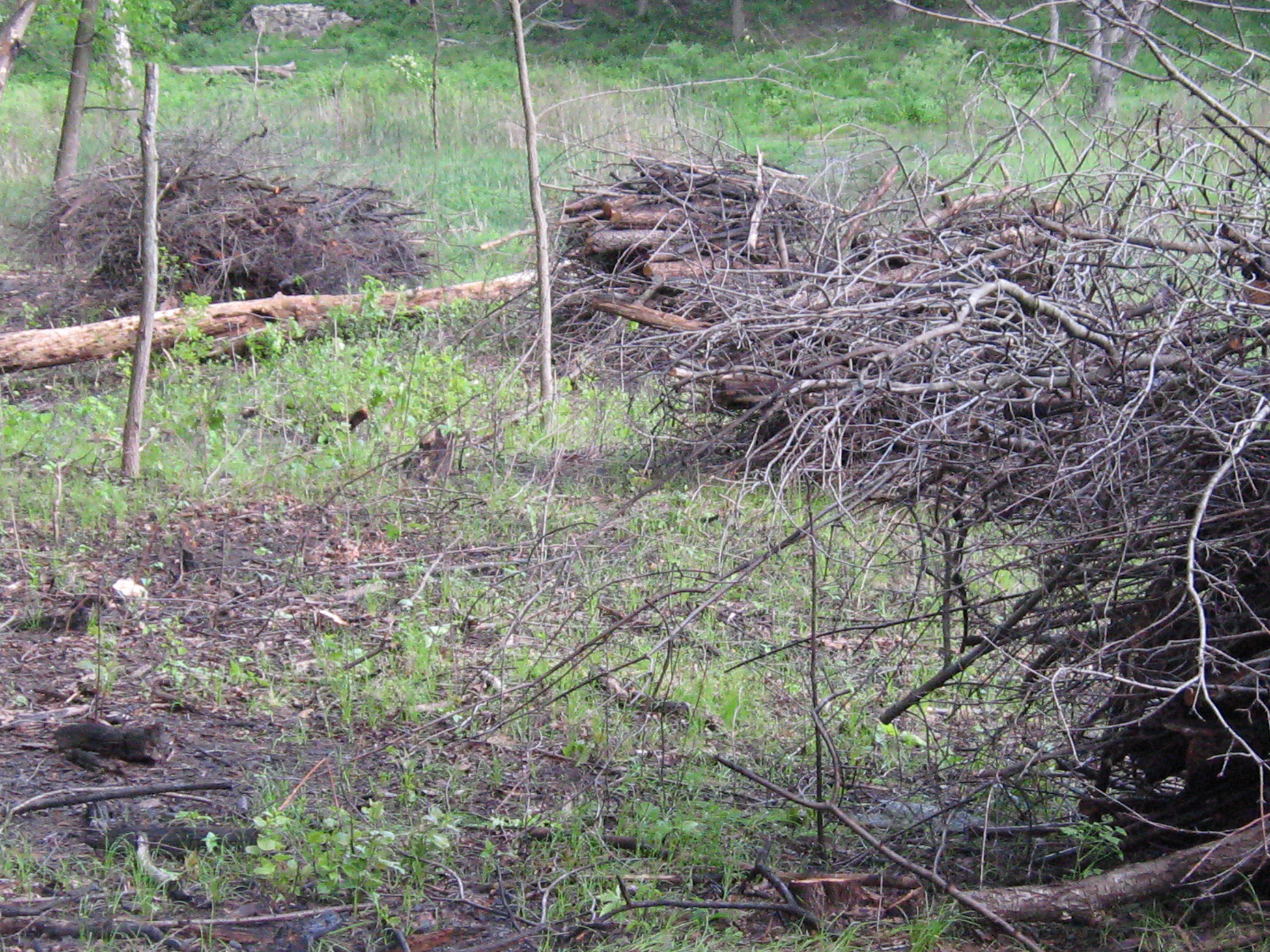
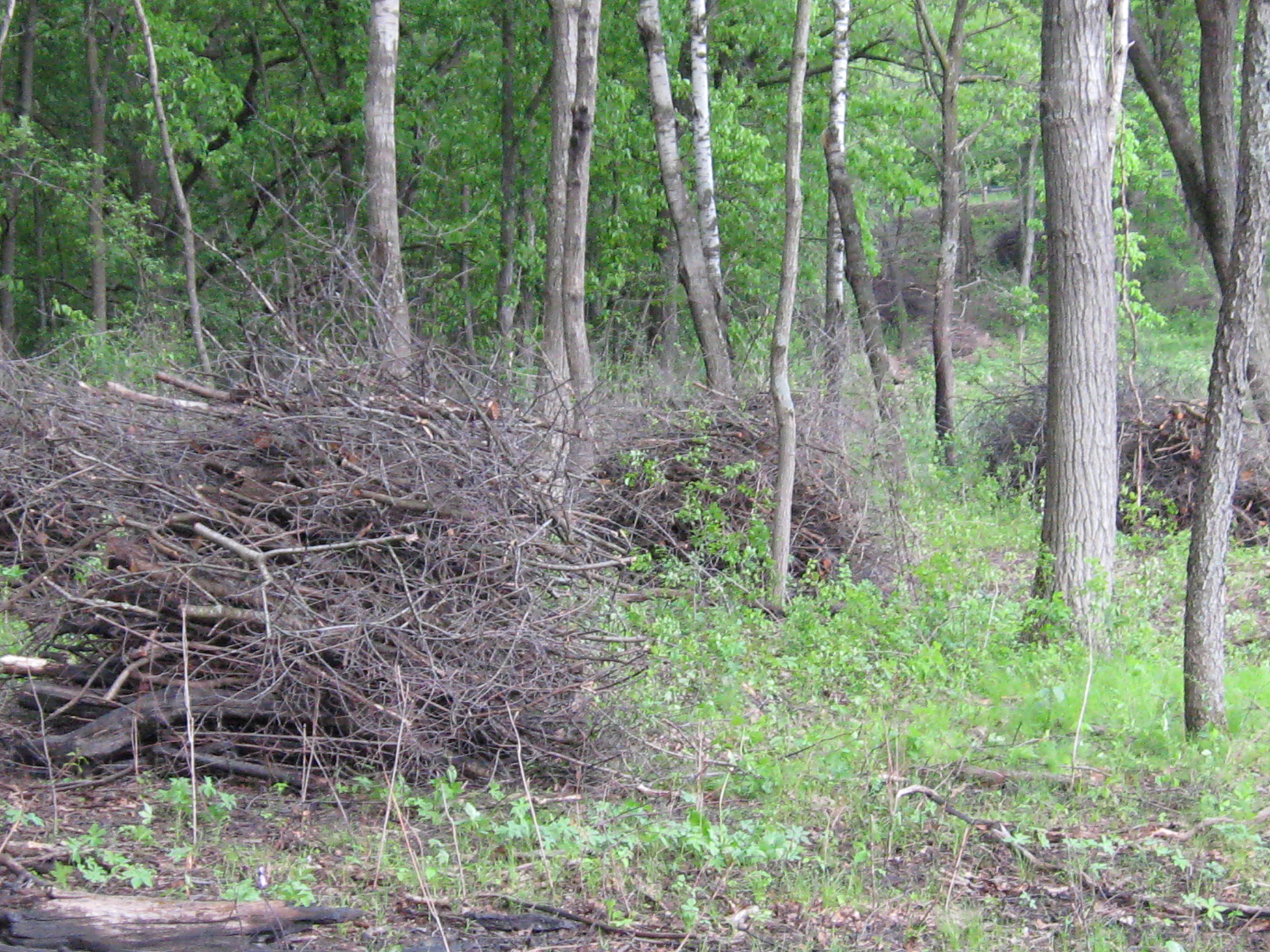
I spent the afternoon piling buckthorn between the north side of the river and the cut-off trail and made another dozen or so piles. John and Sue arrived to say hello and we had a great conversation regarding the restoration effort and then they lead me to this rare patch of kitten tails.
Our good friend, the north wind, blew into The Springs and it was cool and cloudy most of the day, but when the sunshine finally broke through, it was glorious.
Another spring may have started flowing, check this out:
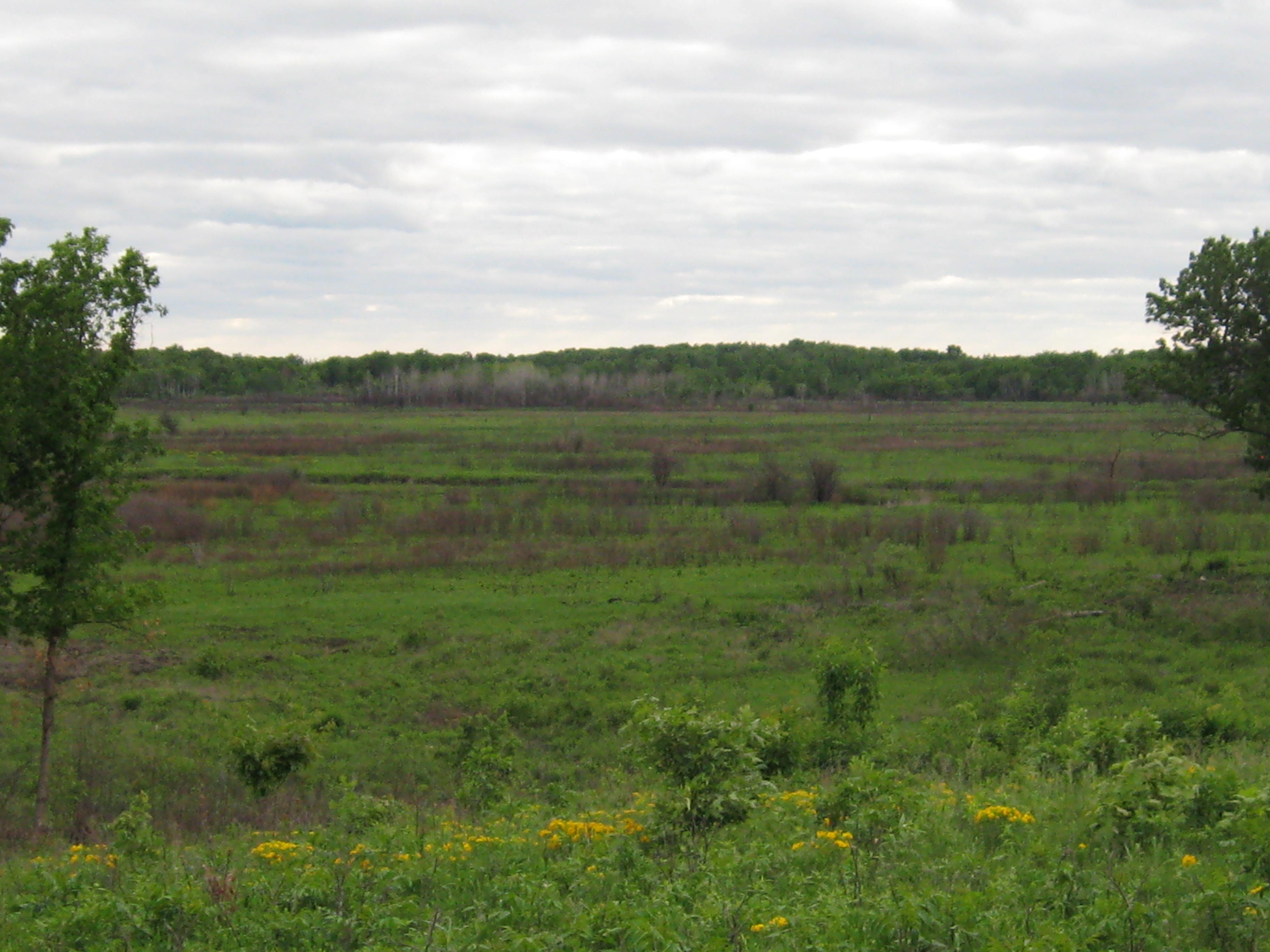
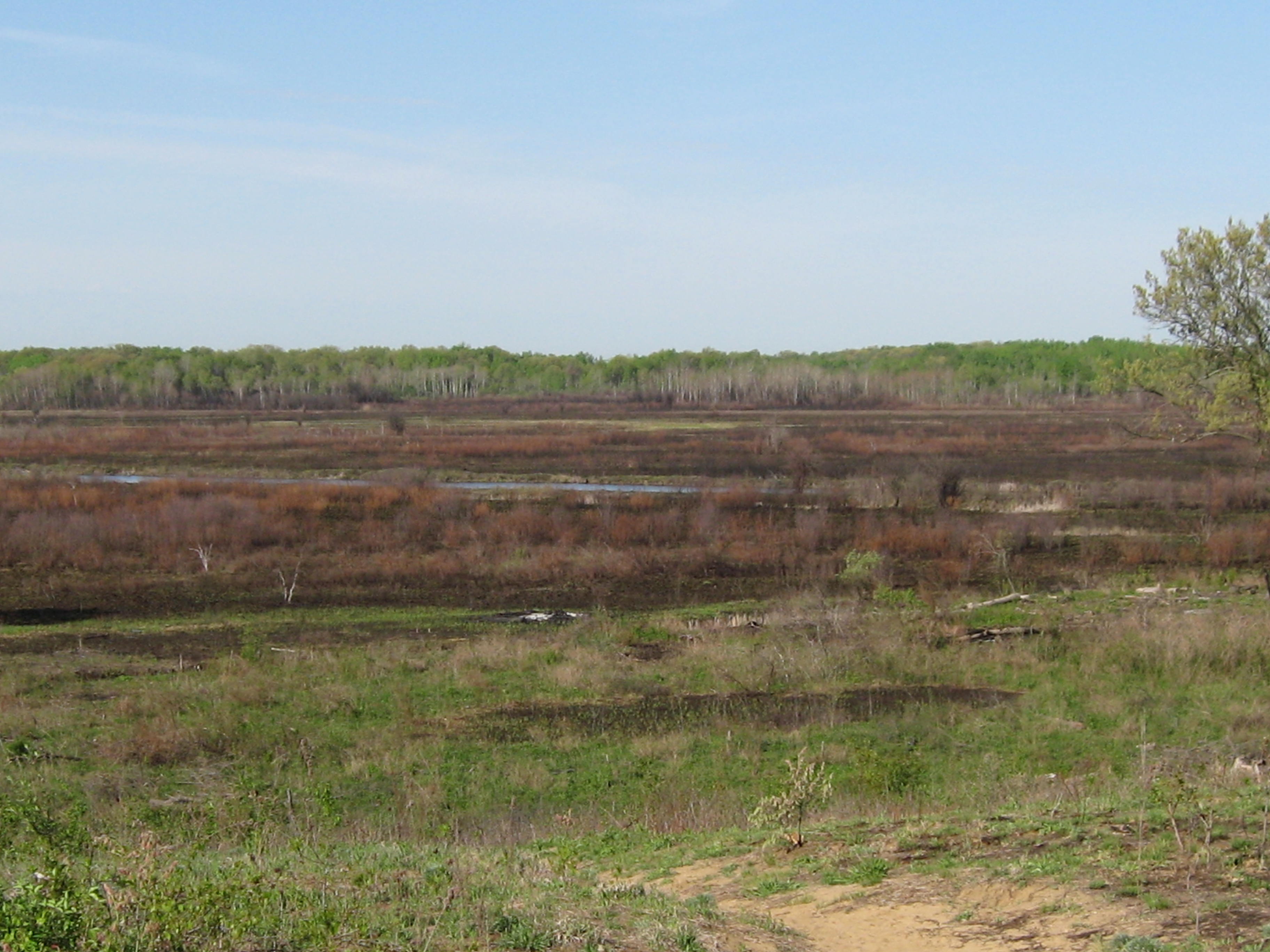
Views of the Scuppernong Prairie from the Sauk Campground…
… and the marl pit bridge.
My sweetheart, Pati Holman, road her bike the 40 or so miles from Milwaukee to join me and we took a nice walk around the loop trail before heading for home.
The sensation is like that of a feather vaguely wandering across the skin. Slowly, like ripples spreading in a pool of consciousness, the mind awakens to the touch; there is something crawling on me! Out at The Springs we are under attack from the ground and air by ticks and mosquitoes. Good Lord! The ticks are thick and “questing” and, along with their airborne allies, they share an affinity for the same flesh to satisfy their wanton blood lust. The ticks leave a memory upon the surface of the skin that comes to mind again and again; long after they have moved on. Every itch and tingle is a tick! They are in My Truck, waiting for me!
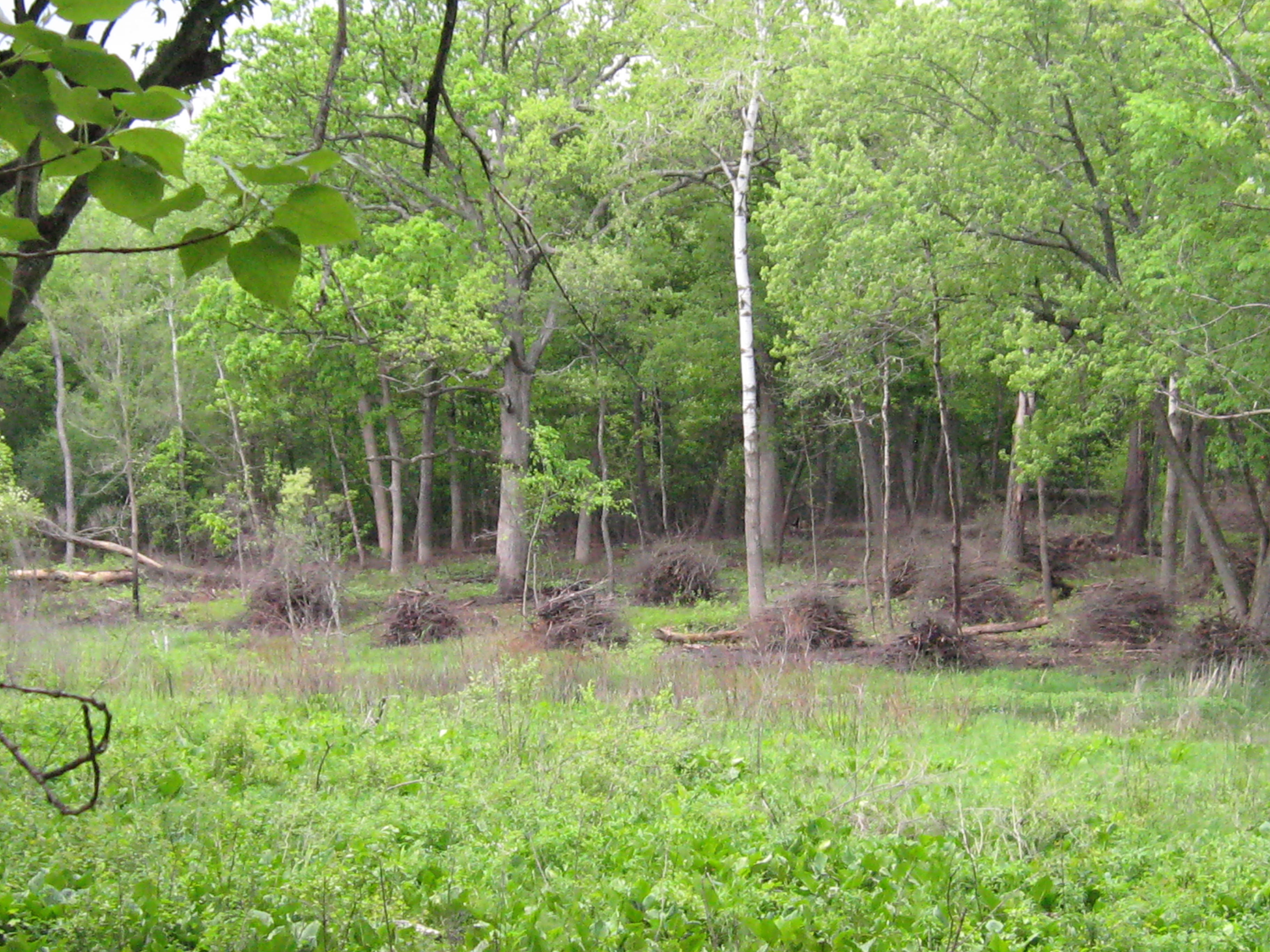
Despite the little things that try patience and distract from the pure joy of living, I spent two Happy Days at The Springs this past Wednesday and Thursday (May 29-30). Rich Csavoy joined me on Wednesday and we had a marvelous time girdling aspen, pulling garlic mustard, piling buckthorn and discussing the first principles of philosophy. Here is a video tour of the north side of the Scuppernong River, just west of the old barn site, where we made around 13 piles.
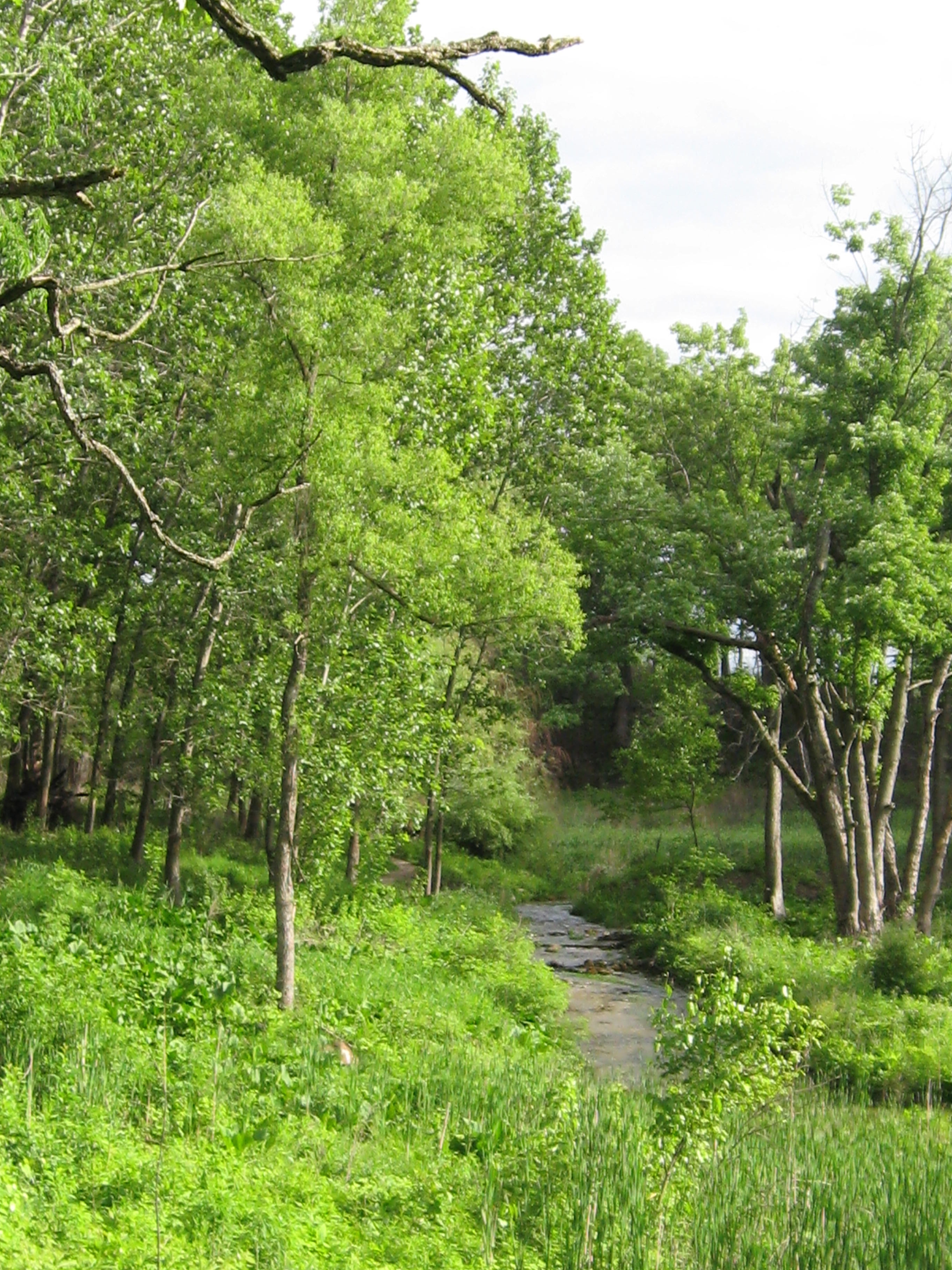
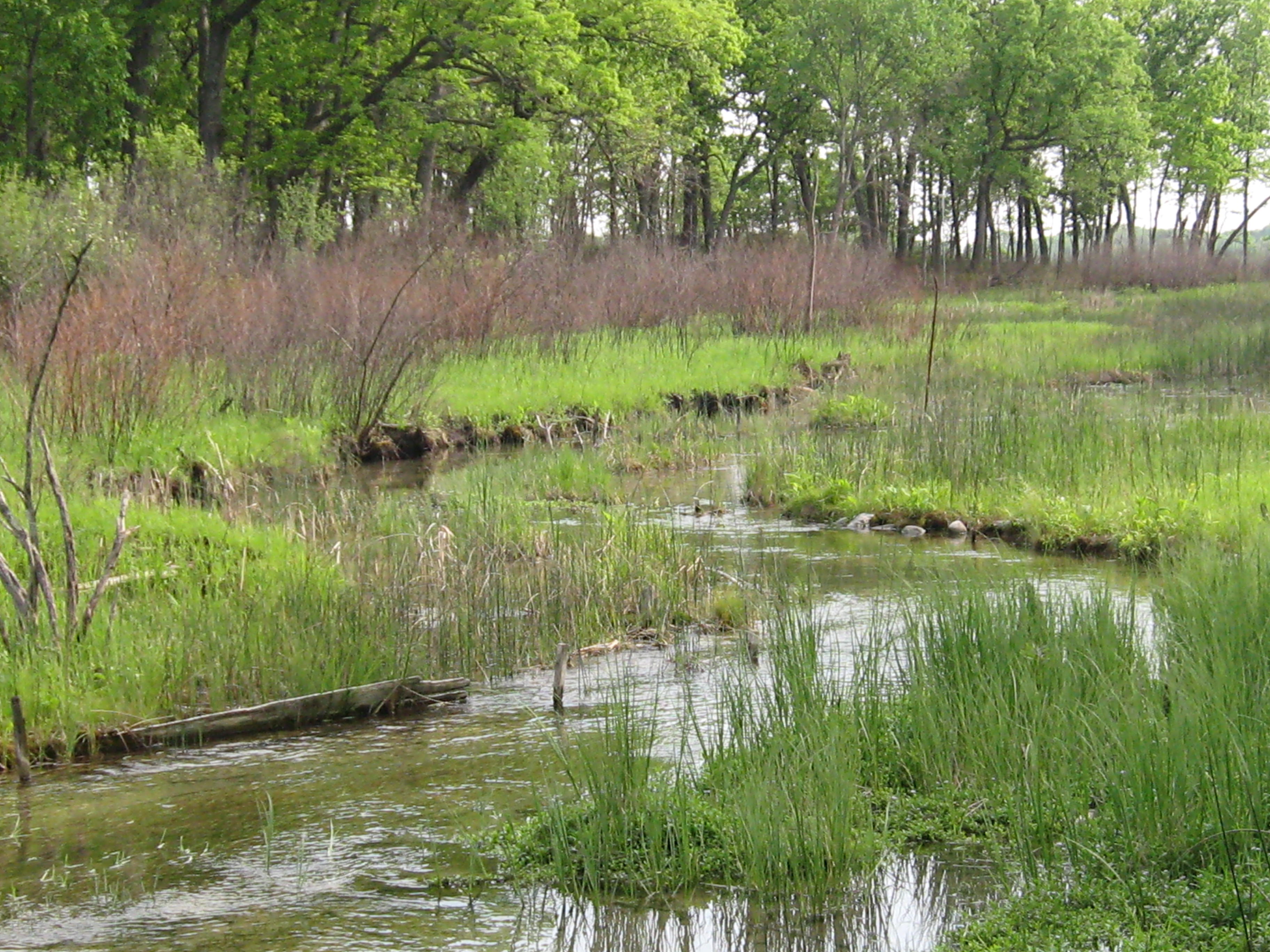
The view downstream from the work site.
Looking at the new brush piles from the hotel site.
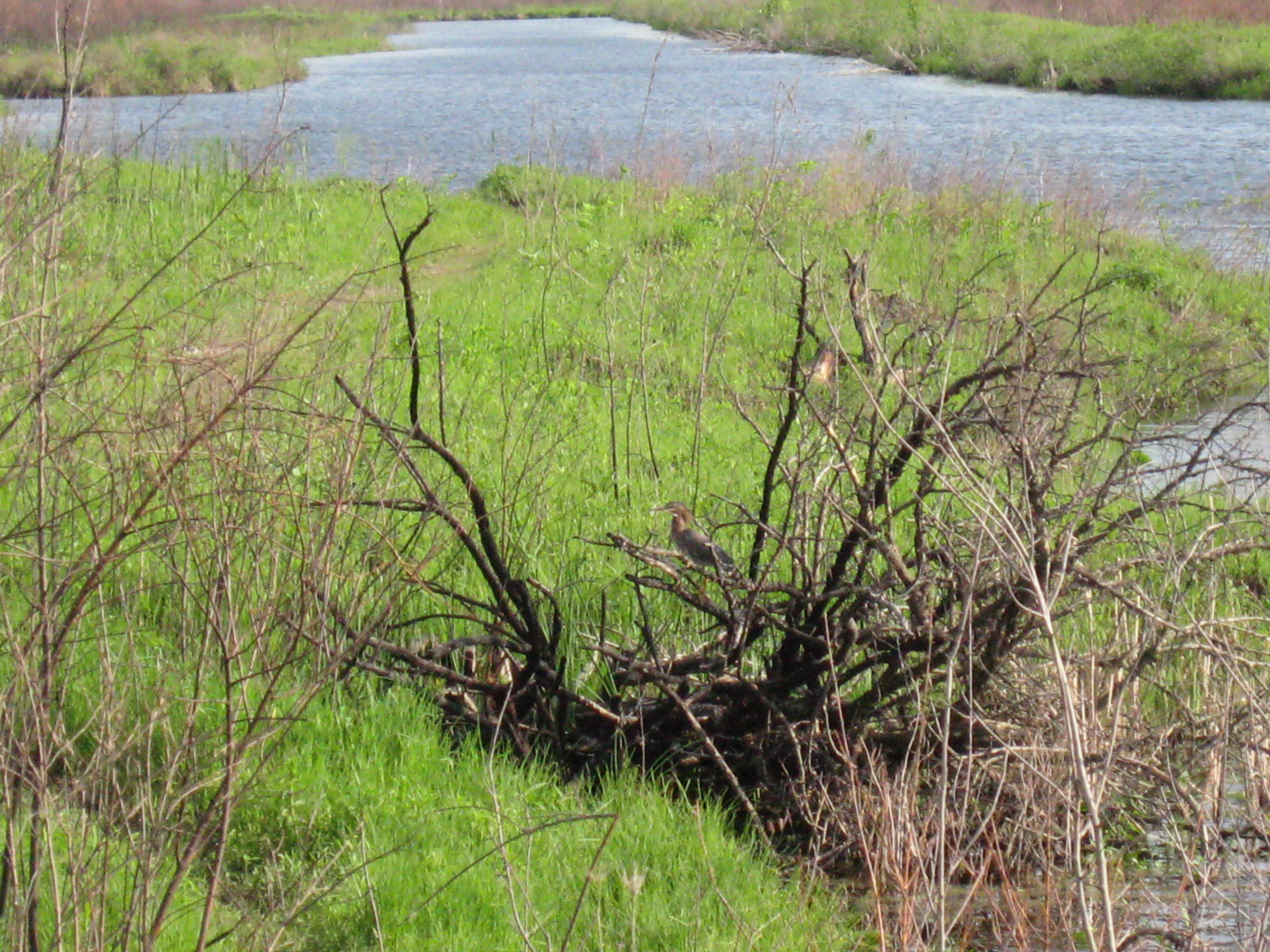
We are seeing a green heron quite frequently at the marl pit bridge.
The Sauk Campground as seen from the marl pit.
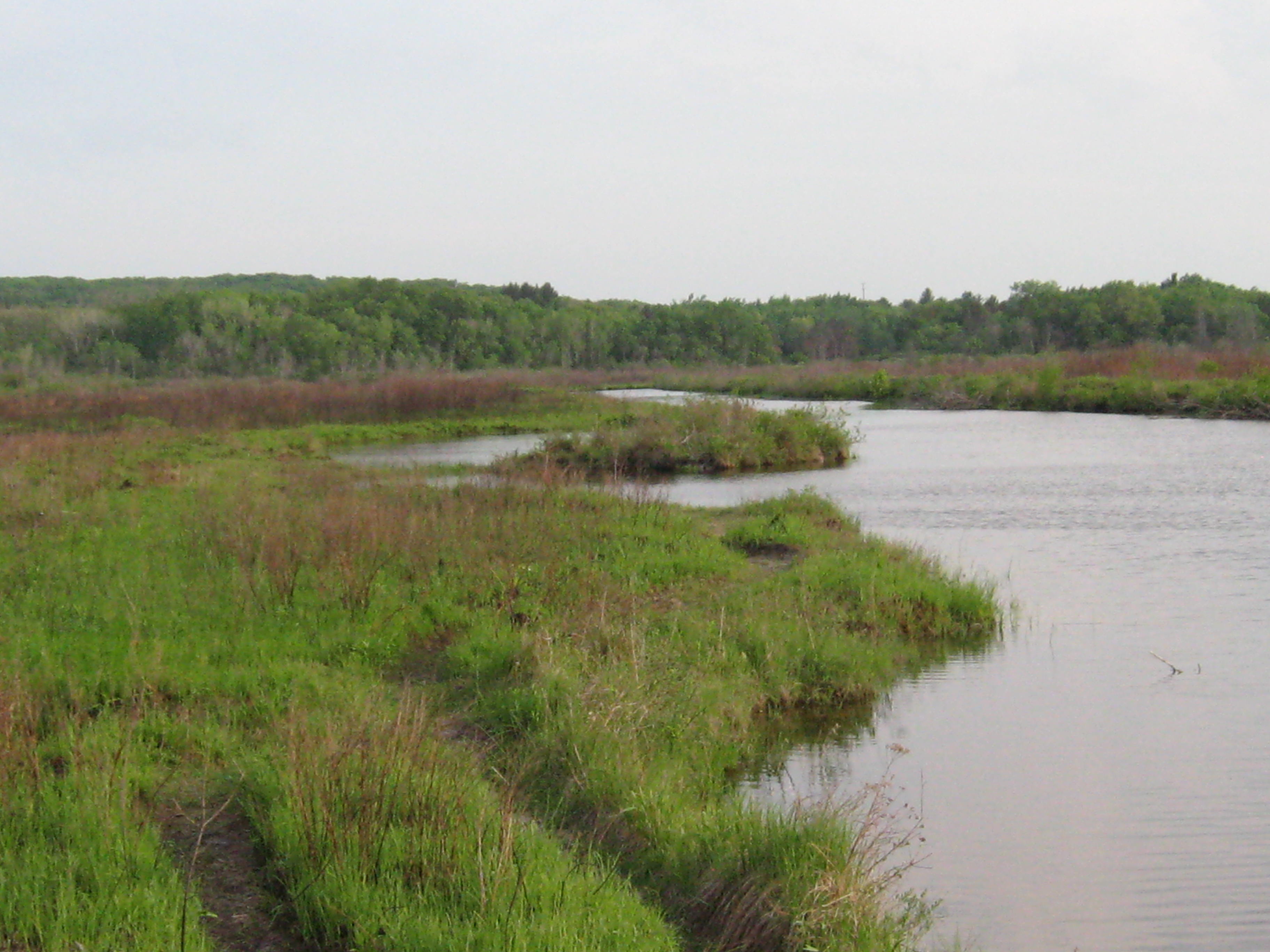
The pit.
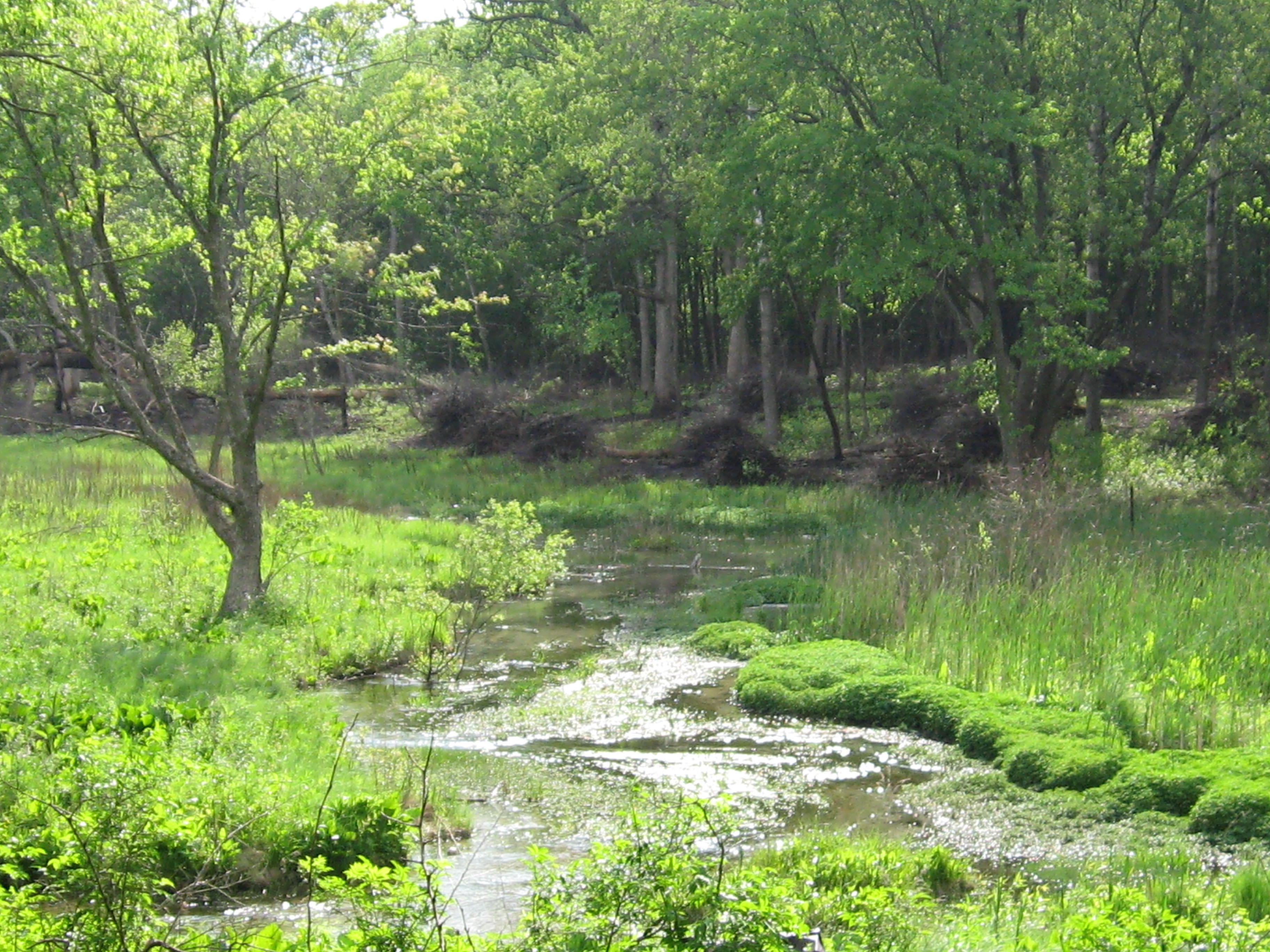
The valley.
Lindsay, and his mate, Connie, stopped over and shared a delicious bottle of Zinfandel from the Lewis Station Winery wine with me and we surveyed the prairie as evening descended.
I was back at it again on Thursday with a stop down at the Scuppernong Spring to get some drinking water.
Here is a walking tour of the Sauk Campground with the advantage of the morning sun behind me.
I took a chance that it would not rain and sprayed 8 gallons of glyphosate on first year garlic mustard seedlings, which literally carpet many newly cleared areas. Then I girdled a clonal colony of aspen on the west side of the river across from hotel site. The goal is to keep the boundary areas along the river valley free of aspen. And finally, I returned to the north side of the scuppernong river, west of the old barn site, between the river and cut-off trail, to pile buckthorn.
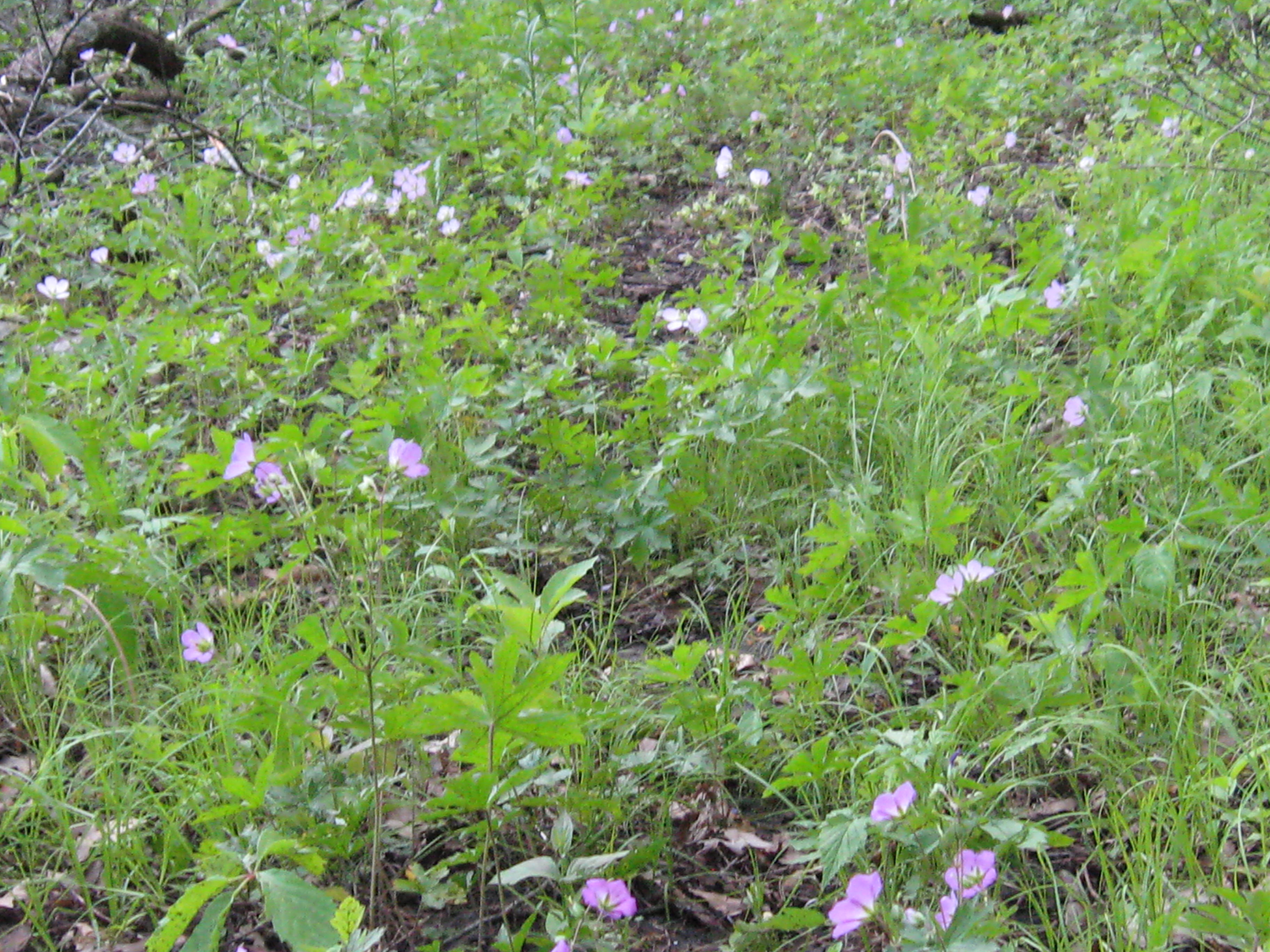
Check out this patch of geraniums!
The water level is up to around .4′ from the early spring levels around .34′ and it seems like the river channel is getting more narrowly defined, i.e. some of the marl and muck is getting washed downstream.
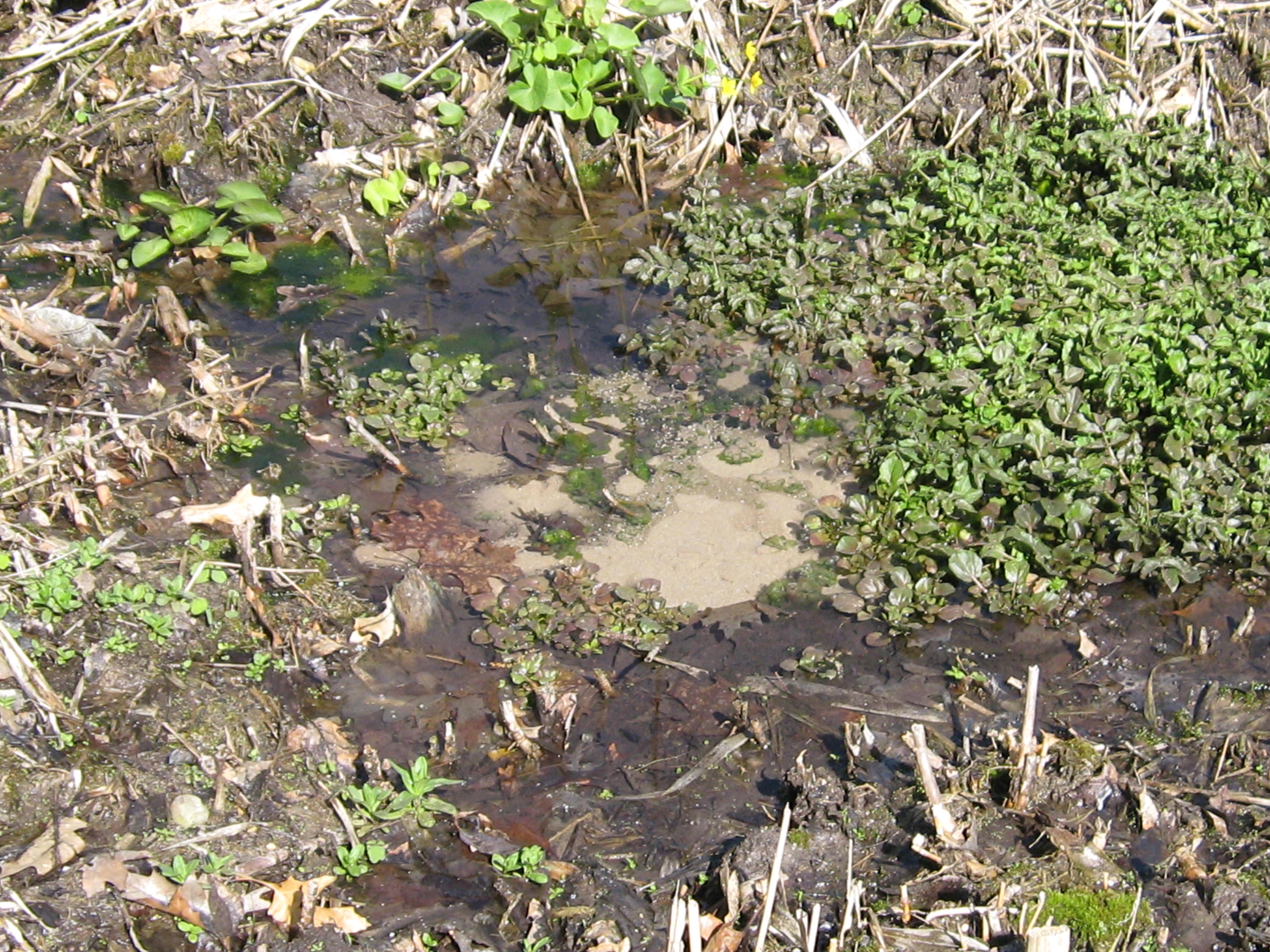
The Emerald Springs are constantly changing their configuration.
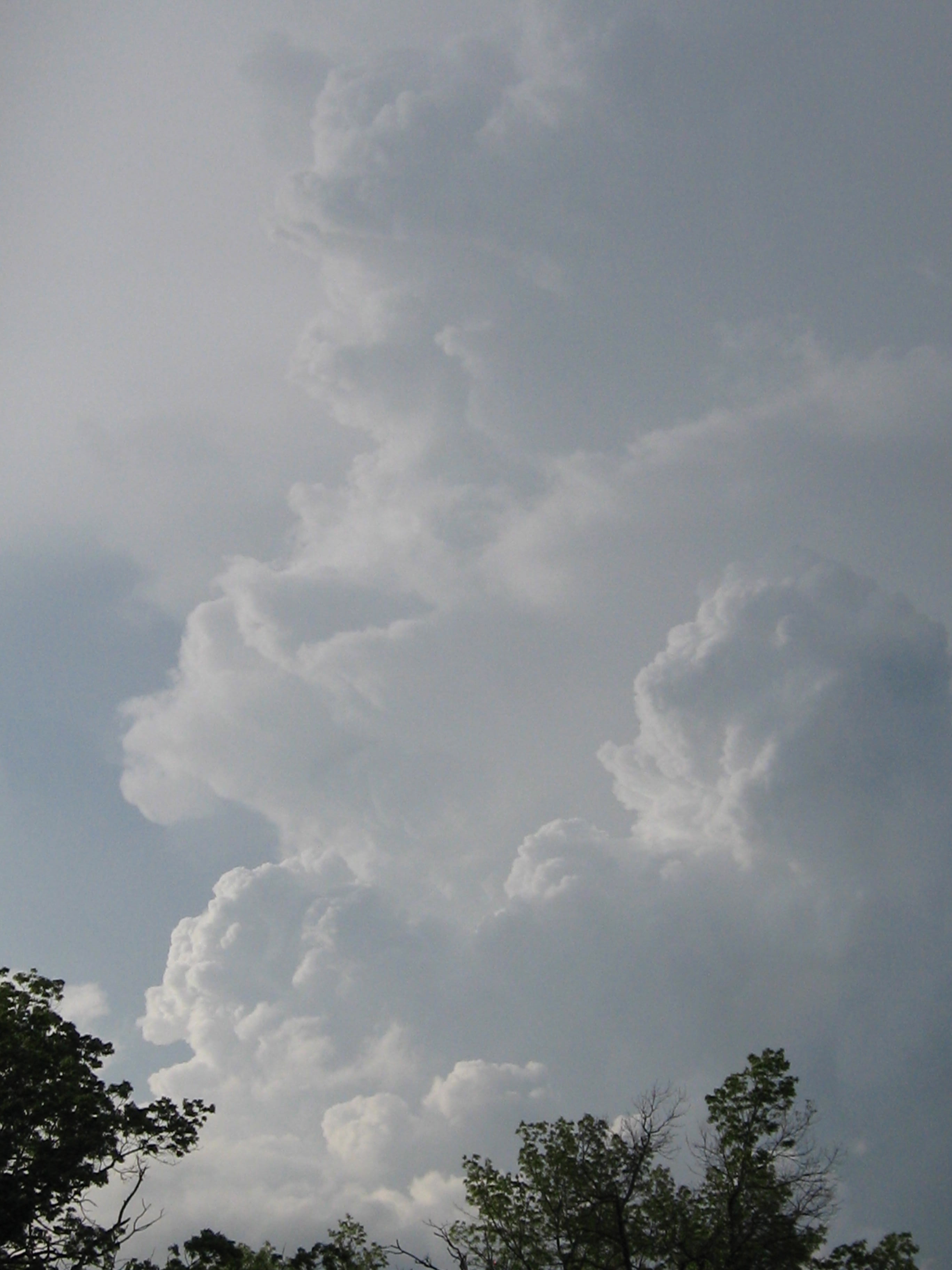
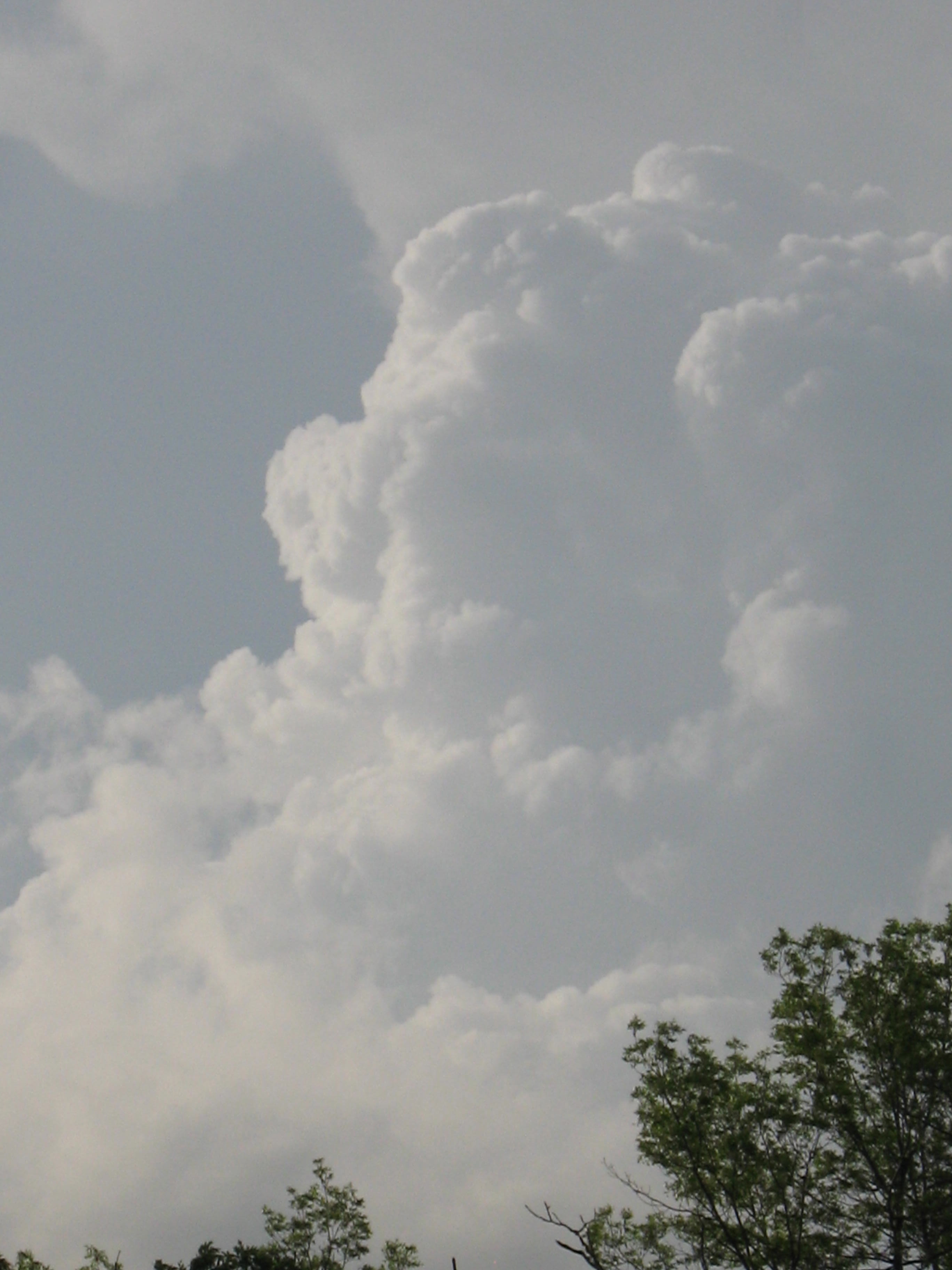
When the glorious pearl and alabaster clouds of these noonday storms are being built I never give attention to anything else. No mountain or mountain-range, however divinely clothed with light, has a more enduring charm than those fleeting mountains of the sky–floating fountains bearing water for every well, the angels of the streams and lakes; brooding in the deep azure, or sweeping softly along the ground over ridge and dome, over meadow, over forest, over garden and grove; lingering with cooling shadows, refreshing every flower, and soothing rugged rock-brows with a gentleness of touch and gesture wholly divine.
I’m celebrating! Its been 2 years since I returned to the The Springs and 2 years since I had surgery to remove the cancerous tumor from my neck. So much has changed since then in both me and The Springs; I got healthy, retired and discovered philosophy, and The Springs got some tender loving care including a good cleaning.
One of the most exciting things we did last year was to uncover springs that were totally obscured by watercress, phragmites, cattails, buckthorn, and other brush.
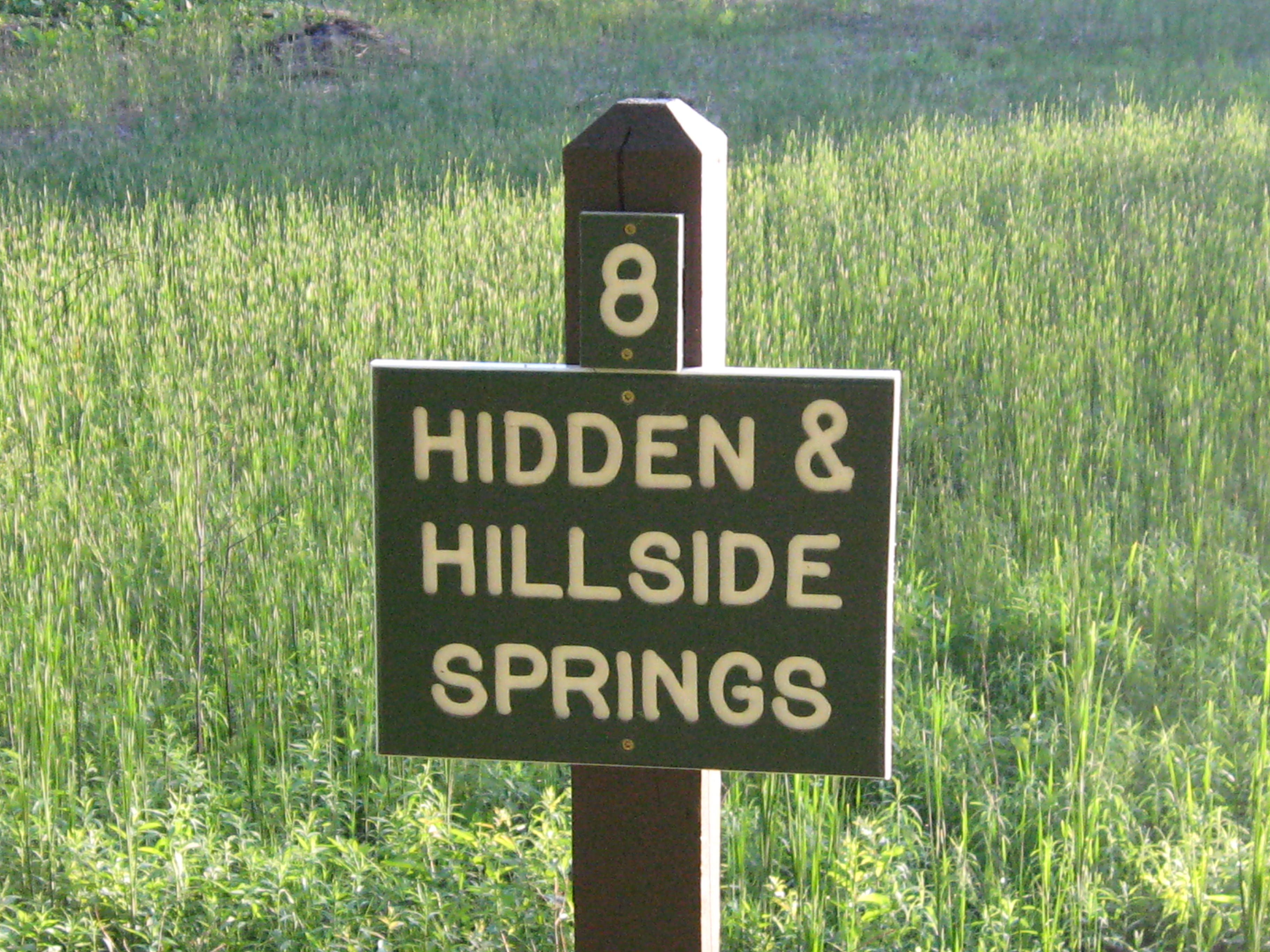
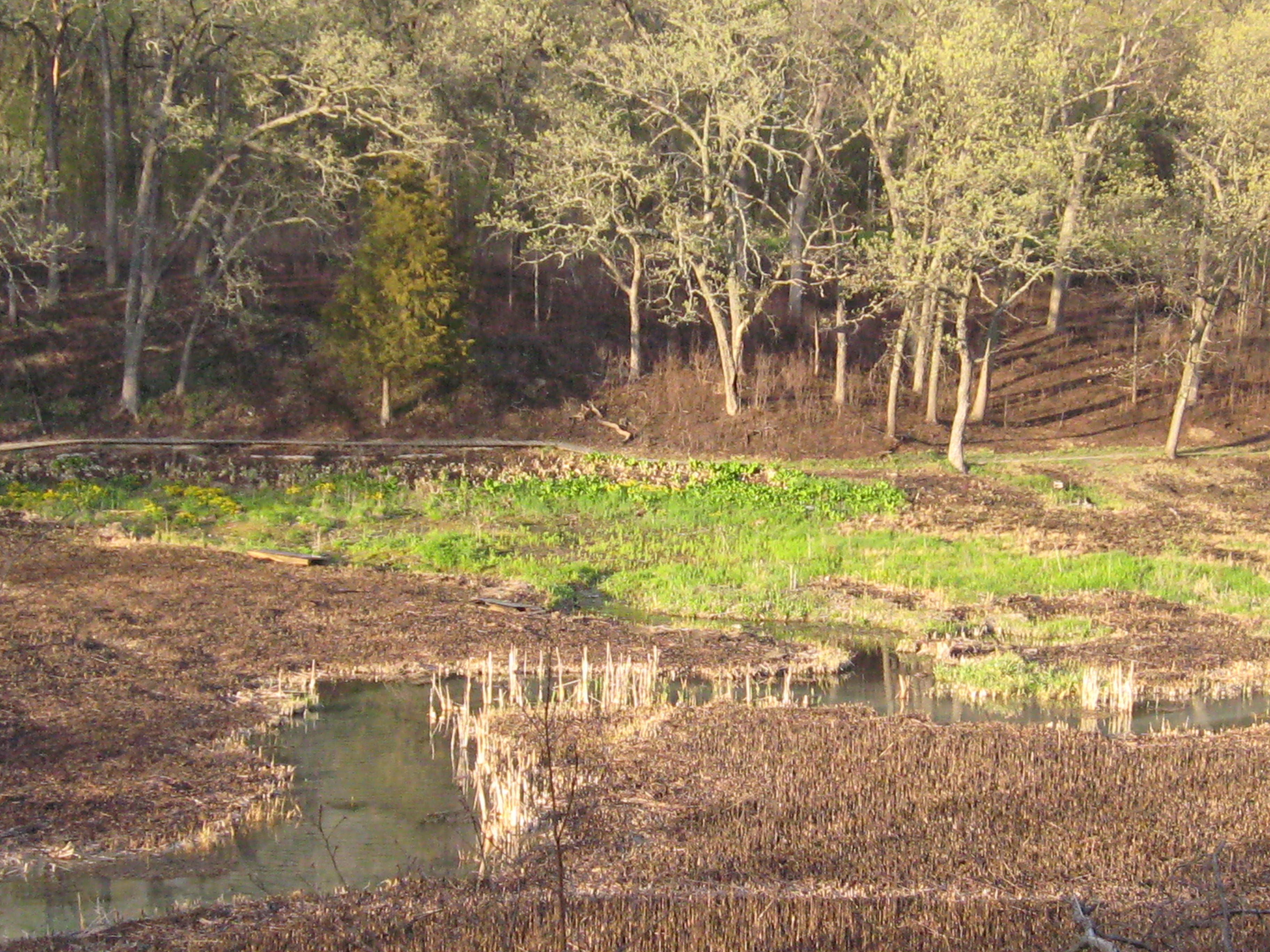
We began the cleanup focused on removing the watercress that was damming the river, without consulting the map above, so it was one surprise after another as we “discovered” the two sets of Hillside Springs, The Hidden Spring and the Hatching House Springs. Yesterday, the morning light was just right and I paid respect to The Hidden Springs.
The views from the steps above the springs.
There are some nice bubblers here.
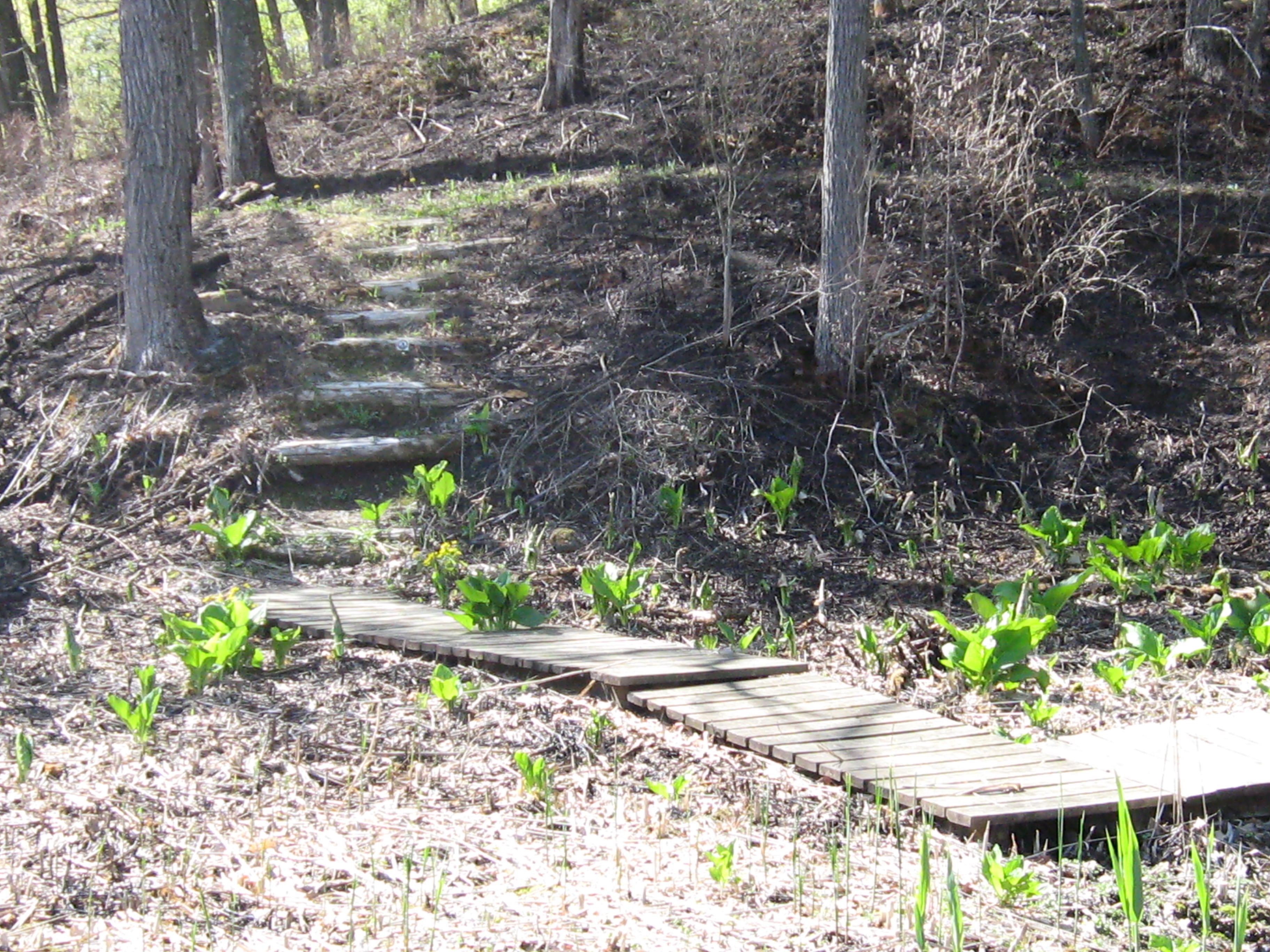
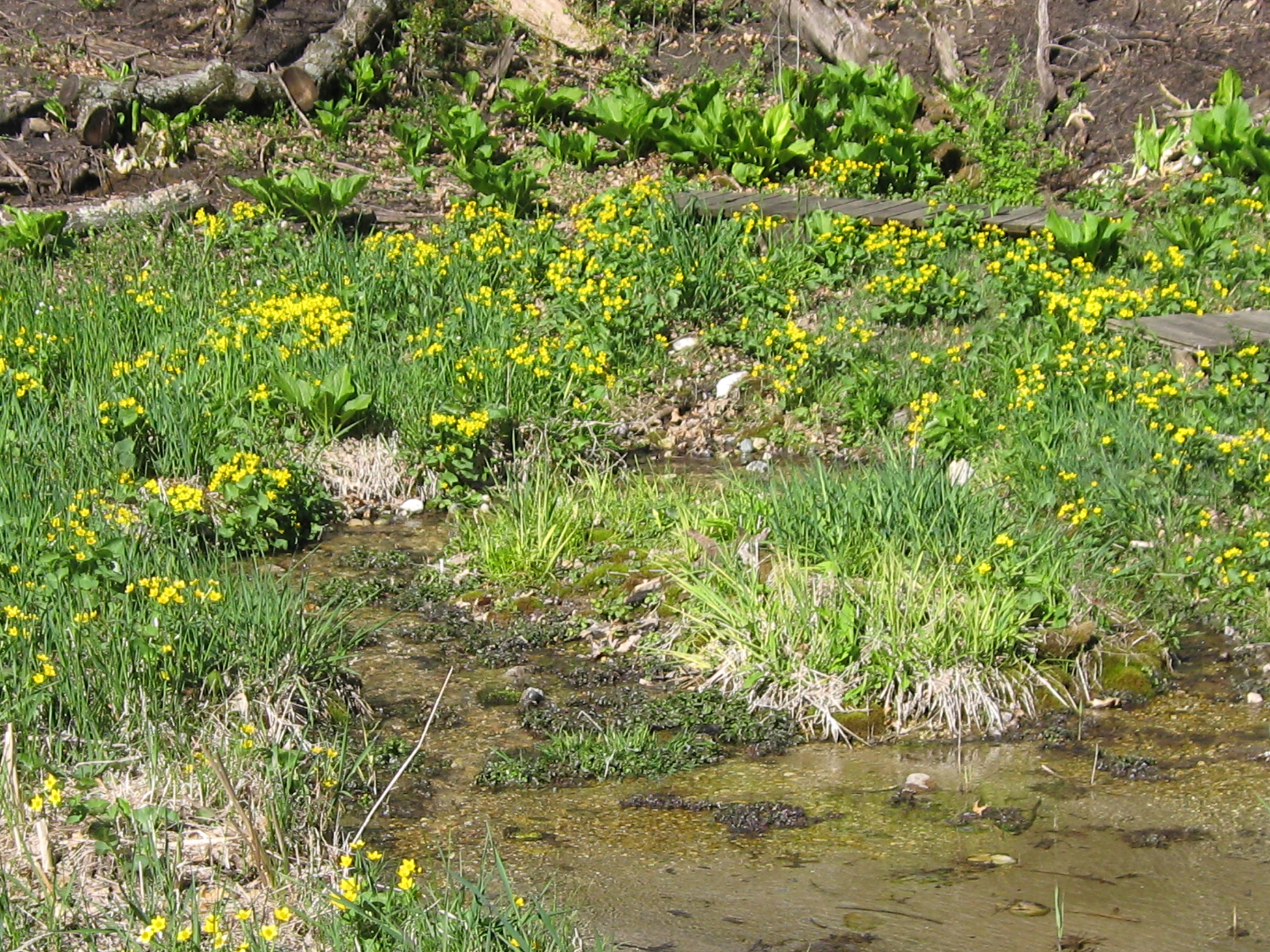
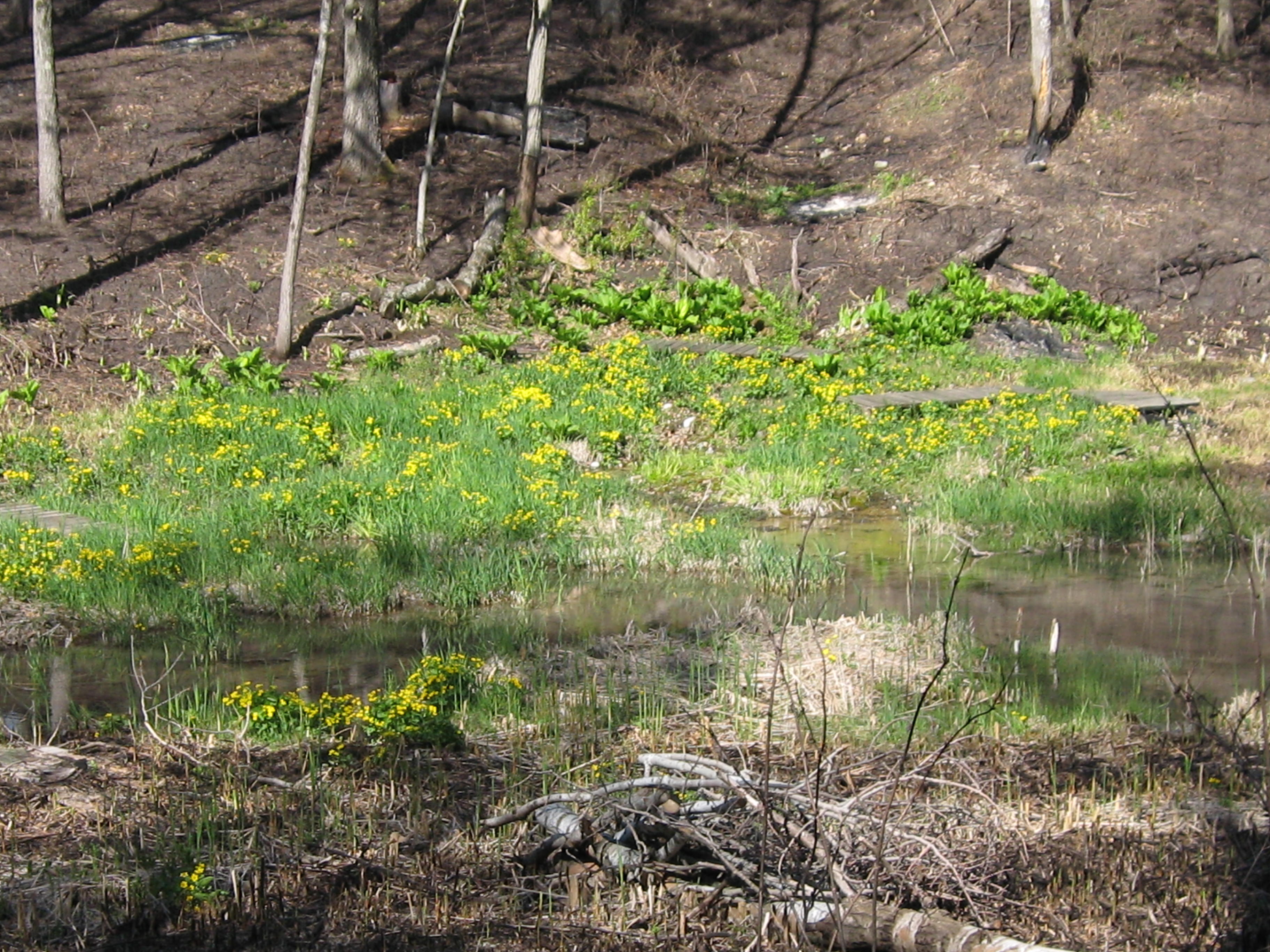
Marsh marigolds and skunk cabbage frame the springs.
In discovering philosophy, I found my own hidden spring; a spring for my soul. One of the very simple ideas I’m contemplating is from The Yogatattva Upanishad that I found extracted in C. W. Leadbeater’s book The Chakras:
What a beautiful way to visualize the body and breath in harmony with nature!
Chester W. Smith erected the first dam just below the Hotel Springs in 1846 to power a saw mill and the river valley was flooded until 1992. The fires have laid bare the landscape and it is clear where the trout farmers divided the flooded river valley to suit their purposes. We are hoping, if we can check the phragmites and cattails, that some of the original flora might resurface.
This embankment crosses the valley just north of The Hidden Spring.
I continued spraying spotted knapweed on the Indian Campground; this is working very effectively. I sprayed a lot of flowering garlic mustard in the area south of the trail that did not get burned.
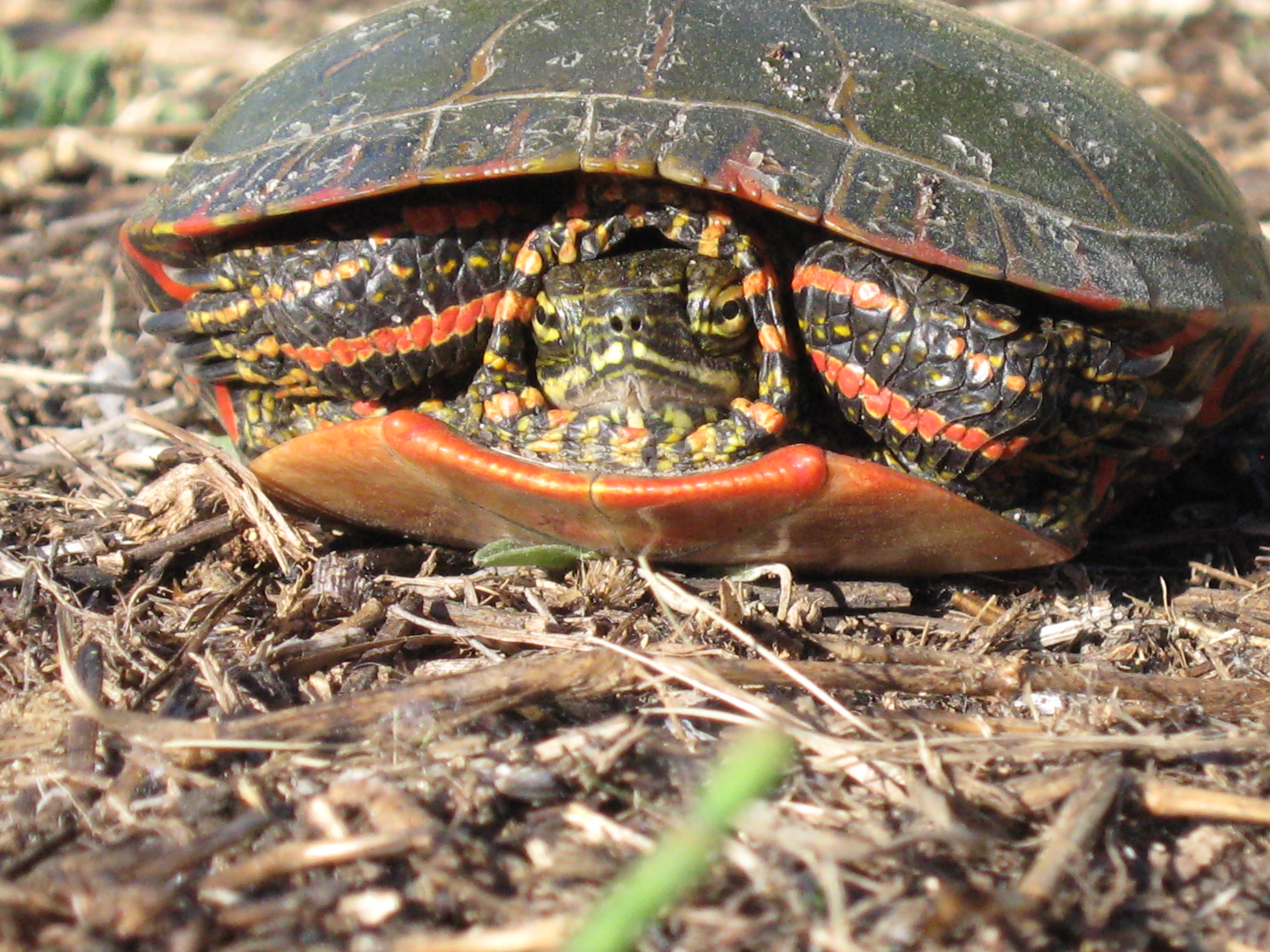
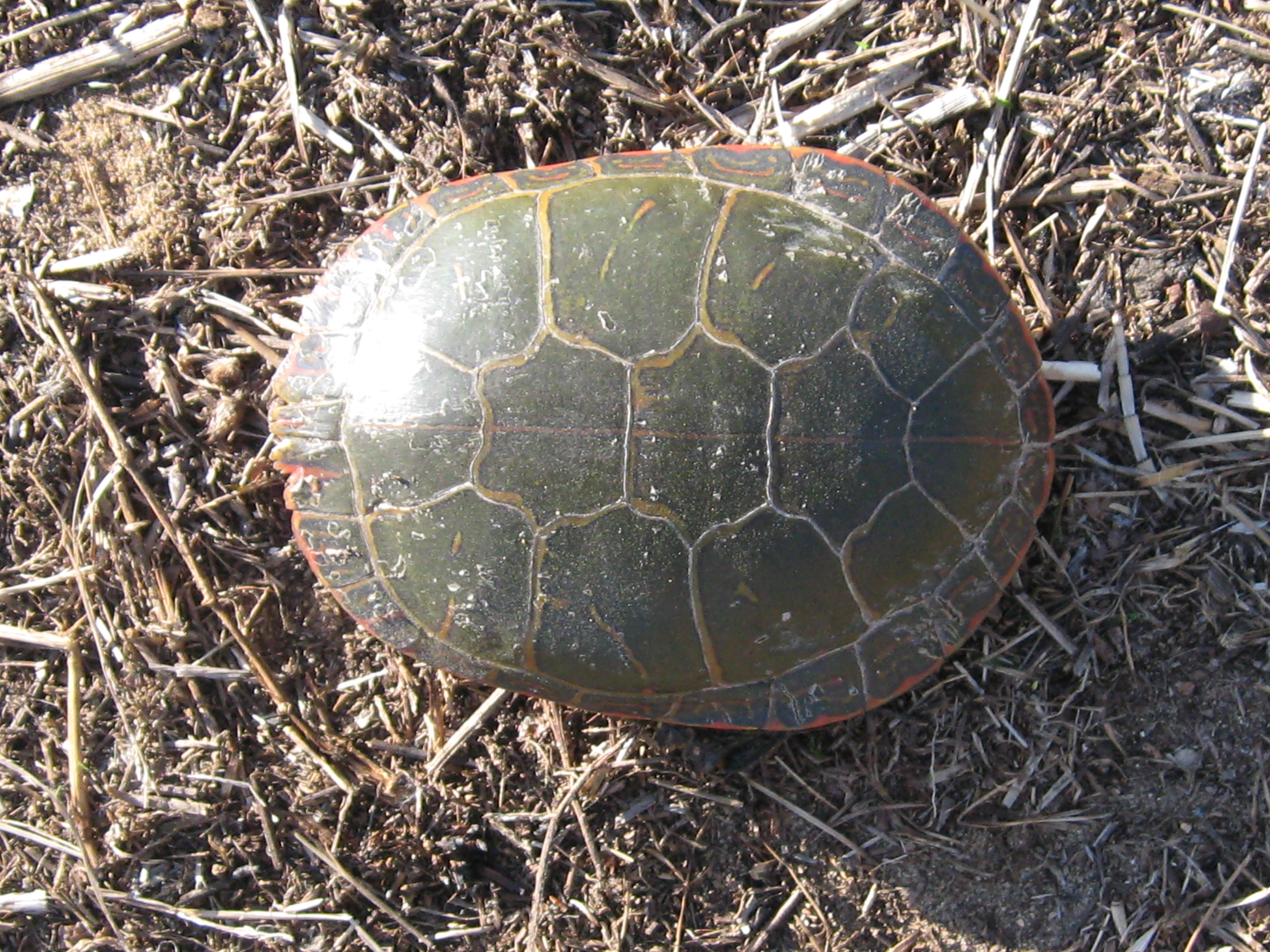
This painted turtle was sunbathing on the trail just above the Indian Spring.
I finished girdling the aspen in the area around the old hotel site and piled the remaining brush there as well. Check out this video walking tour.
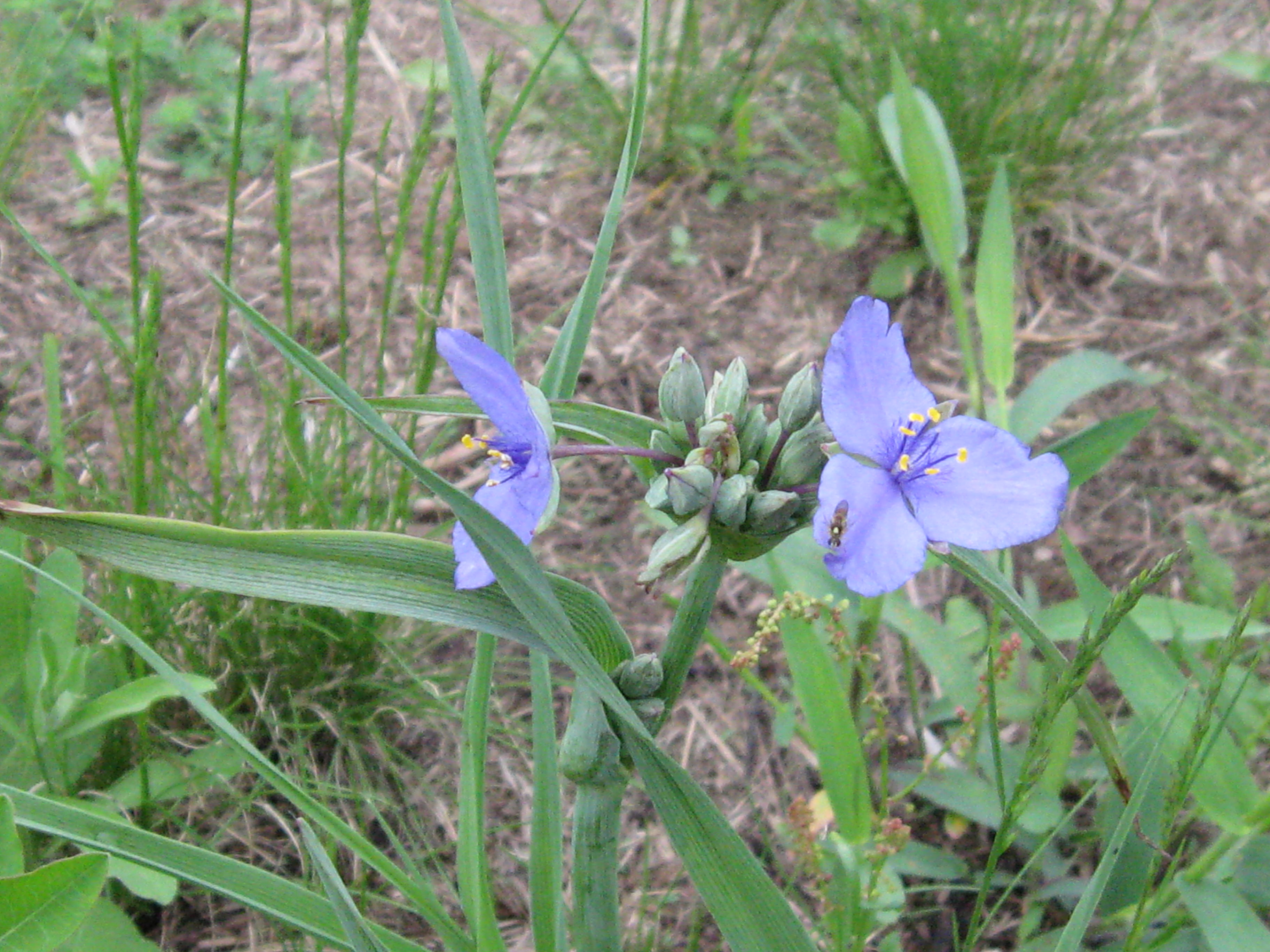
I spotted some Pussytoes and Wood Betony along the trail by spur to The Emerald Spring. A profusion of new growth is emerging!
How can I describe what a great time I had at The Springs yesterday? The temperature and humidity were as pleasant as a Pacific Island. The air was fresh and breezing and the sunlight clarified everything. My thoughts were occupied by the current time; the present moment. Time is a spiritual current-cy. How do we spend it? What do we pay attention to? ‘As you sow, so shall you reap’ and ‘what goes around, comes around’ aren’t just cliches; they are examples of Natural Law, specifically, the Law of Attraction, which is immutably in-force everywhere at all times. So when I say I had a “great time” at The Springs yesterday, I mean it was joyful to invest my spiritual currency paying attention to nature and working to help create the beautiful world that I want to see.
The morning light was flush on the Hillside Springs.
There are lush patches of fresh watercress just below the Scuppernong Spring and I harvested a bagful to include in my green juice recipe.
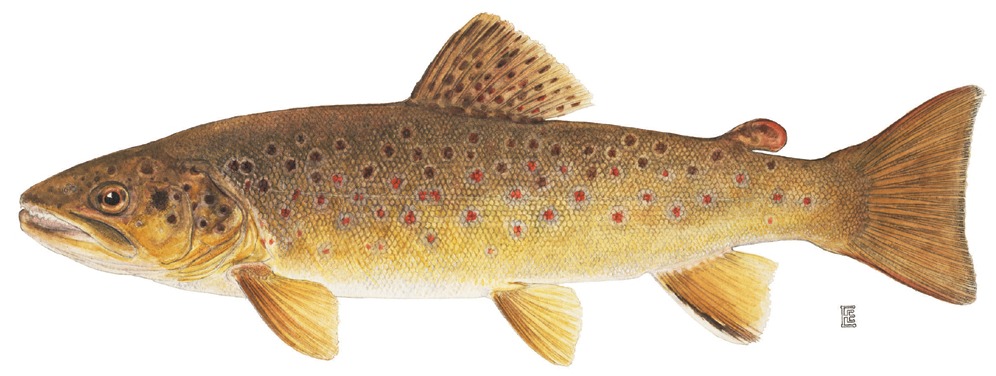
As I was rinsing the watercress at the point where the Scuppernong Spring spills out of its pool and starts to flow as a river, a brown trout emerged from beneath a rock rim and swam about in the pool. I don’t know for sure what is going on with the trout; are they visitors, or a local reproducing population?
Thousands of garlic mustard seedlings have emerged at the south end of the loop trail literally carpeting the ground. I carefully sprayed them with glyphosate trying to avoid the many good plants that are also emerging.
I conscientiously sprayed the spotted knapweed that dominates the sand prairie of the Indian Campground with clopyralid; carefully avoiding the many, many, diverse plants that are also coming up. This sand prairie is going to come alive with color in a couple weeks.
There were more aspen to girdle along the river valley. If we don’t do this, the clonal colonies will spread into and dominate the valley floor.
I piled brush in the afternoon by the old hotel site. You can see the foundation stones in many places now. I forgot to take some pictures, but if you’ve seen one brush pile… I was covered with soot when I finished and took a cool dip in the river by the marl pit bridge to wash off. Clouds moved in and I marveled at their beauty while doing some yoga asanas.
With the video below I attempted to capture one of those ‘you had to be there’ moments.
Siddhartha taught me to listen to the river. Time is an illusion; the “present” moment is an embraceable gift to us. Instead, we often treat time as a commodity to be spent, or saved, or wasted. The past haunts us, we fear for the future, all the while missing the gift of the present moment.
I was lucky to spend some time with the oaks this past weekend; paying attention, listening and feeling the gentle vibration of their subtle speech. The last few weeks I’ve been distracted with the burn, inmates and doctor visits but I found calm again in the present moment amongst the oaks.
On Saturday, May 11th, I joined Ginny Coburn and DNR Conservation Biologist Jared Urban for a workday at the Lone Tree Bluff Scenic Overlook to girdle some aspen trees. Jared leads the Endangered Resources (ER) team in southeastern Wisconsin. His crew varies in size from 3-5 people and they are responsible for approximately 20,000 acres.
Jared hobbled to the top of Lone Tree Bluff on crutches due to an ankle sprained while lighting a 90 acre prescribed burn at Lulu Lake on May 6th. This was after the ER team spent the bulk of the day helping to burn the Scuppernong. The expression “Still waters run deep”, was coined with Jared in mind; I calm down just being around him. But, you should have seen his face when he described the fires he lit at the Scuppernong; the tone vanished as his jaw dropped and I could see the 40′ flames reflected in his widened eyes. Below, Jared gives us a natural history lesson and explains the science behind girdling aspen trees.
When you contrast the billions and billions of dollars the government spends on the military, security industrial complex, versus what it spends to nurture the land, it recalls to mind TreeBeard’s lament in The Lord of the Rings that, ‘no one cares about the trees anymore’. The war mongers misleading us, our Saruman’s if you will, have propagandized us using the old divide and conquer strategy, demonizing Muslims, and distracting us from what our real priorities should be here in the homeLAND.
Whew, I’m ranting again. I’ll try to be more calmly passionate (sounds like something Joseph Conrad might have written, not to suggest I could have even sharpened his pencil). We had a lot of fun working together and I thoroughly enjoyed it.
In the back row Diane, Carol, SwordMan, Princess and Ginny and in the front row, Carol, Thayer and Jared.
I’m new to this area so I stayed to explore a little. Here are a few shots of the bluff.
The Bluff Creek Springs emerge from the north side of the moraine and feed Bluff Creek. I had to check them out.
I found another set of springs on the east side of the moraine.
I wanted to hear what the oak were saying up at Lapham Peak, where Mike Fort and the Lapham Peak Friends have been restoring the prairies, oak woodlands and oak savannas for over 20 years. They have perfected techniques for cutting, stacking and burning buckthorn that are models of efficiency. This past week they did a 75 acre prescribed burn in the area marked in white on the map below and they burned approximately 177 acres total in the park this spring burn season.
This huge swath of the north flank of the peak extends from “the big slide” cross country ski trail east to the tower hill road. I was in awe taking in the scope of the effort as I well remember this hillside was thick with buckthorn.
The oaks were swaying and singing gratefully with the blustery north wind, giving thanks for the tender loving care of the Lapham Peak Friends.
Approaching the tower.
A bird’s eye view from the tower (I need a wind screen for the camera mic).
If you haven’t visited Lapham Peak lately, or ever, consider paying attention to what the friends have accomplished and spend some present moments there.
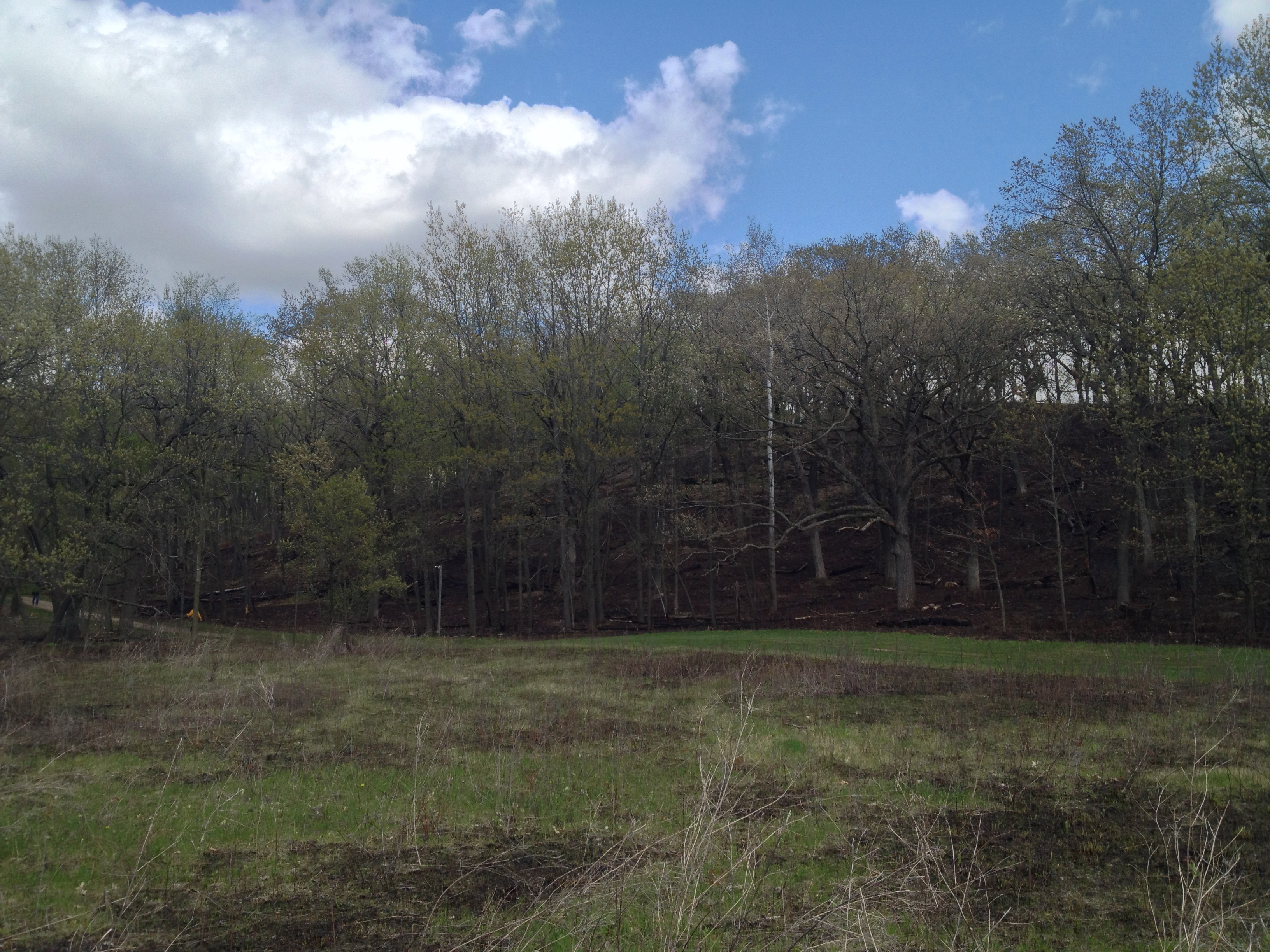
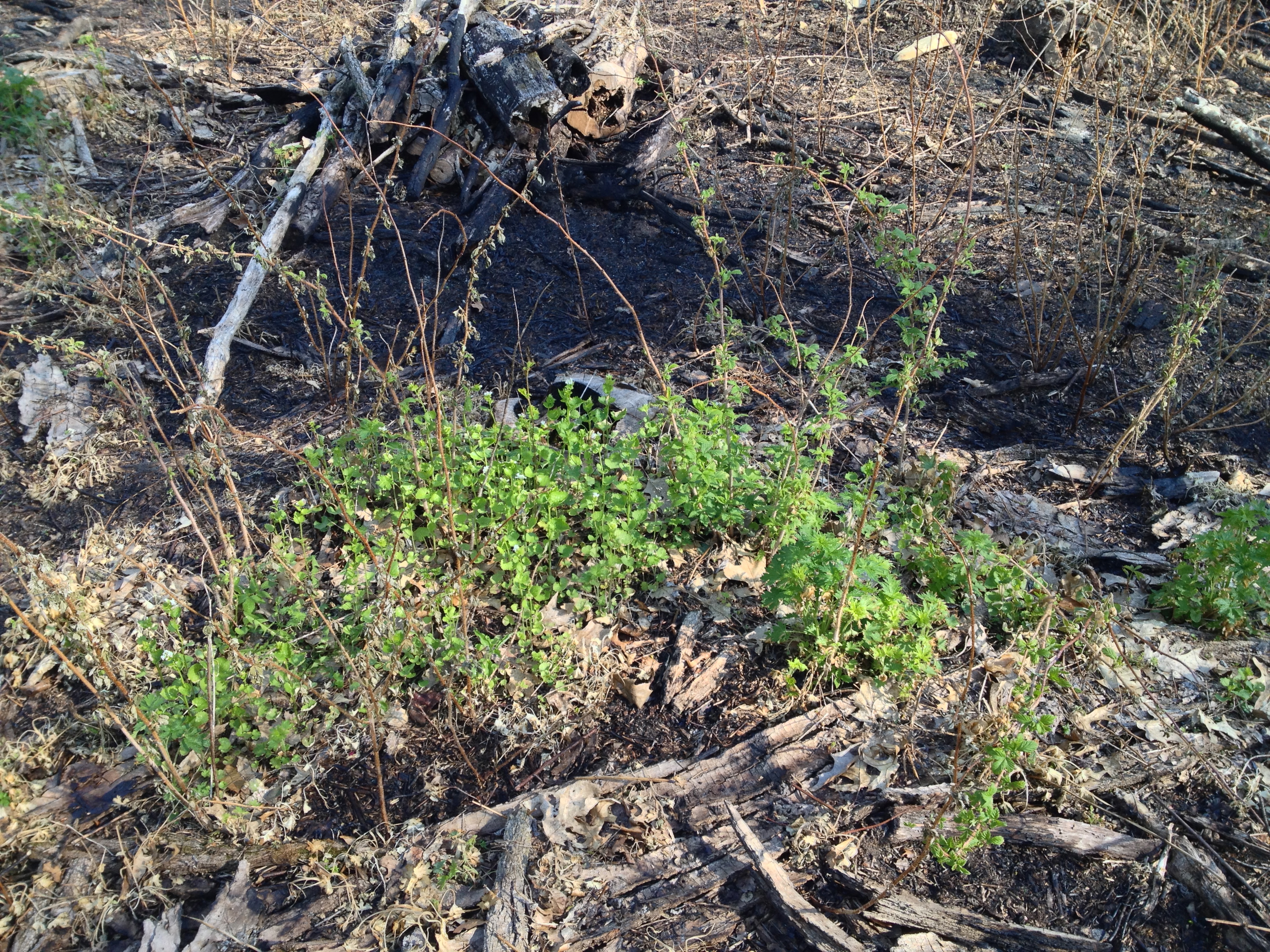
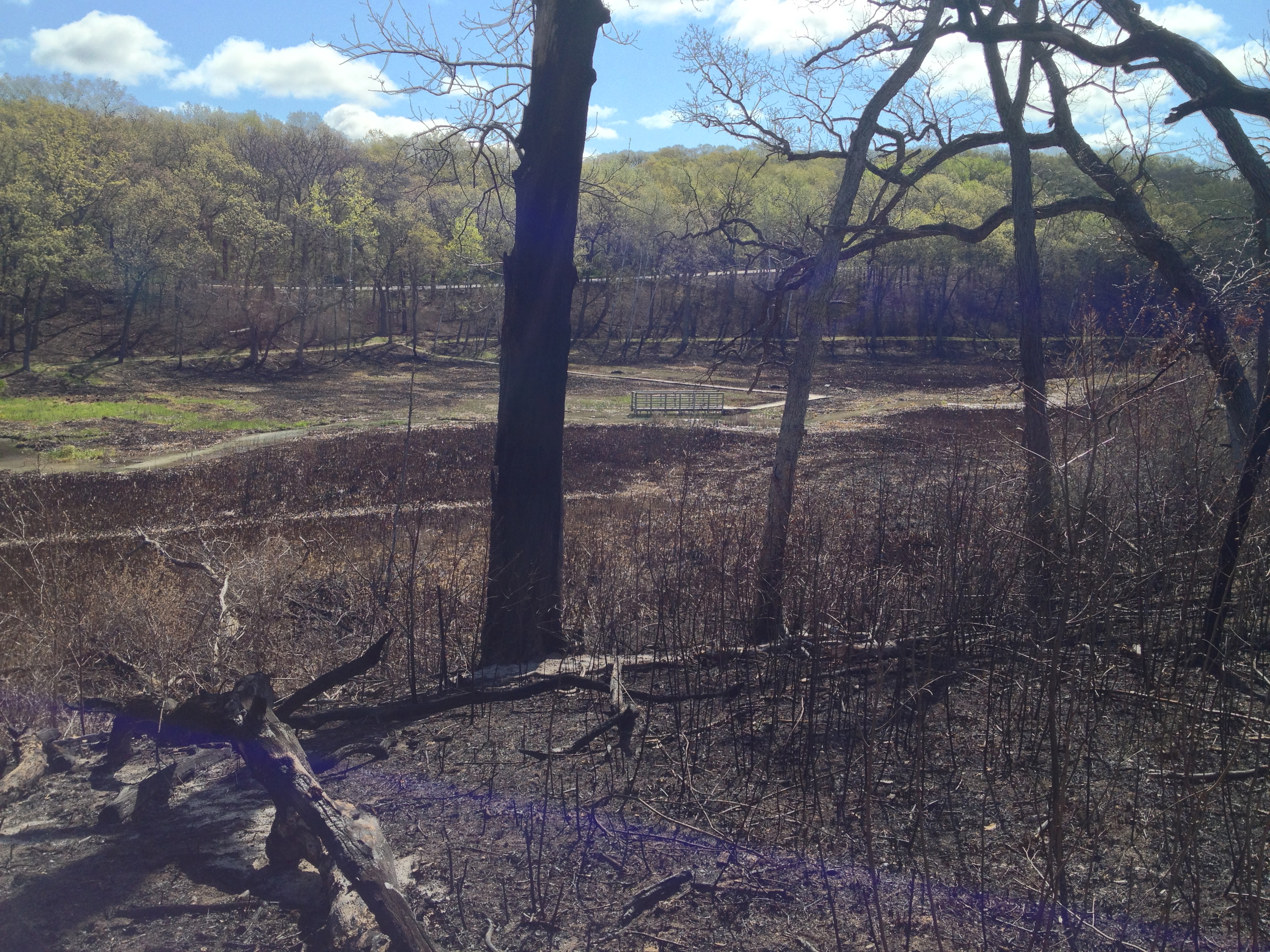
On Sunday, May 12th, I was back at The Springs. Wow, I wonder how long it will take for the forest floor to become green again. I wonder if the native flowers and grasses will have enough strength in their roots to push up fresh growth this year; or next. I began the day spraying garlic mustard, which appeared in isolated patches that escaped the fires.
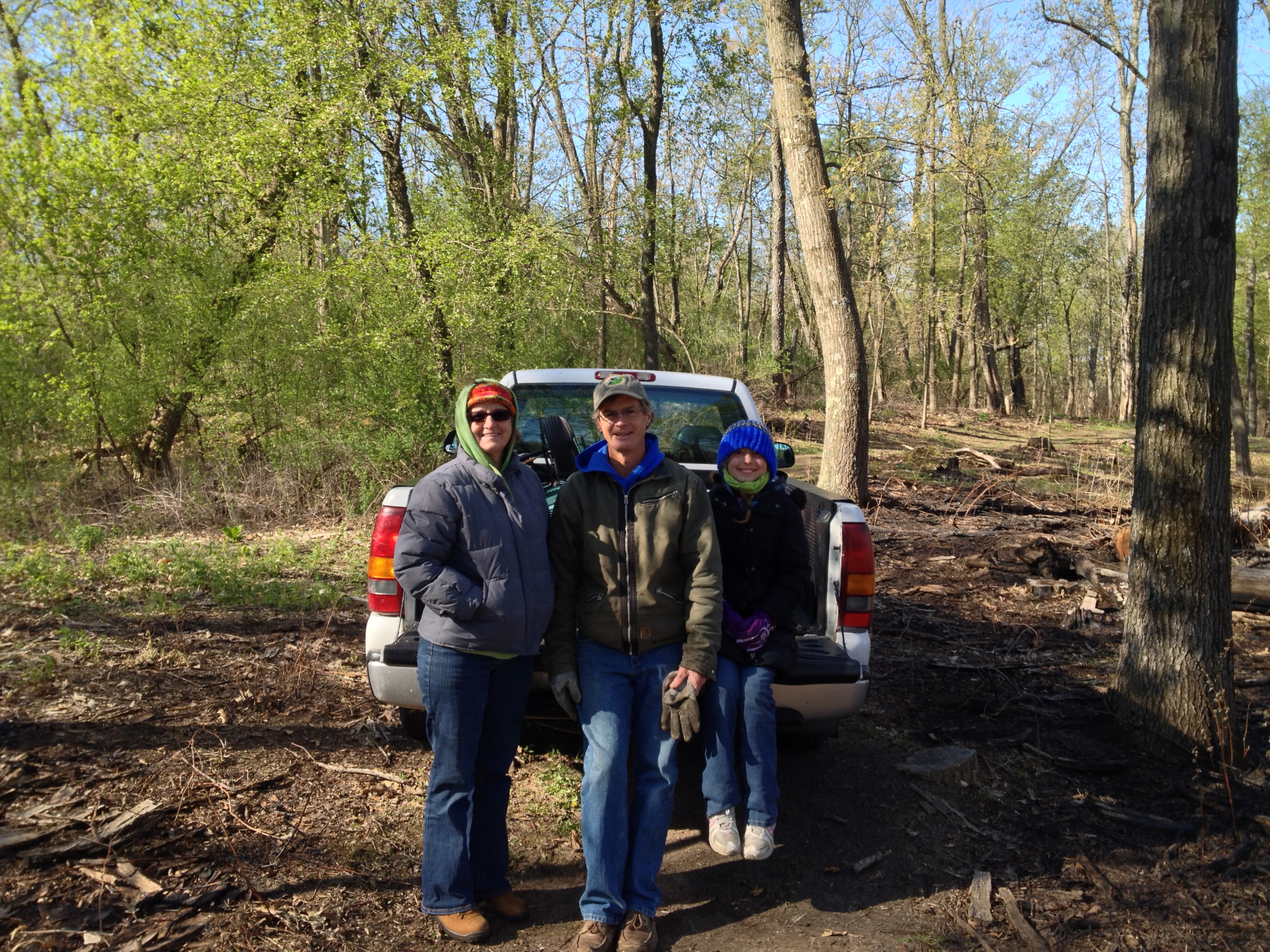
I was pleasantly surprised, and heart warmed, to see Lindsay, his wife, Connie and her granddaughter Sophia, arrive to pick up a load of wood.
When I talked to Don Dane after the burn he mentioned that this would be a great time to attack the spotted knapweed on the Indian Campground. Loaded with the recipe I got from Lindsay, I started that application. Spraying herbicide is my least favorite thing to do in the woods and I limit how much I do in a day. There is plenty more garlic mustard and spotted knapweed proliferating out there and I’ll be spraying for the next two months.
Some scenes from the Indian Campground.
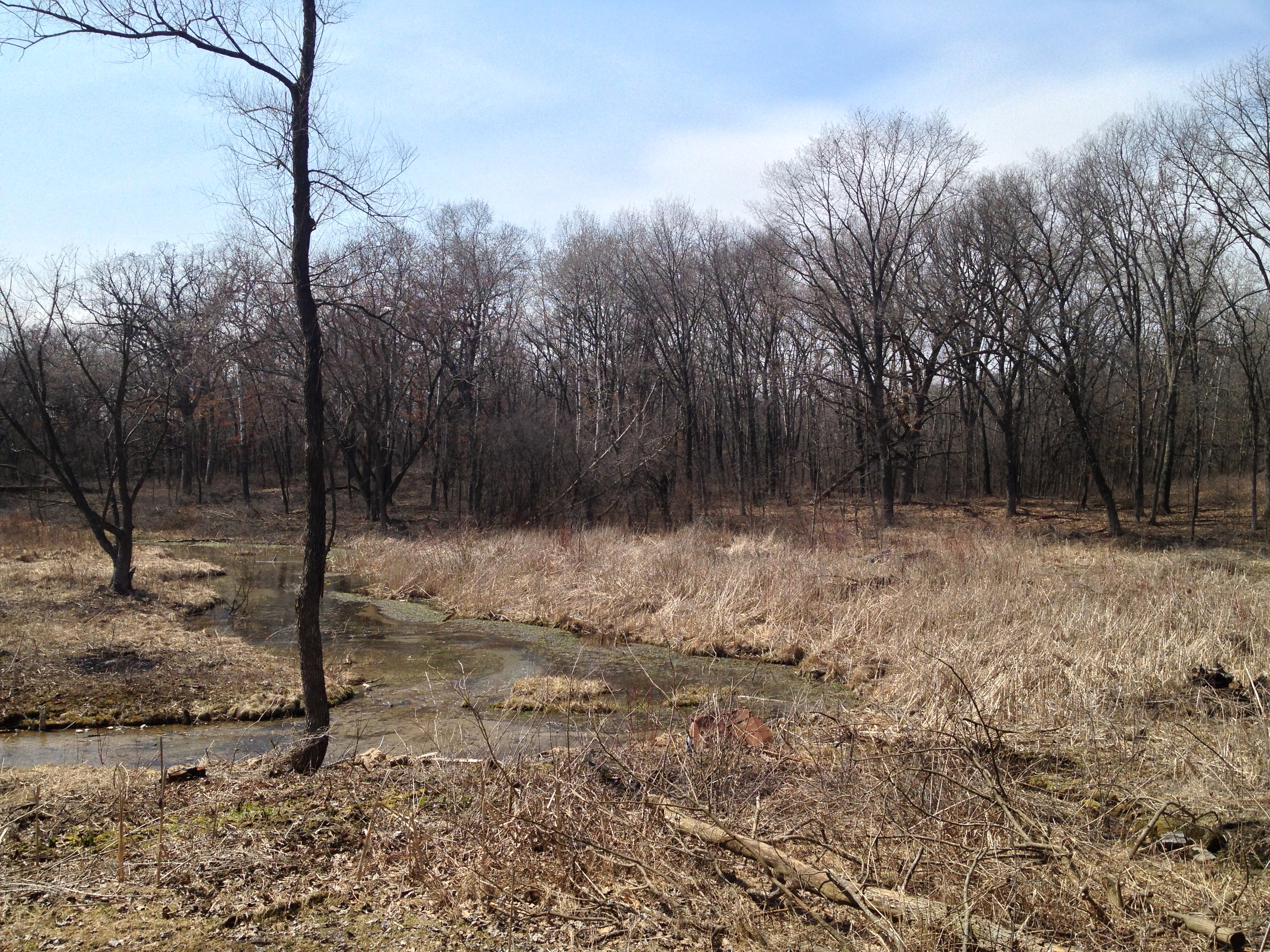
Looking down into the river valley from the Indian Campground.
Next on the agenda was girdling aspen. I intended to continue working at the old hotel site, but I thought better of it as I was walking down the river valley, and I attacked a few isolated clonal colonies that were spreading into the valley.
A quick stop at the Scuppernong Spring.
Finally, I started piling buckthorn just north of the old barn site. I have been a cutting fool for the last couple months thinking that I would get a crew of inmates from the Sturtevant Transitional Facility to help me pile, but I don’t think that is going to work out, so I’ll be piling for the next few weeks to catch up. I made around 10 piles and it was very relaxing work with a great view down the river to the west.
DNR Visitor Services Associate extraordinaire Amanda Prange is leading an effort to install a new set of signposts to match the trail brochure.
The Hatching House Spring is looking great.
I followed the channel of the Indian Spring’s towards it’s junction with the Scuppernong River and caught this panorama video. The marl pit factory ruins are just to the right of the sun.
I like to fancy myself as someone who knows how to think critically, but I suffered a momentary lapse of reason recently acting on belief instead of real knowledge. Fortunately, the consequences in this case were minor and served as a good reminder. To think critically consistently, a tool like the trivium is indispensible; grammar, logic and rhetoric, these are the keys we can use to distinguish truth from fiction and knowledge from mere belief or opinion.
In my last post I reported that we have been spraying spotted knapweed with glyphosate, aka, RoundUp, on the Sand Prairie believing this was the right approach for this invasive plant. The problem is I had not researched this plant i.e. I had not done my grammar and answered the questions of the Who, What, Where, and the When as applied to spotted knapweed. Lindsay sent me the link above via which I learned that the preferred technique is to “Apply selective herbicide clopyralid during bud growth in early June for best results (48 oz per 100 gal water).” I complained in the post that I didn’t have any clopyralid without doing the grammar on this compound. Thankfully, Lindsay did and he informed me that clopyralid is the active ingredient in Transline, which we do have. So this was a good reminder for me to apply critical thinking skills as we continue to try to restore the Scuppernong Springs Nature Preserve.
The scientific method goes hand in hand with the trivium and critical thinking and I’m trying a little experiment in the Scuppernong River just a few yards upstream from the bridge across the former embankment that created the upper pond. When Ben Heussner and his team of DNR Fish Biologists recently inspected the river, he pointed out that the river was not “head cutting” at this point and that is why it is still filled with silt and marl upstream. I’m trying a little low tech experiment to encourage the river start head cutting here.
Saturday, April 27, was a very pleasant day at The Springs and I started out spraying garlic mustard along Hwy 67 north of the old barn site. The understory here is severely degraded and consists mostly of garlic mustard.
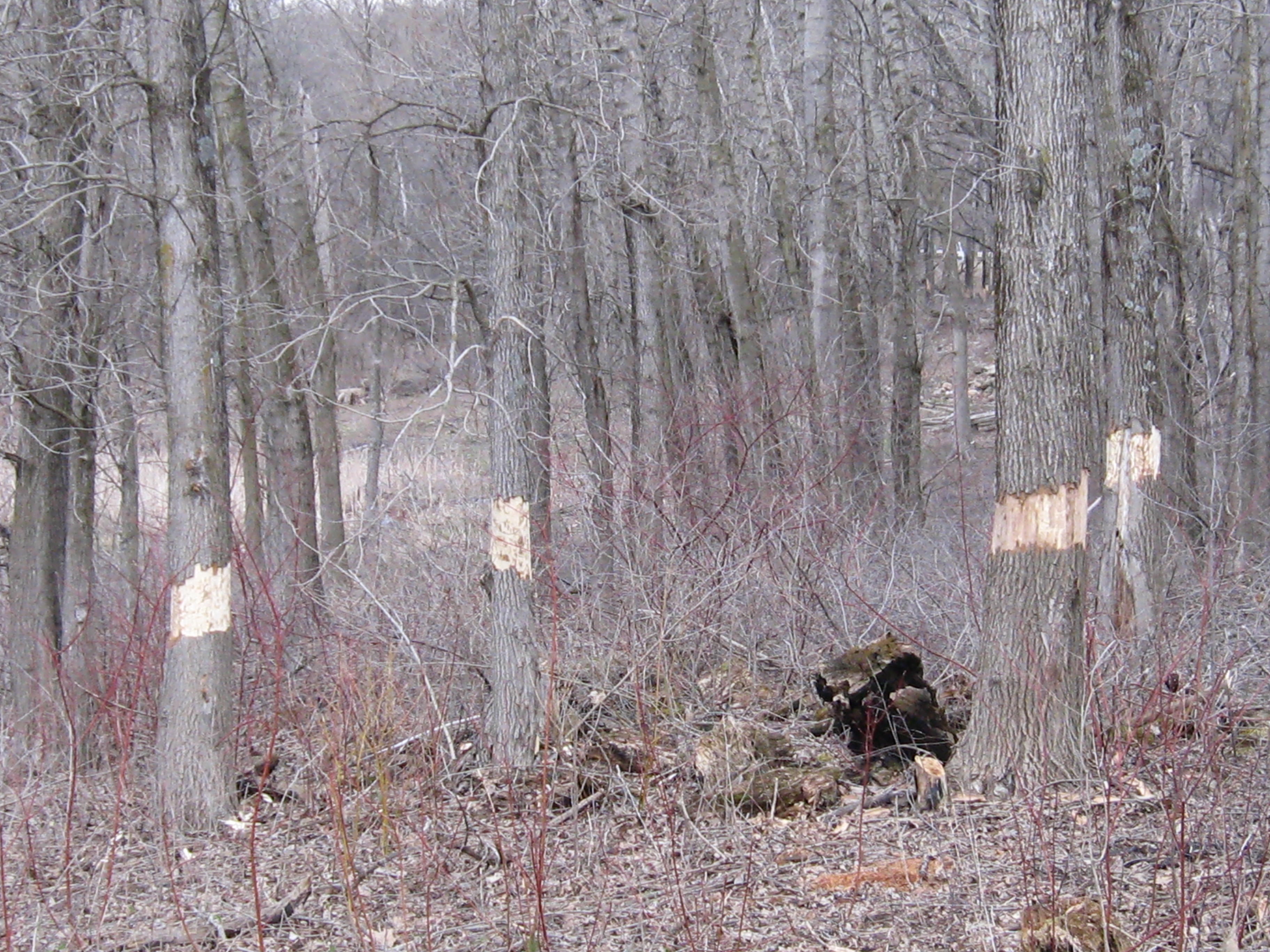
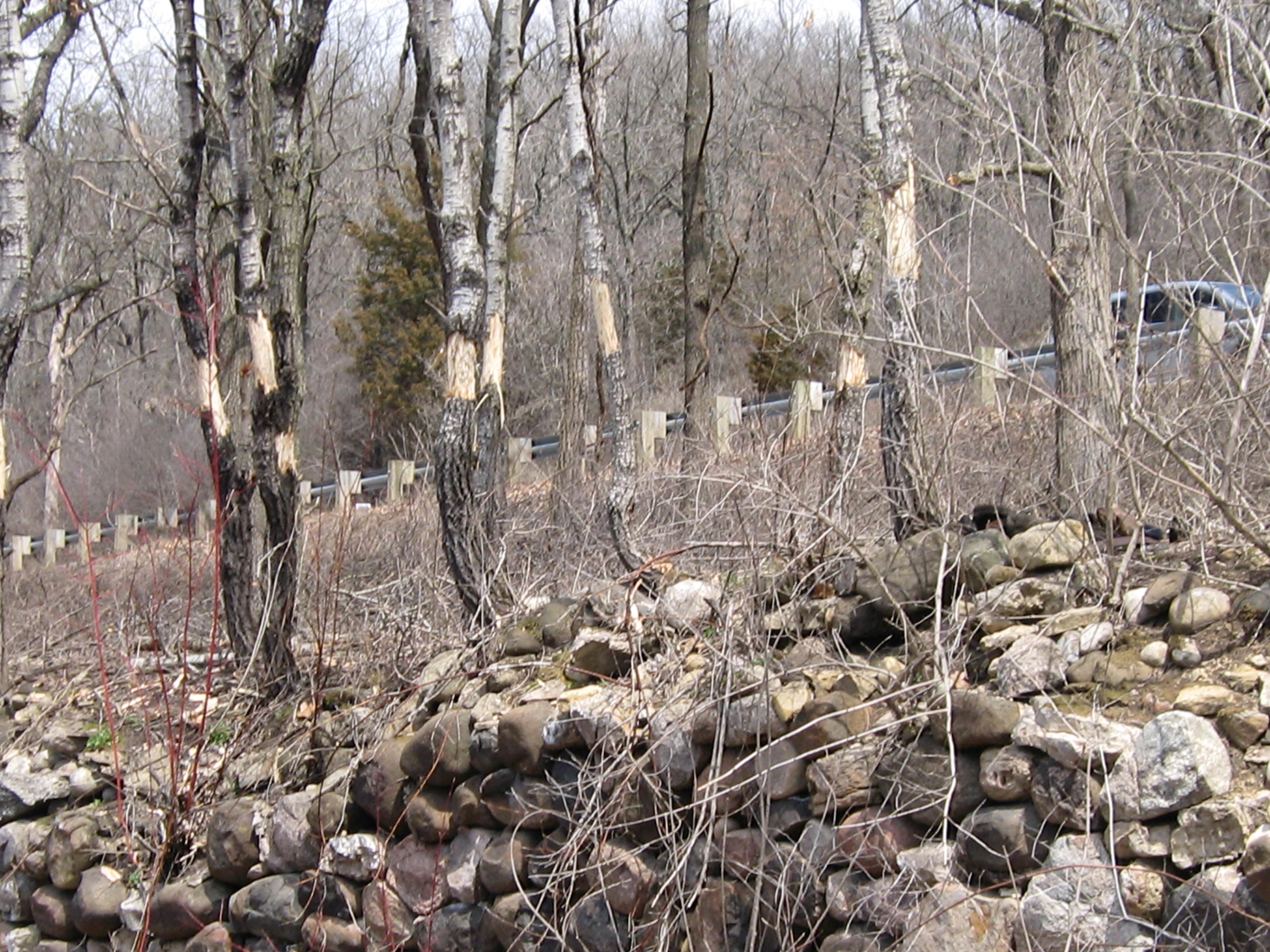
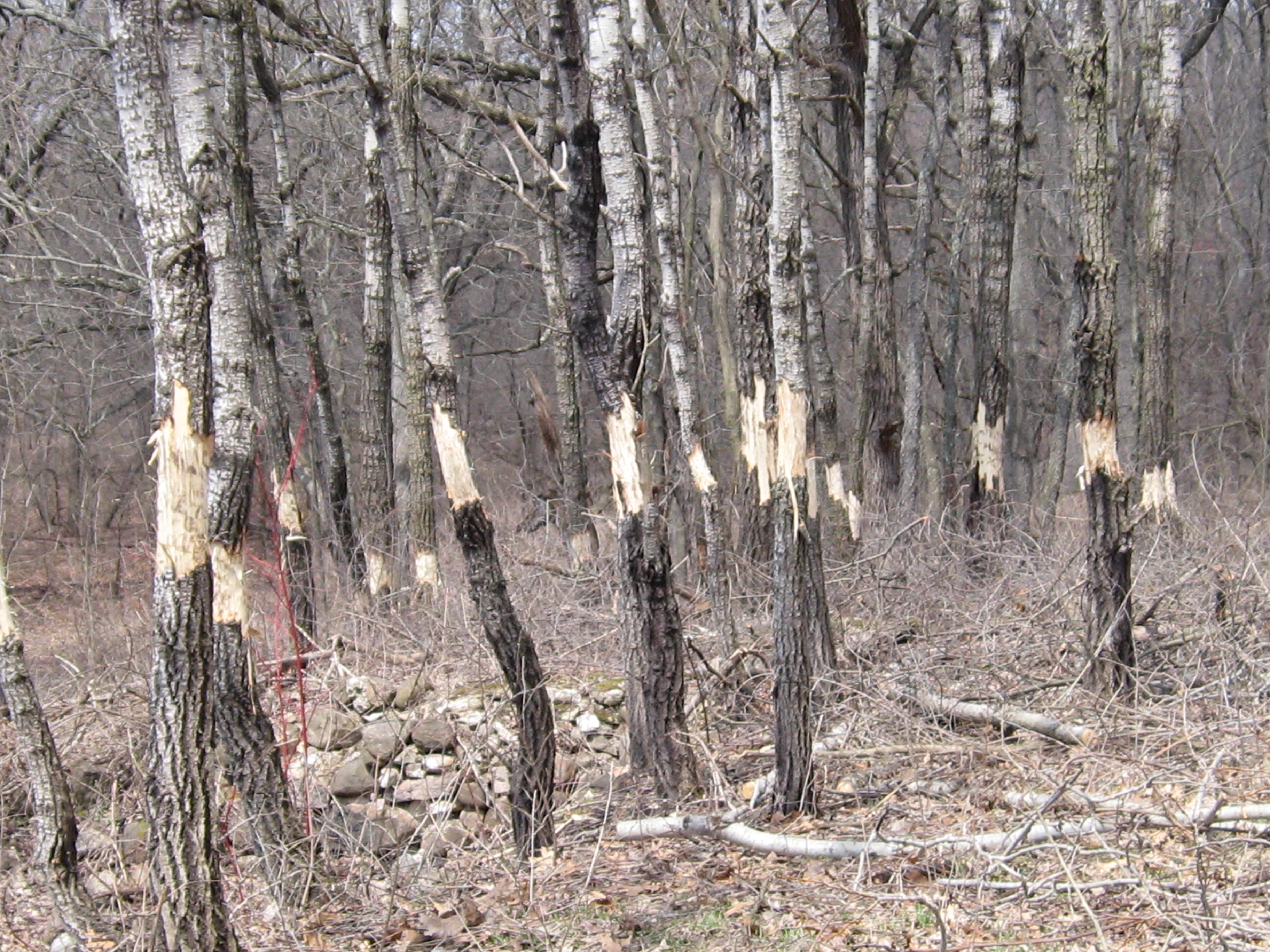
Then I spent a couple hours girdling aspen at the old hotel site. There are some huge trees here and I was skeptical about attacking them with hand tools, but the bark is separating very easily from the trunks now and I made good progress.
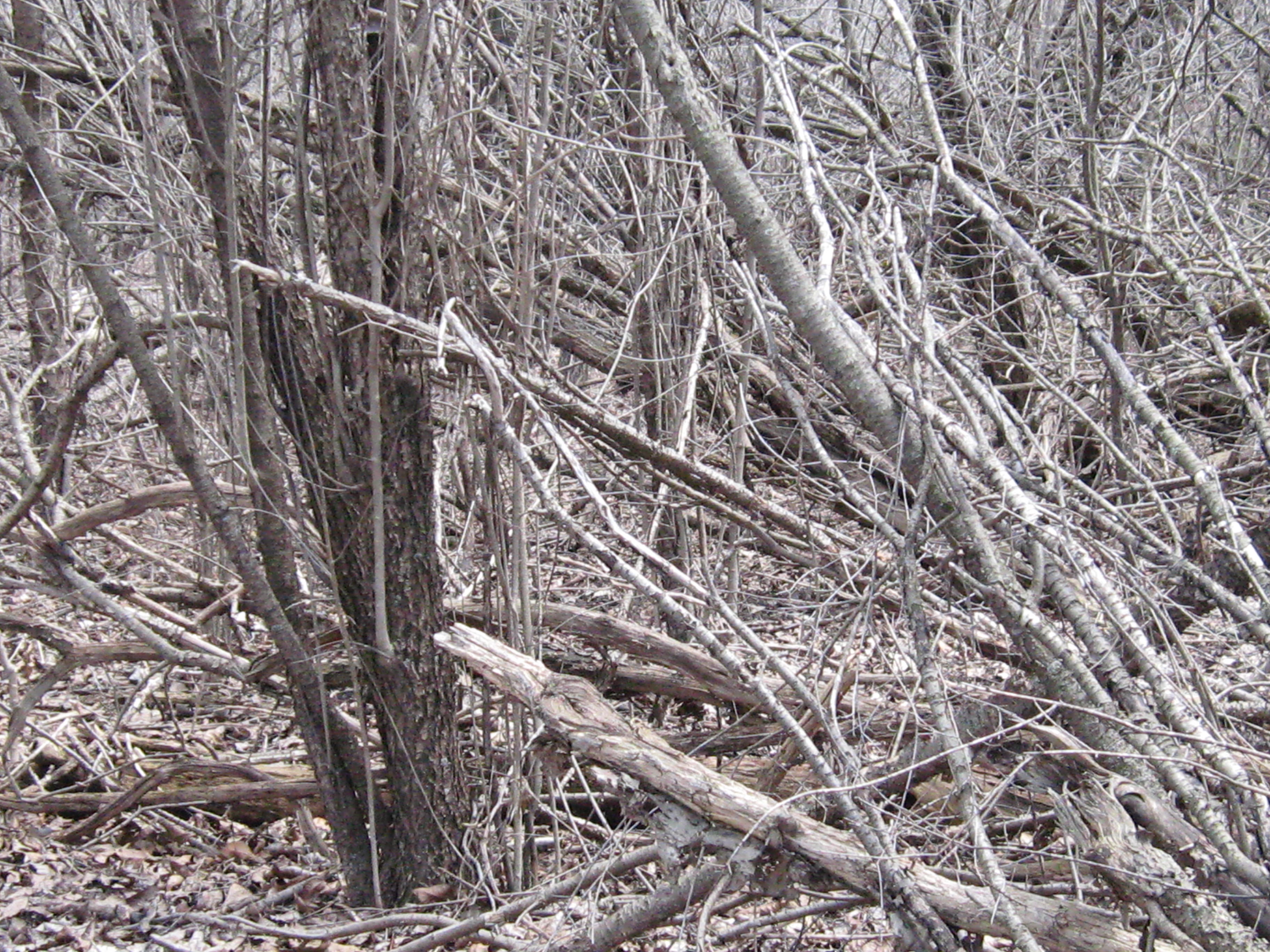
Around mid-day, I headed over to the Buckthorn Alley, or, perhaps tunnel is more descriptive, and got started on one of the nastiest buckthorn thickets I have ever seen.
I made a small dent and already you can start to see things, like the sky, that will make this section of the trail much more enjoyable and interesting.
The day flew by and I had a date with Pati at home, so I had to depart before the sun set. Here is a parting panorama taken from the Indian Campground.
Welcome back to The Springs! I was lucky and fortunate to spend both this past Saturday and Sunday at the Scuppernong Springs Nature Trail. I don’t know if the health benefits derived from the fresh air, sunshine and cold spring water can be objectively measured, but by the end of the day yesterday, I was in a blissful state.
Rich Csavoy joined me bright and early yesterday morning and we loaded up our backpack sprayers and got after the garlic mustard in the area around the old barn site. Rich showed me what the seeds look like when they first emerge and we tried to hit some of these, which literally formed a carpet in some areas. The DNR intends to burn here if conditions permit, but “the best laid plans of mice and men often go astray”, and we are not assuming this will happen. We also sprayed some spotted knapweed on the Sand Prairie that covers the Indian Campground.
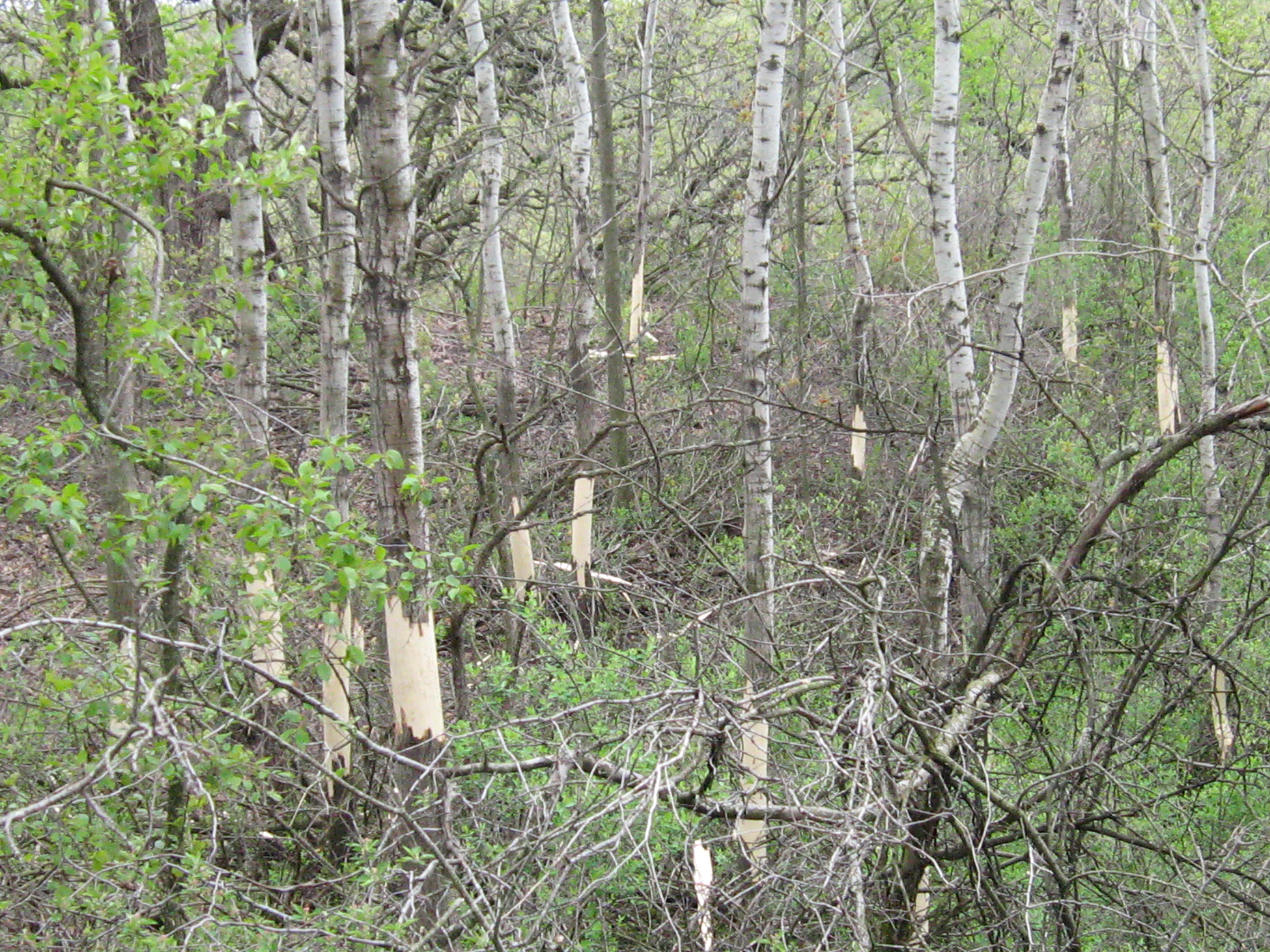
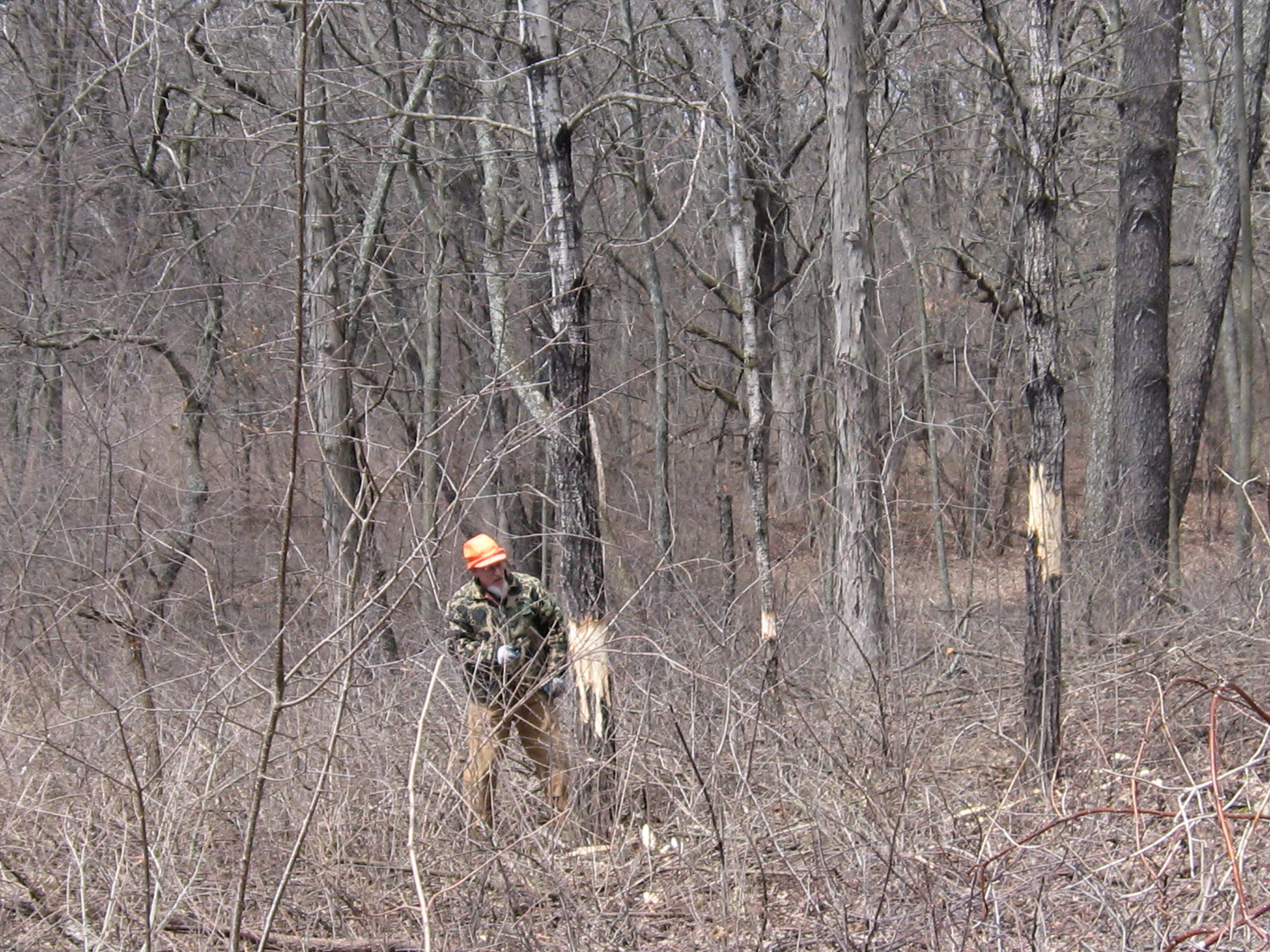
After spraying we commenced girdling aspen trees at the old barn site. I refer to them as “clones” in the video below, but the correct term is clonal colony.
We are refining our techniques but this type of hand work is laborious. This is my first attempt at girdling aspen in this way, without using poison, and I want to give it a fair shot. I must confess though that the prospect of girdling the clonal colony of huge aspen at the old hotel site by hand is a little daunting. When I was working at the Hartland Marsh, I used my chainsaw to girdle a clonal colony of 40-50 huge aspen and I sprayed some glyphosate into the cuts. This worked perfectly and to this day there is nary an aspen in sight. I’m inclined to use the same approach at the Scuppernong Springs Nature Trail except for switching from Glyphosate to Transline, which the DNR uses for black locust, which spreads by putting out suckers from it’s roots . We’ll see how it goes.
After dispatching that clonal colony of aspen, we grabbed some heavy duty garbage bags and picked up litter on both sides of Hwy 67 south of where east-bound Hwy ZZ leaves Hwy 67. I had noticed a lot of trash when I was spraying garlic mustard along the highway on Saturday. This was a good opportunity to get some nice views of the springs and river.
Finally, Rich loaded his van with cherry, oak and buckthorn firewood and I headed over to the cut-off trail with my chainsaw. Here is a view of the area from across the river at the old hotel site. You can see a swath of buckthorn amongst a large sugar maple tree.
I was chomp’in at the bit to finish this last stretch of buckthorn between the cut-off trail and the river and slashed and flailed with impassioned vigor. Three tankfuls later…
The view across the freshly cut area from the cut-off trail.
And the view from the old hotel site.
By the time I loaded my gear back in the truck and began my ritual walking tour, I was very relaxed. The Marl Pit bridge is one of my favorite places to hang out. In the summer, I always take a bath here in the river and do a little yoga to relieve any muscle stress. Here is panorama video from that location.
The highlight of the day however was the sound of the frogs; a veritable din! Listen to the Spring Peepers and Western Chorus frogs in this video.
The frogs are very active in the wetlands and old cranberry bogs along the cut-off trail. Last spring it was so dry, there was barely a peep from the frogs. Check them out if you get a chance.
I was starting to feel the signs of Vitamin D deficiency. Thankfully, the Creator blessed us with a gorgeous sunny day and I was happy to spend it at The Springs. The agenda for the day included spraying garlic mustard, girdling aspen and cutting some buckthorn,
I interrupted a pair of geese in a pool just below the Scuppernong Spring as I was fetching some drinking water for the day.
With the light snow and chilly temps, I decided to try girdling some aspen down by the Indian Springs until the sun could do its work. Here is a view of the two groups of aspen clones I wanted to get.
It’s getting easier and I was able to girdle around 15-20 trees in a couple hours.
The garlic mustard, spotted knapweed and other weeds are just emerging and it’s a perfect time to spray them with glyphosate. The plants are small, so they require less spray, and the weeds are the only things that have leafed out so there is very little collateral damage. I finally got a couple of decent backpack sprayers and that made it a lot easier. I ended up spraying the rest of the day using 12 gallons of mix and covering the south end of the trail including the Indian Campground, Indian Springs and Marl Pits. No doubt there will be additional weeds emerging from these areas, but our efforts over the last two years are paying off and the weeds are on the run.
This is a great time to visit The Springs if you are a birder. Ruby crowned and gold crowned kinglets are migrating through and they are fun to watch. Sand hill cranes, great blue herons, ducks, hawks, vultures and pileated woodpeckers, amongst many others, are active as well.
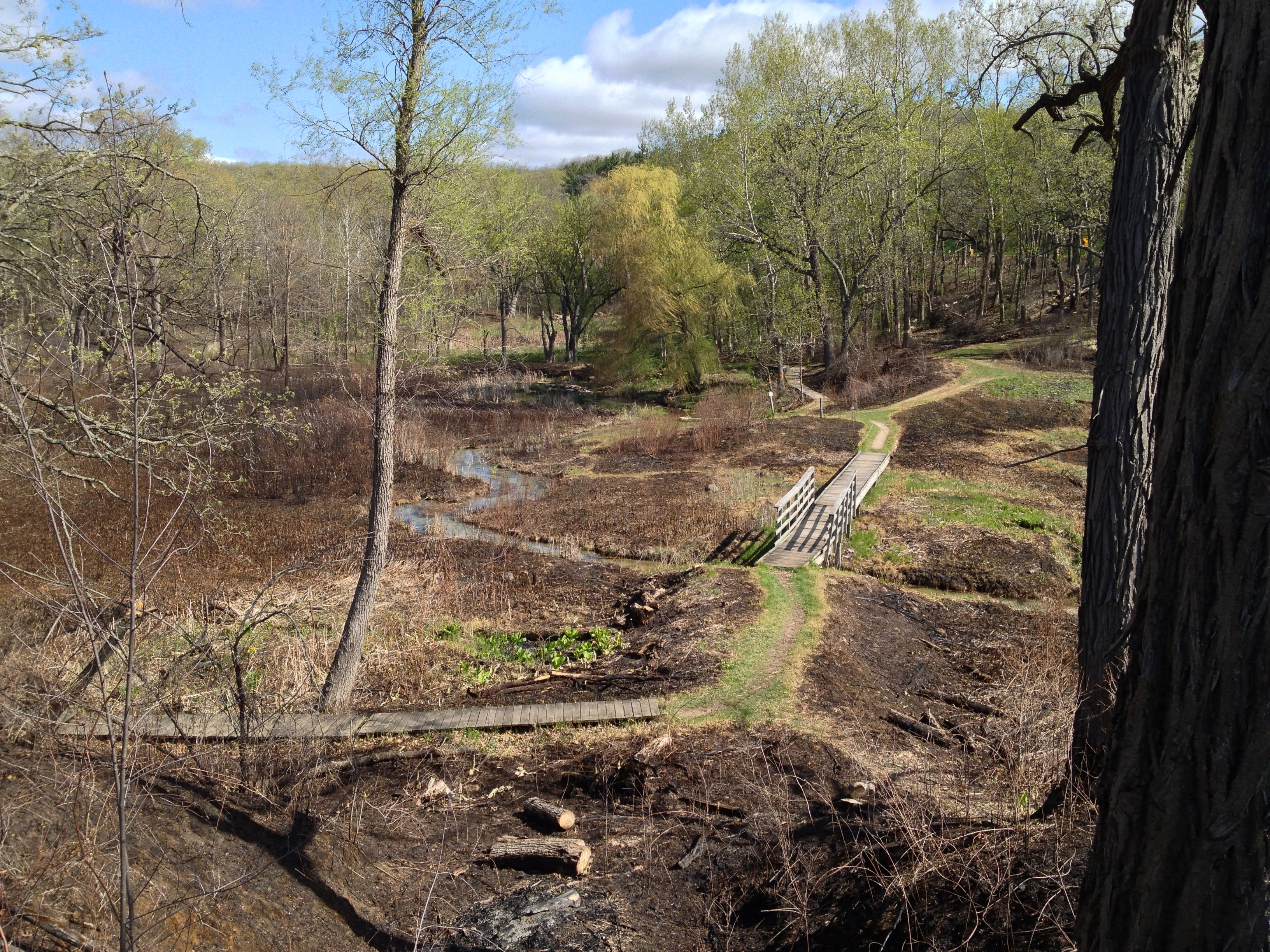
Here is a view of the Hillside Springs. Last June, these springs were completely covered with water cress and the surrounding hill was a thicket of buckthorn and honeysuckle; you couldn’t even see the boardwalks.
John and Sue Hrobar hike at The Springs frequently and they are keen observers of flora, fauna and fallenover. They reported that the pole holding the antenna at the stream gaging station had broken free and was leaning against the bridge. Anne Korman, Assistant Superintendent Kettle Moraine State Forest – Southern Unit, came out to investigate and within a day or two, Mike Parsen, Hydrogeologist with the Wisconsin Geological and Natural History Survey and Rob Waschbusch, from the US Geological Survey got it repaired.
There were a lot of people at the springs today and I had a great time meeting and talking with them as I was taking a leisurely walk.
Buckthorn is a nasty invasive tree that can completely dominate an area slowly eliminating all competitors. It seems like the only thing that likes buckthorn is garlic mustard!
Here are a couple videos of our current efforts in the area of the Indian Springs. I’m planning to update this site with a work schedule, or simply a task list, so that those who would like to help will know when we are working or what they can do on their own schedule. We can definitely use some help piling brush and Phragmites.












































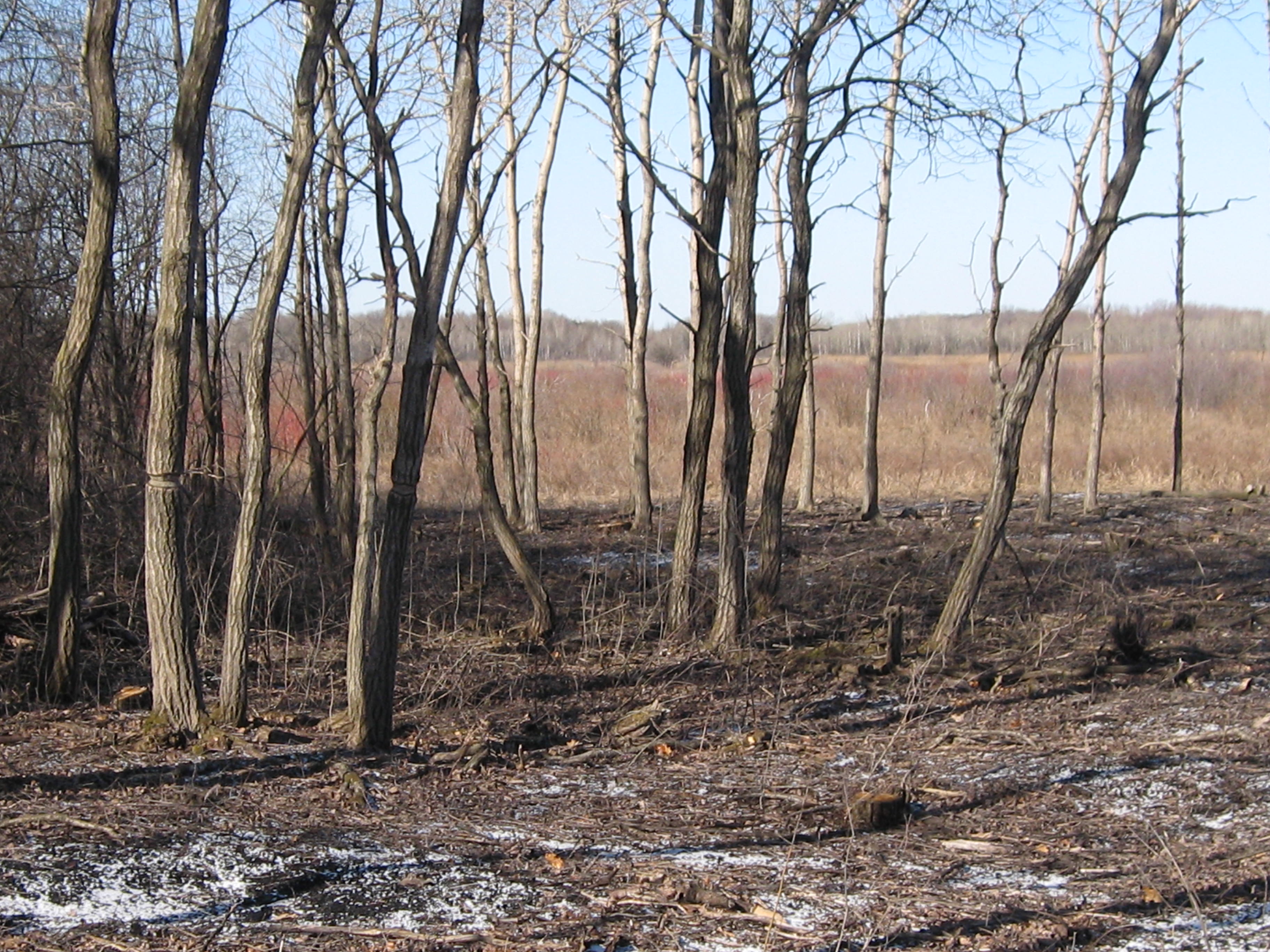


 Scuppernong Springs Nature Trail
